




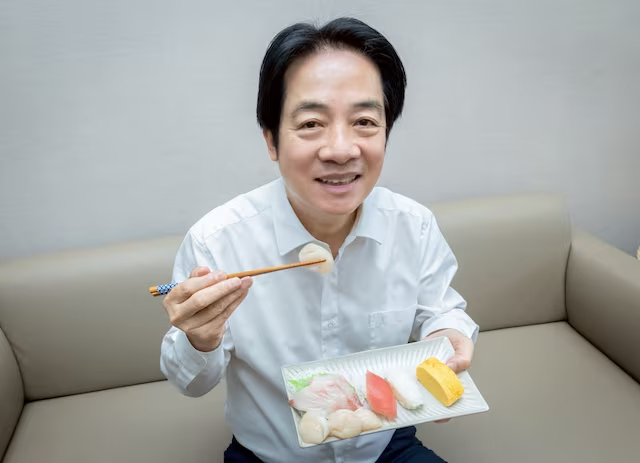
After China banned Japanese seafood, Taiwanese president Lai Ching-te posted an image of his lunch on Instagram. Credit: Presidental Handout / Instagram





In recent days, the lights of soft power diplomacy have been going out over China. Quite literally, in the case of Japanese singer Maki Otsuki, who was performing on-stage in Shanghai last Friday when the stage lights were abruptly turned off. Otsuki — who sang the iconic theme tune to One Piece, an anime series hugely popular among young Chinese — was escorted off stage and her gig scheduled for the following night was canceled. Another Japanese pop legend, Ayumi Hamasaki, also had a Shanghai concert axed. A similar fate has befallen Crayon Shin-chan — the latest animated film starring Japan’s favorite five-year old, mischievous and flatulent, has had its Chinese release delayed indefinitely.
The reason for this string of punishments lies in a comment made in early November by Japan’s new prime minister, Sanae Takaichi. Asked what might constitute a “survival-threatening situation” for Japan when it came to the tensions swirling around Taiwan, she offered what many Japanese would regard as a reasonable and realistic answer: “If there are battleships and the use of force, no matter how you think about it, it could constitute a survival-threatening situation.” Under a law passed in Japan 10 years ago, expanding the traditional interpretation of Japan’s pacifist constitution, this would mean that Japan’s Self-Defense Forces (SDF) could be activated.
Taiwan lies 110 kilometers away from Japan’s south-westernmost island of Yonaguni. You can see it from the beach on a clear day. Over the past decade, scuba-divers have jostled for space on Yonaguni with members of the SDF, there to set up bases and radar stations and more recently to prepare for the deployment of medium-range surface-to-air missiles. The fear in Japan is that any Chinese attempt on Taiwan would pose a threat to islands like Yonaguni. They might be attacked or even occupied, for use as forward operating bases.
China’s reaction to Takaichi’s comments was swift and forceful. In addition to shutting down Japanese films and concerts, the government placed a devastating import ban on Japanese seafood and asked Chinese tourists planning to visit the country — as millions do every year — to think again. China regards Taiwan as its business, and no-one else’s: a renegade province that will be dealt with as and when it sees fit. For Takaichi to hint at military intervention was deemed unacceptable.
In fact, Takaichi wouldn’t have much room for maneuver in the event of a Taiwan emergency. A decade-old law allows for the SDF to be deployed if a country with which Japan has close relations is attacked — but only if Japan’s own survival is also at stake. Even then, the SDF is only permitted to do the minimum necessary to protect Japan and its people. Those surface-to-air missiles headed for Yonaguni don’t have the range to make it even halfway to Taiwan.
Still, Japan tends to follow America’s lead when it comes to Taiwan: recognizing China’s claim to the island without endorsing it, and maintaining a policy of strategic ambiguity when it comes to potential actions in the event of a Taiwan emergency. Takaichi briefly crossed a line here, damaging Chinese attempts to manage the public conversation about Taiwan across East Asia and beyond. China is reportedly involved in buying media influence in Taiwan, wooing low-level officials with subsidized visits to China and undermining faith in democracy. Hints of solidarity with Taiwan, which might boost pro-independence sentiment and morale, go down very badly in Beijing.
Chinese officials have no doubt watched with growing alarm as Japan and Taiwan have grown close across recent decades. The two are not formal allies — Japan doesn’t officially recognize Taiwan — but they have a strong trading relationship. Taiwan’s semiconductor-maker TSMC has a factory in Japan and a second is in the works. Taiwanese people also adore Japanese culture: Japan is a major tourist destination for Taiwanese, and everywhere you go in Taipei, you’ll see Japanese food, fashion, anime, music and convenience stores.
Taiwanese president Lai Ching-te was thus pushing at an open door when, in the wake of China’s ban on Japanese seafood, he posted an image of his lunch to social media — yellowtail sushi and scallops — and suggested that now might be a good time for Taiwanese to eat Japanese seafood. The idea went viral on social media and people have been buying up Japanese seafood and booking holidays to Japan.
What’s remarkable about this is that Taiwan was part of the Japanese empire for 50 years, from 1895 to 1945. Korea and parts of China were under Japan’s control for less time and yet bitterness there remains acute and politically potent to this day. Why, then, such warmth for Japan in Taiwan?
Part of the answer is that when Taiwan transitioned from martial law to democracy in the late Eighties and early Nineties, Japan served as an inspirational model: rich, open, peaceful and technologically advanced. Affection grew over the years that followed. When Japan suffered its “triple disasters” of earthquake, tsunami and nuclear meltdown in 2011, the generosity of Taiwanese donations was equaled only by those from the US. A decade later, when China placed a highly-damaging ban on imports of Taiwanese pineapples — ostensibly for health and safety reasons, but widely regarded as political — Japanese consumers participated in a “Freedom Pineapples” campaign, buying up Taiwanese produce in a show of solidarity.
But colonialism is part of this picture, too. Far from being swept under the carpet for the sake of better relations, Taiwan’s half-century under Japanese rule is remembered by many on the island as a formative phase in its history.
In 1895, Japan was an emerging Asian power, keen to show the likes of Britain and France that it was capable of becoming their equal. One of the ways to do that, during the high noon of empire, was to demonstrate the civilizing influence that you could have on other countries, near or far.
Taiwan was the ideal candidate, after it was ceded to Japan by Qing China following the Sino-Japanese War (1894-5). The island’s Japanese administrators treated it, in the words of one official, like a “laboratory” for testing out modern ideas of all kinds. Wide streets were created featuring impressive buildings including what is now the presidential office — which faces east, towards Japan and the rising sun. Schools and hospitals were built, rabies and various tropical diseases were eliminated, and opium addiction was tackled; 10,000 kilometers of roads and railway lines were laid down and a public sanitation system was established. Japanese rice, miso soup and raw fish all became major elements in the Taiwanese diet.
Democratic politics was not on the list of Japan’s modernizing reforms. In common with their British and French imperial mentors, the Japanese did not believe colonized peoples to be ready for self-determination. Anti-Japanese resistance in Taiwan’s mountains was severely punished — on at least one occasion, it is thought, with the use of chemical weapons. An educated urban middle class discovered that asking nicely for rights didn’t work either.
But for the Japanese and many Taiwanese, the results of the “model colony” approach were deeply satisfying. European visitors to Taiwan professed to love what the Japanese had done with the place, lavishing praise on colonial administrators for the manifest good they were doing.
Taiwanese nostalgia for the era of Japanese colonial rule owes a great deal, too, to what happened in the years after Japan’s defeat in 1945. The island came under the control of the mainland Chinese government led by Chiang Kai-shek. When he finally lost his war against Communist insurgents in 1949 and a People’s Republic was declared, he and what remained of his allies and army — some 1.5 million people — fled to Taiwan. They ruled the island under martial law for the best part of 40 years, fostering economic growth but dealing with democratic aspirations so harshly that both the old Japanese empire and the new postwar Japan appeared benevolent by comparison.
China and Japan may still find a way out of the current impasse. Perhaps economic self-interest will ride to the rescue, restoring relations between two countries that did nearly $300 billion worth of trade with one another in 2024. But with both Taiwan and Japan beefing up defense spending under pressure from Washington, and Xi Jinping showing few signs of changing his mind about the urgency of the Taiwan question, some kind of escalation around the island appears grimly inevitable.
Russia’s failed full-scale invasion of Ukraine in early 2022 has no doubt been watched with much concern in China. China’s leadership risks serious reputational damage, both at home and abroad, if an attempt on Taiwan by its relatively inexperienced armed forces goes wrong. And yet the more that China’s ability to manage international public opinion appears thwarted by warm feelings and symbolic seafood moments, the likelier its leaders are to conclude that a much talked-about naval blockade and even a full-scale invasion is unavoidable.
 drchrisharding