




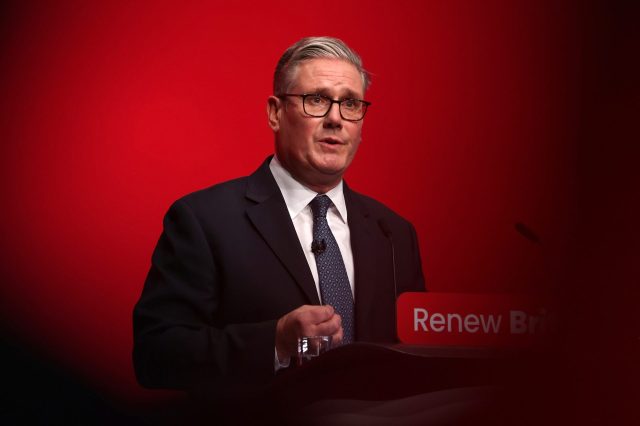
KeithGPT. Dan Kitwood/ Getty Images.




Keir Starmer seems to have tasked ChatGPT to post on Substack for him. Or perhaps it was a wonk, or even Starmer himself; from the language it’s hard to tell. “Communication is changing,” his account announced, “and I want to be a part of that.” So far “being a part of that” comprises one post justifying scrapping the two-child benefit cap in prose as bland as the Budget itself was chaotic. Starmerstack is, in fact, so bland it’s difficult to read, and the fact that he’s embraced an American-based blogging platform as a meaningful vector for prime ministerial messaging is more newsworthy than any of the words posted there so far.
The only memorable line is a catchphrase: “a Britain truly built for all.” It stands out not just for being repeated, but also for begging two crucial questions. Obviously, it seems to say, we all agree on the answer to the question: what is “Britain”? And clearly we all agree who’s included in “all”, as in “a Britain truly built for all”? Except we don’t. Especially since Brexit, how we define Britain, and who should be included in it, is so intractable a dispute that it appears to have swallowed our entire ability to do politics. Nothing could be less settled than what Britain is, or who is included in “all”.
And the irony is that the digital platforms Starmer (or KeithGPT, or whatever) is embracing (he’s also recently joined TikTok) are a key reason we’re having these arguments. TikTok is Chinese; Substack is based in San Francisco; both are used all over the globe. And this de-materialized, post-geographic quality maps strangely onto our struggles over what a nation is, and who’s included.
The explanation Starmer gives for embracing Substack is as bland as the rest of his writing: “People have a right to know how decisions that affect them are taken and why. And I believe all politicians should explore innovative new ways to do that.” But at least in relatively recent history, a “nation” has implied both a defined geography and its occupation by a defined group. And the paradox of a national leader leaning so heavily into the internet is that this medium is so post-geographic in its effect as to make nation-states as such appear increasingly quaint: an impression the most radical tech elites are now embracing as the future of politics.
In the interminable online culture wars over how we define nations, what often gets overlooked is their historical, technological catalyst: the invention and spread of printing. European nation-states, as the historian Carlton Hayes showed, were never tight-knit tribes but instead “agglomerations of peoples with diverse languages and dialects”. These emerged out of a medieval plurality of sometimes tiny polities, across which an elite of scholars, merchants, and politicians communicated using the lingua franca inherited from ancient Rome: Latin.
Wherever printing centers took root, from 1450 onward, the dialect in that particular area would become gradually more widespread, fixed and culturally dominant. These print-powered dialects morphed over time into the “official” languages of much larger polities, while other dialects lost status or disappeared. The circulation of printed books and newspapers in these newly standardized vernacular languages in turn forged “nations” into self-conscious political units: the print historian Elizabeth Eisenstein shows how the idea of a “public” as such derives from “publishing”, offering a new, printed mirror within which these publics saw themselves reflected, for the first time, as “imagined communities”.
It wasn’t just print, of course. But print helped to fuse geography, language and power into modern nation-states, in which, as Hayes puts it, “a particular nationality […] constituted the core and furnished the governing class and the official language” along with other minority peoples, in a form “more akin to small empires than large tribes”. In time, many of these “small empires” became large ones — such as, perhaps most notably of all, Britain. Over the same period, too, Latin began to wither as a living lingua franca, replaced by now-competing “national” vernaculars.
What does any of this have to do with Britain now? And what does it have to do with Substack? Well, it’s not a coincidence that elites around the world began dreaming bigger than nations or even empires, just as new broadcast media emerged to challenge print for the public’s attention. You don’t have to be Marshall McLuhan to wonder whether being able to beam TV images around the world might, in time, affect who we imagine our “communities” to be, and how widely we cast that net. Nor is it a coincidence that the TV era also saw Britain dislodged as “Top Nation” by our own imperial progeny, the USA.
Of course, as critics have noted, American hegemony came cloaked in the neutral utopianism of “rules-based international order”. This bait-and-switch was perhaps less obvious to the English than some other cultures, because the “official” language of this order was a variant of our own: the modern-day equivalent of medieval Latin, American English, or latterly “International Business English”.
This is the flat register in which the Starmerstack is written: “But, as I argued above, it’s also impossible to look at poverty and not see the visible impact of the cost-of-living crisis.” It’s hard even to choose an illustrative quote: it all feels equally lump-free, like the verbal equivalent of mechanically recovered meat. But the fact that he’s felt obliged to start a Starmerstack, instead of just going on TV, points to the still more disruptive recent triumph of the internet over broadcast: a shift that’s now shoving even Starmer out of the internationalist 20th-century dream, into a far more fractious and fragmented world.
Why? Well, print created the idea of a “public”, and forged language-communities into geographic and political ones. In other words: it massively affected political form. Broadcast allowed us to dream of uniting the world as one giant community. Another massive effect. It stands to reason the internet might change things again; but how? Perhaps the most optimistic exposition to date of how this might look comes from US tech investor Balaji Srinivasan, in his 2022 ebook The Network State. Here, Srinivasan set out a vision for a new kind of digital-age political entity, not defined by geography but shared vision and values, and beginning as internet-only entities. Once cohesive and well-established, he suggests, such entities could then realize themselves in the material world by crowdfunding real-world holdings, gaining political clout, and ultimately pursuing diplomatic recognition as a “network state”.
Examples of real-world projects with a “network state” flavor include Peter Thiel’s (as yet fruitless) “seasteading” vision, and also the Praxis group, which occasionally makes headlines by attempting to buy Greenland and such audacious stunts. Other proposals to create assorted forms of either pop-up or permanent startup city-state exist, in various states, such as the Próspera “startup zone” in Honduras.
What these have in common is that they recognize the radical new potential afforded by digital for transforming politics, and want to experiment — for example by forming polities that dispense with geography, or central banking, or (often) democracy. They share public ideas on platforms such as Substack, and hatch private plans in closed spaces such as Urbit. They tend to be, like the tech scene itself, both Anglophone and international (Substack’s founders are an American, an Indian-American, and a New Zealander) but, unlike the 20th-century globalist dream, highly exclusive. Like the 20th-century globalists, Srinivasan envisions opt-in, ethnically pluralist, secular polities. But while pluralist and secular, there’s nothing inclusive about “network states”. If you don’t like it, you can leave; by extension if the founders don’t like you, you can be expelled.
Srinivasan’s vision was first ignored by the mainstream. But more recently, especially since the Trump victory brought wealthy figures such as Srinivasan and Thiel closer to the White House, network states have inspired a slew of increasingly unnerved mainstream coverage. Such articles tend to fret about the openly anti-democratic worldview expressed by advocates such as Patri Friedman, who invests in “startup cities” and is frank about his firm funding companies “starting non-democratic cities”.
What if these post-democratic elite innovators really do end up setting the tone for the polities of the future? It doesn’t bode well for the little guy. To this we might reply that the dubiously democratic nature of even self-identified democracies, especially since Covid, somewhat blunts the moral force of this critique. A more substantive challenge is perhaps that in being digital-first, such polities are parasitic on goods provided by traditional nation-states. It’s all very well having Bitcoin, but as long as you’re dependent on an old-world nation-state for reliable roads, telecoms, waste management, power, sewerage, public order, and enforceable property laws backed by a (nation) state monopoly on violence, your claims to statehood are still acutely vulnerable. You’re also radically dependent on the viability of the system you claim to be trying to replace.
Against this, we might argue that these are transitional issues that can be resolved either (for tech-optimists) by more automation, or through gaining physical capabilities as network-states become more established. But to my eye, the hardest challenge to the tech-bro model for new countries is the oldest: where does your cohesion come from? Srinivasan grasps this in theory, emphasizing the need for unity in cultural, moral, and identity issues. But as expected from a tech-libertarian, The Network State stops short of advocating religious or ethnic homogeneity as a basis for such states.
This does not bode well. Anyone who has spent time in online communities knows how fissiparous they are. Meanwhile the 20th century is littered with attempts at secular utopias that turned into sex cults, or suicide cults, or just had huge rows and fell apart. But what if Srinivasan is just not seeing the wood for the trees? If we borrow the broad “network state” formula, but discard the “grey tribe” distaste for racial and religious identitarianism, we only need to glance about to see that germinal “network states” already exist — it’s just that the groups driving them aren’t Silicon Valley elites.
Americans, for example, were recently shocked by the revelation that organized Somali-heritage communities in Minnesota have been methodically defrauding the state government, funneling vast sums of money out of America toward co-ethnic communities overseas. And though their relation to state funding doubtless varies a great deal, I suspect comparable low-tech networked “nations” are now increasingly common across the West, as a byproduct of 20th-century utopianism.
Could this represent at least one possible future template for post-national political solidarity? Seen dispassionately, a resource-extraction network of the kind documented in Minnesota appears highly cohesive and internally solidaristic. It leverages existing infrastructure. It’s spread over a distributed geographic area, and using digital tools to network. It’s focused on increasing real-world holdings. What actually distinguishes this from a “network state”, apart from the lack of interest in blockchain?
Those still attached to nation-states may well harrumph about deportations, or even (like Trump) actually do some. But none of that changes the internet’s power to convene post-geographic networked polities. Like other digital platforms, Substack’s popular readership communities are post-national; as long as such digital platforms exist, whether on Substack or elsewhere people will go on forging post-national, geographically distributed communities. In light of this, nation-state nostalgists may need to accept that the globalists are right to view such entities as obsolete.
But the internationalists may also need to accept that their “one world” model is obsolete as well. The decentralized, de-materialized, many-to-many environment enabled by the internet doesn’t deliver a united planet of peace and harmony. Rather, it delivers McLuhan’s real “global village”: a chaotic place of competing digital tribes, each hoarding their store of resources and competing to extract whatever they can for their own, from what’s left of the commons.
Whether wealthy, secular and high-tech, or tribal, religious and low-tech, these are the real “post-liberal” successor entities to nation-states. In their world Starmer’s “all” doesn’t exist; there is only the in-group. And whatever (or even whether) KeithGPT himself thinks, to the extent that network nations on this model become a template here, the nation-state “Britain” of his catchphrase will be nothing more than a carcass for them to loot.

Join the discussion
Join like minded readers that support our journalism by becoming a paid subscriber
To join the discussion in the comments, become a paid subscriber.
Join like minded readers that support our journalism, read unlimited articles and enjoy other subscriber-only benefits.
Subscribe