




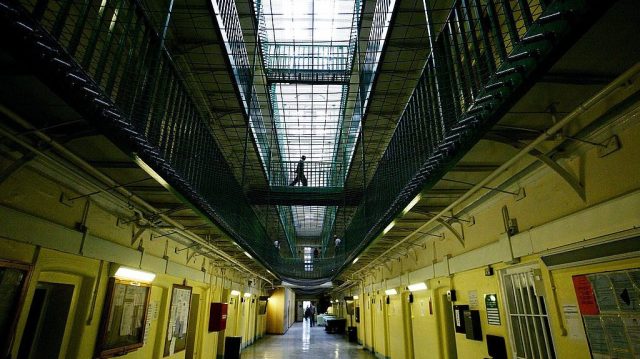
'Until we confront that internal culture, we will keep returning to cases like Bourgass.' Waldie/Getty Images.





HMP Frankland, 2008. I was standing in the dinner line near Kamel Bourgass when a single punch brought him crashing to the ground, his tray skidding across the tiled floor. The wing fell silent. Seconds earlier, Bourgass, a convicted Algerian terrorist, had wrongly accused his attacker in broken English of trying to pinch something from his cell. The fist-shaped reply was swift and final. Officers surged in and marched the puncher to segregation. The line shuffled on. The whole thing lasted seconds, but it captured something essential about the era: men convicted of terrorism were being dropped onto mainstream wings in some of Britain’s hardest prisons, one of the most self-defeating policy decisions of the last two decades.
The prisoner sprawled on the floor was no ordinary inmate. In 2003, during a counter-terrorism raid in Manchester, Bourgass stabbed four police officers; Detective Constable Stephen Oake later died of his wounds. Convicted of murder and given a life sentence with a minimum term of 22 years, he was later handed another 17-year sentence for his part in the so-called “ricin plot”. He was, in every sense, a defining figure of that early wave of al-Qaeda-linked offenders.
Two decades later, Bourgass is reported to be on the cusp of his first full parole review. The precise timings are unclear, but the decision may already have been made; Bourgass might walk out of prison as early as this month. The Parole Board’s role is not to punish retrospective horror, but to weigh current risk: it must assess the man before them, not the man he was. And yet, as Bourgass’s minimum tariff is now expiring, the country is left with a more uncomfortable question: what does “rehabilitation” really mean when the beliefs behind the violence are so hard to change?
I pose that question not as a distant commentator, but as someone who spent 17 years inching through every category of the prison system, after being convicted of murder in 2005. Along the way, I lived alongside some of the most dangerous men in the country and, eventually, sat before a stern-faced parole panel myself.
The Parole Board is one of the few parts of the justice system that still works with forensic calm. It takes nobody’s word for “change”. Before any file reaches a panel, the Public Protection Casework Section (PPCS), inside His Majesty’s Prison and Probation Service (HMPPS), manages the referral and compiles the core dossier, coordinating the required reports from prison and probation. The Board then conducts a first-stage review of that dossier, and decides whether the case can be settled on the papers alone or needs an oral hearing, with witnesses called and challenged.
But terrorism cases expose the profound limitations of this process. Everything is documented, but not everything is meaningful. The ERG22+ risk tool, for instance, measures behavioral and psychological indicators linked to extremism — factors such as grievance, identity needs, susceptibility to influence and capability for violence. It can, therefore, help flag patterns, but can never reveal what someone truly believes. The Healthy Identity Intervention (HII), meanwhile, is designed to challenge extremist thinking and help offenders build up a non-violent identity. Yet its success depends entirely on honesty, while ideologically committed prisoners can learn the jargon without ever changing their core beliefs. And that is the central difficulty: the system is designed to reward behavioral compliance, not to test ideology’s durability. The file may glow; the risk may remain.
I saw early signs of that tension when Bourgass first entered Frankland. Days after he was felled in that dinner line, he went looking to settle scores and picked the wrong target — a 21-year-old who had once been kept in a cage used for Charlie Bronson. As he made his move, the younger man clamped his hands around Bourgass’s head and bit his face. Bourgass was quickly moved to the wing next door, but the atmosphere remained tense.
Months later, Bourgass’s cell was set ablaze after claims that he and a handful of fellow Islamists had boasted they would “run the wing” once enough of “the brothers” arrived. What followed was sharp and ugly: a white prisoner was slashed across the face, followed by a small riot that left several prisoners and staff injured, one officer with a broken arm.
Those early years should have been a moment of clarity. Instead, the danger was consistently downplayed, and a new dynamic took root. With similar flare-ups happening across Category A prisons, there soon emerged what prisoners called “the brotherhood”: less an organization than a network, one fusing Islamist extremism and grievance with the gang discipline of existing prisoner groups.
In practice, these Islamist groups came to operate with a subtle but unmistakable authority, their days revolving around small acts of domination. They often isolated themselves from non-Muslim inmates, for instance, deciding who cooks in a jail’s communal kitchen. Pressure often arrived as a “friendly chat”, an offer of protection, a meal placed on a new arrival’s bed or even a copy of the Quran — gestures that looked charitable but carried an unspoken price. Refusal meant isolation, threats, or the quiet sense of eyes following you around the wing, sometimes ending in violence.
For some men it was easier to blend into the group — to “convert” for safety — than stand outside it. Their routines blended the swagger of a jailhouse thug with the absolutism of jihadist doctrine: instilling the most literal interpretations of scripture, holding cell sermons, debating conflicts in the Middle East, always framed as proof that the West was at war with Islam. The impressionable gravitated toward this intensity; the harder cases used it to justify enforcing discipline. Ideology gave the violence meaning; violence gave the ideology weight. In the dark corners of a prison cell, simple grievances hardened into hate.
And that ideology didn’t stay contained on a single wing. The brotherhood’s strength lay in its reach — often vengeful. A slight against a brotherhood-aligned prisoner in one jail might be “answered” months later in another, by different hands of the same network. I witnessed the results of that cold logic when the man who had floored Bourgass arrived at HMP Long Lartin. A decoy question at his door — “Where you from, mate?” — before a brutal rush from behind. He woke with stab wounds dotted across his face. “I was lucky not to lose an eye,” he told me later.
To anyone who hasn’t lived it, this sounds like exaggeration. It isn’t. In 2016, former prison governor Ian Acheson, in his report on prisons, told ministers to separate the most dangerous ideological influencers — men who radicalized others or used violence to enforce Islamist discipline — into dedicated units. Jonathan Hall KC’s 2022 review went further. He found that the service had long under-appreciated Islamist gang-type activity and the “perverse esteem” enjoyed by terrorist prisoners, noting how “brotherhood” groupings dominated wings and exerted coercive control. Both Acheson and Hall urged governors to take clear ownership of terrorist risk.
The uncomfortable reality is this: poorly managed prisons can entrench ideology more readily than they can challenge it. When a group holds authority and the cultural high ground on a particular wing — through numbers, status, and a ready-made sense of belonging — the incentive to change almost inevitably vanishes. Hall’s point, and Acheson’s before him, is that treating this as mere “prison culture” is how control is lost — and how the rest of us inherit the risk.
Bourgass himself later spent months in segregation at HMP Whitemoor amid concerns about his influence over others. In 2015, the Supreme Court ruled that parts of his extended segregation had been unlawful on procedural grounds: decisions to keep him isolated beyond the initial 72-hour limit had been repeatedly renewed by prison managers rather than the Secretary of State, as the law requires, while he had also not been given enough information to meaningfully challenge these decisions. They might sound arcane, but these details matter: it shows how long the service has wrestled with the question of what to do with ideological leaders who make already-violent places more dangerous. That tension now sits at the center of Bourgass’s parole bid.
A case like this rarely reaches a parole hearing without formal evidence of risk reduction. As always, PPCS coordinates the referral and dossier; on life sentences, the Parole Board review begins as the minimum tariff nears, and considers whether the case should go to an oral hearing. Yet terrorism cases unsurprisingly don’t sit in a silo: counter-terrorism police and MI5 both contribute, and any release plan runs through what’s known as a “Multi-Agency Public Protection Arrangement”. Parole management, for its part, falls to the Probation Service’s National Security Division — a specialist unit created to handle the most complex, high-risk cases — if the Board agrees to release a convicted terrorist.
Paperwork, though, is not certainty. I learned that on my first day out of prison, when I helped restrain Usman Khan on London Bridge, an act for which I received a Royal Prerogative of Mercy and later a Queen’s Gallantry Medal. Khan, too, had “done his rehabilitation work”, had sat on a de-radicalization program in custody, and was under tight license conditions. But none of this was enough to prevent the murders of Jack Merritt and Saskia Jones. As the coroner’s subsequent report lays out, a man can look “compliant” yet remain ideologically primed.
That is the paradox the Parole Board now faces with Bourgass, if it hasn’t faced it already. Ideology disrupts the usual calculus. A stable workplace, supportive housing, a curfew, an electronic tag, a conscientious probation officer — these are all important. But they do not neutralize an extremist belief system. HII may genuinely shift thinking for some, but for the most committed, it becomes a vocabulary lesson, a guide on what to say, not a mechanism for change. The Board knows that and will probe it.
When Bourgass is ultimately released, the next question becomes whether the state can safely manage him outside. Probation will model scenarios; police will develop contingencies; MI5 will again contribute its view. But someone must ultimately sign a license and believe it will hold. Risk can be managed or mismanaged; it cannot be eliminated. And even if release were judged manageable, the question of deportation introduces a different kind of difficulty. Terrorist offenders like Bourgass, who entered the UK unlawfully, cannot simply be removed at the end of their sentence. Deportation requires the receiving state’s agreement, and a court must be satisfied there is no real risk of torture or degrading treatment on their return. Algeria has repeatedly resisted forced returns, and British courts scrutinize diplomatic assurances with caution, often finding them insufficient.
My hunch? Bourgass is unlikely to be freed on his first attempt. The Parole Board tends to be more conservative in cases where ideology intersects with violence, and where deportation complications muddy the supervision picture. But whether now or the next time, his return to public life is no longer a distant abstraction. It is approaching.
And that is where the deeper national problem lies. For years, parts of the high-security prison estate have served as incubators, raising up the most committed ideologues and silencing more moderate Muslim voices. The brotherhood, for its part, understood this dynamic long before the institution recognized what was happening. Until we confront that internal culture — not with euphemism, but with honesty about who commands influence on prison landings — we will keep returning to cases like Bourgass: underplaying the risks, and hoping they don’t spill back onto the streets.
In 2005, the author of this piece was convicted of murder, and sentenced to 17 years in prison. In 2019, he was was involved in stopping the London Bridge terror attack, and is now a writer and speaker.