




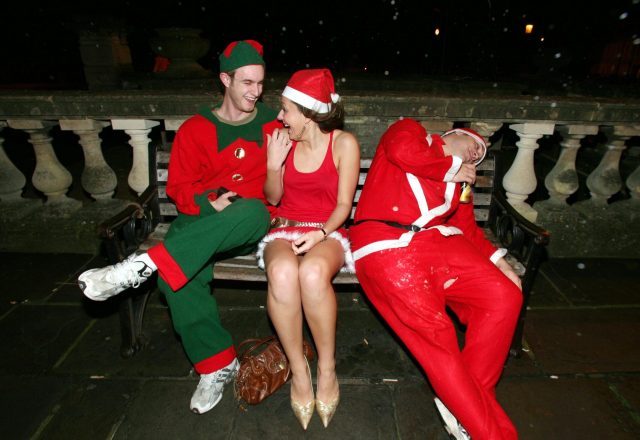
Amid the modern tyranny of healthism, downing a Class 1 carcinogen to quiet one’s thoughts feels like a tremendous act of rebellion. Credit: Matt Cardy / Getty Images




How many have you knocked back already? December has a habit of loosening our restraints. It’s that special time of year where our hypochondriac, health-obsessed society cheerfully throws caution to the wind to get pickled for Jesus. For weeks we oscillate between an exquisite stupor and mild nausea, downing drinks to revel in the company of friends or to endure the proximity of our work colleagues and family.
Such boozy traditions are becoming rather old hat. The young, we are informed, are increasingly giving up alcohol in favor of more health-conscious habits. The industry, desperate to keep pace, now churns out non-alcoholic beers and buzz-free approximations of spirits for this increasingly peculiar demographic.
While “sober-curious” Gen Z have yet to spoil the occasion for us aging drunks, it’s worth pausing to ask the question you’ve been pushing to the back of your mind: is this annual ritual of alcoholic debauchery really justified?
Objectively, of course, alcohol is a disaster. The cause of numerous afflictions from liver disease to seven types of cancer, booze fuels a litany of social ills including domestic violence, public disorder, accidental death, car crashes and infidelity. Worst of all, it makes you fat!
Yet like all hopeless addicts we persist in constructing elaborate apologetics. We tell ourselves that it’s all about balance, that one has to consider alcohol’s compensating virtues along with its vices. It’s a “social lubricant” which brings us all together in a pleasantly warm buzz. It lowers our inhibitions to allow us to be our true selves. The poet Panyasis praised wine as “like fire, an aid and sweet relief” which “wards off all ills and comforts every grief”. Notorious booze-hound Simone de Beauvoir romanticized drunkenness as an “an exaltation of the moment and a complicity with other men”. Scottish novelist Robert Louis Stevenson offered perhaps the most charming defense when he described wine simply as “bottled poetry”.
However, this sentimental view collapses quickly under scrutiny. While downing a few drinks no doubt provides some pleasure, its primary effects are anesthetic not empathogenic. Alcohol does not reveal our authentic selves, it dissolves the self. It loosens the tongue by dulling the mind, and provokes an urge to dance and sing by temporarily paralyzing the parts of the brain designed to preserve our dignity. For this temporary sedation, we are rewarded the next day with pain, vomiting and regret.
Alcohol’s virtues don’t come from reinvigorating the spirit, but by numbing the senses. There is a much darker side to our favorite drug. As Charles Bukowski famously put it when drunk: “the world was still out there, but for the moment it didn’t have you by the throat.” The joy in drunken revelry is really the relief which comes from escaping our miseries. Our lust for libations masks a deeper thirst for the void.
For a more honest account of our poor habits, one has to swallow some difficult realities. The pessimist philosopher Arthur Schopenhauer, a true Commissar of Curmudgeons, insisted that life is not a steady ascent toward fulfillment but an endless slog that “oscillates like a pendulum between pain and boredom”. Consciousness, in his telling, is a curse, a biological catastrophe which places man at war with the blind, ceaseless striving of the “Will” — the metaphysical force which underlies all existence. Yet Schopenhauer also believed in rare, sacred moments where this torment loosens, most notably in the experience of beauty, especially music, which dissolves the self and grants “a liberation from the individual will and its torments”. While he had no time for drunkards, Schopenhauer did concede that alcohol, properly consumed, could provide such temporary transcendence.
There is something refreshingly pagan about decadent, supposedly Christian, drunken festivities. In antiquity, this dark undercurrent of intoxication was idealized in the figure of Dionysus, the god of ecstasy, frenzy and dissolution. His festivals were ritualized descents into chaos, moments where the self loosened its grip and individuals dissolved into a primal, undifferentiated swarm. The same daemonic drive persists to this day: generous servings of egg nog and mulled wine are ostensibly offered out to enable partakers to “unwind” and “relax”, but secretly the enactment is an ancient, ritualized ode to oblivion. Even the most tepid office celebration carries the faint scent of Dionysian madness.
On balance the pains brought by alcohol both to the individual and society far outweigh the pleasures. Yet the desire to drink isn’t merely a hedonistic impulse; it is a far more esoteric half-conscious urge to slip the chains of the Will and dissolve, however briefly, into something beyond ourselves.
We turn to “bottled poetry” because modern life lacks the touch of the sacred mysticism and beauty which nourished us in the past. The old forms of exalted communion — in shared prayer, ritual and awe — are now substituted with shared chemical escape. Alcohol steps into the vacuum as a cheap, fast and brutally effective sacrament. Behind every third glass of prosecco is an urge to avoid thoughts of mismatched desires, loneliness and the never-ending torment of time.
This self-destructive urge has some value. In many ways drinking culture acts as a counterbalance against the far more pernicious modern obsession with “self-optimization” regarding health, longevity and productivity. We are currently swimming in propaganda marketing by fitness companies and wellness influencers, who tell us that we should fixate on every calorie, heartbeat and hour of sleep. Amid the modern tyranny of healthism, downing a Class 1 carcinogen to quiet one’s thoughts feels like a tremendous act of rebellion.
It’s no surprise that as we’ve seen a dramatic decline in alcohol consumption amongst the young, we’ve also seen a dramatic spike in mental health problems, celibacy and risk aversion. Raw dogging consciousness was always going to produce frayed nerves and quietly miserable lives.
Sobriety may be suitable for certain temperaments, particularly those for whom bacchanal joy can quickly descend into foolishness and bastardry. But for the romantic, one who demands more from life and can finely balance civilized restraint and pagan excess, a suitable dose of intoxicated ecstasy can offer genuine spiritual solace in a cold world.
Drinking is not healthy. It is not admirable. It is, however, a reprieve. As the booze apologist and conservative philosopher Roger Scruton once put it: “wine, drunk at the right time, in the right place, and the right company, is the path to meditation.”
So Merry Christmas, Evoe Dionysos. Raise a glass to temporary oblivion!

Join the discussion
Join like minded readers that support our journalism by becoming a paid subscriber
To join the discussion in the comments, become a paid subscriber.
Join like minded readers that support our journalism, read unlimited articles and enjoy other subscriber-only benefits.
Subscribe