




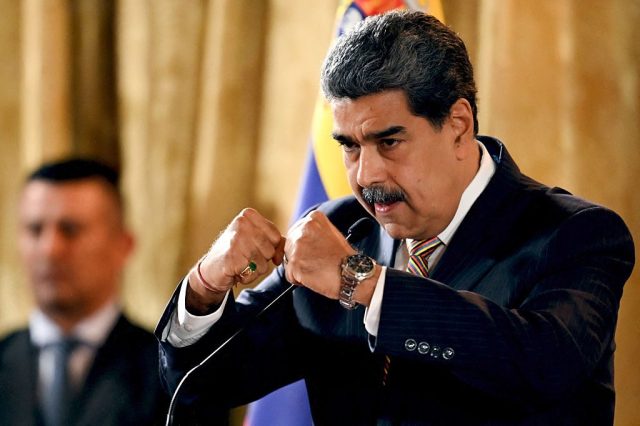
Maduro has called Trump’s bluff. Juan Barreto/AFP/Getty Images




As Chekhov’s well-worn maxim goes, if a playwright puts a gun on the wall in a scene, someone must eventually fire it. Nowhere does this principle hold truer than in politics. If a statesman draws public attention to a problem long enough and deploys enough government resources towards it, the problem must, before long, be meaningfully addressed, or the statesman risks losing both the trust and the interest of the public.
Right now, President Donald Trump’s policy towards Venezuela is running such a risk, and Trump, the consummate political stage director, knows it. His gun has been on the wall ever since he began his military buildup in the seas around Venezuela in late August. For the past several weeks, he has played for time by conducting a foreign policy reminiscent in its unpredictability of a fraternity hazing ritual. He has periodically threatened military strikes against targets in Venezuela, walked back those threats, claimed that President Nicolás Maduro’s regime needs to fall, and suggested a meeting with Maduro and brokering a deal. All the while, he has conducted periodic open-sea strikes on Venezuelan and Colombian drug boats.
But now, even from the perspective of an American public generally sympathetic to Maduro’s removal, the drama has gone on too long. Trump knows that in order both to save face internationally and to avoid American voters’ perception that he’s jerking them around, he needs to do something, soon. For Maduro, that makes the next few weeks exceptionally dangerous.
Trump’s first instinct is usually to use military threats to compel a deal — a deal that persuades a rogue state to follow a course better aligned with American interests. (In fact, the only case in which Trump has made public military threats and then followed through came this past June in his bombing of Iran’s Fordow nuclear facility.) But if Trump is still holding out for a deal that convinces Maduro to address his main concerns — to take a hard stand against drug and human trafficking — he will be disappointed. There is simply no peace deal that advances US interests to be had with the Maduro government.
This is not primarily because the Venezuela of onetime bus driver Maduro, and his predecessor Hugo Chávez, is an untrustworthy partner, untrustworthy though it certainly is. The country expropriated ExxonMobil’s Venezuelan oil fields in 2007. A decade later, it compensated Exxon for a tenth of the fields’ worth, and only when compelled to by an international court. Given these circumstances, it would be reasonable for American leaders never to trust a Venezuelan Chavista regime again. But the main reason that no deal with Maduro can help the US is that he lacks the power to deliver on any of the promises Trump will be looking for.
In today’s Venezuela, significant swaths of the country, including those most involved in the distribution of drugs, are functionally outside government control. In the country’s West, the Colombian National Liberation Army runs cocaine across the Colombian border and distributes it using local airstrips. Much of the country’s South, along the Brazilian border, is held by megabandas — that is, large and armed criminal groups — like El Tren de Aragua, which distribute drugs internationally. Even many territories involved in mining, which is Venezuela’s largest legal industry after oil, are functionally ungoverned.
None of this means, of course, that government officials are not involved in Venezuela’s illegal commerce. The opposite is true — it’s their lifeblood. But it does mean that the Maduro government is not in a position to put a stop to any of it, even if Trump were to make them a very attractive deal. A government crackdown on drugs would mean pitched military confrontations between the cartels and a Venezuelan army that is undersupplied, underfed, badly commanded, and old. The chances that Maduro would take a chance at being humiliated, whatever he promises Trump, are slim.
There are many in the US government and media who still believe Maduro can effectively address Trump’s concerns over drug trafficking and migration if he chooses to. After all, they say, he has effectively remained in power for almost a decade and a half; he can’t be totally ineffectual. But such optimism displays a confusion between regime stability and regime effectiveness.
While it is true that stable regimes typically achieve stability through the legitimacy accorded by effective governance, Maduro’s is an exception. His is a regime that is totally ineffective but surprisingly stable. Venezuela’s public safety, order, and social welfare system have broken down almost entirely, to the point that 30% of the country’s population has left during Maduro’s reign– for Colombia and destinations further abroad, including the U.S. Its economy hasn’t been stable enough even to report an annual GDP figure since 2014. And yet, last year Maduro managed quite easily to remain in office despite losing an election, marginalising his opposition while consolidating power.
Why? Because since the mid-2010s, Maduro has been running a criminal enterprise rather than a state government, and he runs that enterprise well. He has achieved stability by tying the fortunes of Venezuela’s military and civil power brokers so tightly to the country’s endemic graft, corruption and drug trade that they know they can only survive as long as Maduro remains in power. Hanging the sword of Damocles over the heads of all one’s rivals can be as powerful a guarantor of regime stability as democratic legitimacy itself.
In this sense, President Trump is correct to call the Venezuelan government itself a sort of cartel, which the administration did two weeks ago when it designated the Cartel de los Soles (a Venezuelan colloquialism for Maduro’s graft-ridden government) a foreign terrorist organisation (FTO). Maduro’s government is not a cartel in the same sense that El Tren de Aragua is, but it is one insofar as its existence depends upon illegal commerce.
It might be tempting for Trump to meet with Maduro, receive a grant of oil or mining concessions, and declare victory. But such concessions, as we know from ExxonMobil’s experience, would not be worth the paper they are printed on. Neither would a promise to crack down on the drug trade. The only near-term Trump-Maduro deal that could serve American interests would not be peaceful. It would not involve sanctions relief or a decrease in military pressure. It would be a deal in which the US military has free rein to attack drug distributors in Venezuela, and in exchange for Maduro’s non-interference, we leave him alone. But if that’s going to be the deal, why make a deal at all?
If Maduro had a slim chance of convincing Trump otherwise, he might have bungled it on Sunday. It was then that the Venezuelan National Assembly (controlled by Maduro’s United Socialist Party of Venezuela) announced that it would be conducting its own investigation into the Trump administration’s alleged second strike to kill survivors on a drug boat carrying Venezuelan nationals. The war crime allegations, first reported in the Washington Post, have ignited a media firestorm and spurred a US congressional investigation. Trump and his Secretary of War, Pete Hegseth, have claimed to have no advance knowledge of the strike and have dismissed the story as a distraction. Further reporting by the New York Times has cast doubt on whether the second strike was intended to kill survivors (which would have been a war crime), as opposed to fully destroying the boat and drugs on board (perfectly legal under the laws of war).
It is tempting for foreign adversaries, when the transparency of American democracy brings to light some scandal favourable to their case, to press their advantage by piling on. Those weaker adversaries who know how to negotiate with President Trump, however, do not do this. They know that there is no surer way to provoke the president’s ire than to make him look bad on the world stage. Instead, they garner his sympathy with public shows of flattery, modesty, and deference, even while holding to their own bottom line. No one understands this better than Vladimir Putin, whose handling of the American president is usually virtuosic.
Until recently, Maduro seemed to be following Putin’s playbook. He made no attempt to fight the legitimacy of the strikes, and did not even acknowledge that any of the boat’s crews were Venezuelan until last week. But with this most recent strike, the temptation for him to piggyback on the US. Congress’s own investigation seems to have been irresistible. Venezuela’s government has now not only admitted that there were Venezuelans aboard the boat, but launched its own investigation into the US’s purported criminal activity. The presumptuousness of this gesture is likely to infuriate Trump and drive him further away from the negotiating table.
With no desirable deal on the horizon, Trump faces a strategic quandary. If his opening gambit was to persuade Maduro to leave office peacefully, through an overwhelming show of American force, that effort has clearly failed. With the magnitude of the US military buildup and the FTO designation for the Venezuelan government (an unprecedented move that opens possible legal justifications for regime change), it is hard to imagine any means by which Trump could further turn up the heat without ordering an actual attack. He ran up against the limits of his foreign-policy-by-threat this past weekend, when he attempted to declare, via his social media app Truth Social, that the airspace over Venezuela was closed — an announcement that the Maduro government denounced and then ignored.
Now that Maduro has called his bluff, what is Trump’s next step? Militarily, he has a few options. He could initiate a land strike against cartels operating in Venezuela’s South or West. This would be a logical extension of the drug boat strikes. Such a campaign might compel Maduro into making a deal that provides for continued American anti-drug policing in Venezuela. Alternatively, it could draw Maduro’s army into direct conflict with American troops, giving Trump a pretext for forcible regime change. Trump could also skip the formality of attacking cartels and instead attack Maduro directly with airstrikes or a ground assault, working with opposition leaders to install a post-Maduro government. Either of these options carry some risk of an Iraq-style “forever war”, should Venezuela’s opposition government prove unable to consolidate power.
The other option is a covertly-led coup. This option would likely offer a higher likelihood of post-regime-change stability than a direct American attack, and would demand less future involvement from the US. But given Maduro’s tight control over his inner circle, Trump may have to wait a long time for such a plot to come together. One can’t help but wonder whether, if such a coup had been immediately possible, it would have happened already. Either way, it is Trump’s move.
Over the last few months, Trump has orchestrated a crescendo worthy of Beethoven’s most powerful symphonic finales. But big crescendos must lead somewhere; they cannot simply peter out. To make narrative sense, Chekhov’s gun must be fired. If Trump acts against Venezuela, either with an attack on Maduro’s regime or on the cartels he protects, he introduces uncertainties. Uncertainty as to what will follow — an orderly restoration under the leadership of dissidents like Nobel Laureate María Corina Machado, civil war, or something in between; and uncertainty over what American resources will be required, and for how long.
But politically, the consequences of inaction at this late date would be worse. Over recent months, Trump has declared a great reversion in American strategy — from the Wilsonian aspiration of making the world safe for democracy to the Rooseveltian one of making the Western Hemisphere safe for the United States. He chose Venezuela as that strategy’s first proving ground. And if all it takes to stop that strategy is the obstinacy of a single South American crime-boss caudillo, Trump will have shown his administration to be worse than impotent. It will take years, and a new administration, for any foreign adversary to take such American pressure seriously again.
Join the discussion
Join like minded readers that support our journalism by becoming a paid subscriber
To join the discussion in the comments, become a paid subscriber.
Join like minded readers that support our journalism, read unlimited articles and enjoy other subscriber-only benefits.
Subscribe