




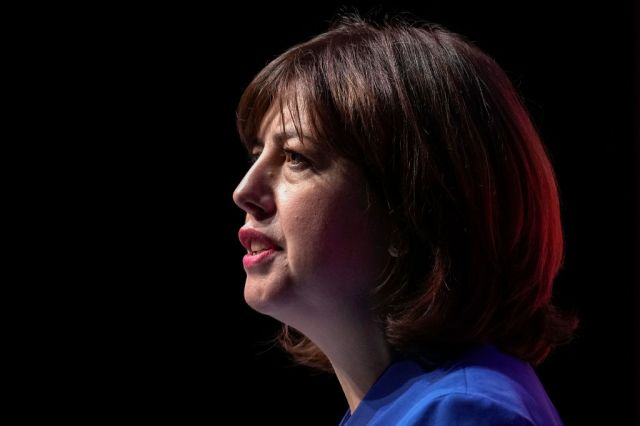
Lucy Powell has appeared to dismiss the matter of the grooming gangs as a partisan dog whistle. Photo by Christopher Furlong/Getty Images




“A phrase much used in political circles in this country is ‘playing into the hands of’. It is a sort of charm or incantation to silence uncomfortable truths. When you are told that by saying this, that or the other you are ‘playing into the hands of’ some sinister enemy, you know that it is your duty to shut up immediately.”
Those words come from George Orwell, who was writing during World War Two about the difficulty of truth-telling. In today’s era of disappointing political leaders, it is easy to forget that it is nothing new for uncomfortable truths, as Orwell put it, to be silenced in the interest of the supposed greater good.
In modern British history, there have been few truths more uncomfortable than that of the grooming gangs. Last week, the organization Open Justice UK released a long fought-for selection of court transcripts. They include sentencing decisions that are both utterly horrific in their graphic detail of sexual abuse, and utterly despair-inducing as to our legal system. The judges presiding over these cases appeared, on multiple occasions, to give offenders much more lenient sentencing than they could have and should have.
Yet the crimes mentioned in the judges’ sentencing remarks are depraved enough to shake anyone’s faith in our species. They are so beyond the pale of normal morality that they make a mockery of the political and social priorities that have taken hold in Britain. Today we live in a censorious culture that has spent more than a decade obsessing over “problematic” issues of media representation; the ever-unrealized dangers of “incels”; and the necessity, or otherwise, of cancellation and social ostracism over “violent” language.
This set of social rules and norms has become the established table manners of media and political life, but it lacks the capacity to respond to a world that contains systematic child grooming. But if the country ignores the transcripts, there will be no prospect of Britain learning the lessons of these awful crimes. Labour’s shaky record on the subject doesn’t inspire confidence.
So far, the Government has given the impression of acute squeamishness on the issue of grooming gangs. This reaction is disappointing but not unpredictable. After months of pressure, No. 10 opened an inquiry into the grooming gangs, even as it worried that that very inquiry would “play into the hands of” the worst of Britain’s racist forces, cheered on by Elon Musk.
But the truth is that important facts have been kept from public view. As Louise Casey’s report into grooming gangs demonstrated in June, two thirds of cases of group-based child exploitation have been processed without ethnicity being recorded. Casey also noted instances where the ethnicity of the offender had been Tippexed out of case files. There’s no telling what crucial evidence might no longer exist. Using the Freedom of Information Act, the Conservative MP Robbie Moore discovered that the Government is yet to legally instruct councils to protect key records. Even now, council office shredding machines might be destroying any chance of real justice.
In a politically schismatic world, Labour must keep its nerve if it is to deliver any kind of justice for the vulnerable working-class women who were systematically exploited. These are women whose lives were ruined as the state looked away.
I have been a member of Labour for two decades, and my faith that the party is up to the job has been rattled. Talking to other members about the grooming gangs has too often produced a patellar reflex-like invocation of the far-Right. And this is a tendency that goes right to the top. In the spring, the then-Leader of the House of Commons, Lucy Powell, appeared on Radio 4’s Any Questions?, where she was asked by Reform’s Tim Montgomerie whether she had watched a Channel 4 documentary on the gangs. She replied: “Oh, we want to blow that little trumpet now, do we? Yeah, OK, let’s get that dog whistle out.”
Powell later explained, by way of apology, that she had meant to object to political point-scoring over the issue. Whether her account was true or not, her “dog whistle” accusation had already indicted our political culture. Labour’s leaders, and indeed the party members beneath them, have been confronted by the evil of organized rape and abuse of children, but they cannot see it as being independent of its political convenience or inconvenience to team Left or team Right. The reality, though, is that to blame this catastrophic failure of the state on a single political party cheapens the discussion: a discussion that deserves dignity.
Kemi Badenoch was seemingly bounced into caring about the cause by her Conservative leadership rival in early 2025. Since then, she has shown a remarkably opportunistic confidence to instrumentalize the issue to make political hay. Yesterday, she spoke of the need for the inquiry to leave “no stone unturned”, notwithstanding her own party leaving plenty of stones unturned when in power. Badenoch is a politician who has spent most of her career on the safer ground of complaining about liberal identity politics. Now she has suddenly found themselves in the company of something truly dark. Her first thought: “This will hurt Labour.”
If Labour’s enemies have shown political cynicism, that does not excuse No. 10’s reticence in opening the inquiry. Nor does it excuse the general impression they give of trepidation in tackling this issue, something Baroness Falkner, the outgoing head of the Equality and Human Rights Commission, called out this week.
Despite her “little trumpet” jibe, Lucy Powell was subsequently elected Labour’s deputy leader. Her gaffe was never mentioned on the campaign trail. Evidently, it didn’t bother Labour members enough for them to look for a different candidate.
In September, too, we were reminded of the party’s frayed relationship with the working class communities it was originally founded to represent. A leaked text message referring to gang victims as “poor white trash from Rotherham” forced the resignation of Peterborough’s council leader. Prior to this, Labour attempted to choose one of Rotherham’s councillors to be a candidate for parliament in 2024, before thinking better of it.
Sadiq Khan, likewise, has failed to distinguish himself. In January of this year, Susan Hall, the leader of City Hall’s Conservative contingent, pressed the Mayor on the subject. In a bizarre exchange, full of implied political point-scoring, Khan put on a virtuoso display of pettifogging, asking repeatedly what was meant by a “grooming gang”. He implied that the character of exploitation in London held a complexity that only few could understand.
In reality, the Metropolitan police re-assessed nearly 10,000 cases, of which an expected 3,000 thousand will require further investigation. An undisclosed number will relate to family and institutional abuse: i.e. they did not involve a gang of men preying on young women. Despite his obfuscation, Khan was right in one sense: as The Times reported in October, the grooming gangs inquiry does not yet have an internal definition of what a grooming gang actually is.
For this, and other reasons, the inquiry’s key contributors are also leaving in despair. Four survivors have resigned from its victim liaison panel and two intended chairs have stepped away, with the search for a viable chair now expected to take “months”. Accusations have been made that the scope of the inquiry is being massaged and widened, no doubt because of who it may “play into the hands of” should its focus remain as originally intended. It’s easy to imagine how the lack of a definition of a “grooming gang” might be a means of using constructive ambiguity to reduce clarity.
Would things be different if the victims were different? It is hard to ignore the feeling that, had they not been poor, the sexually exploited women and girls would never have been ignored, mishandled or denied justice for so long. The majority of Labour’s membership consists of well-educated and often well-paid members of the middle class. They must realize that, in the eyes of working-class voters, the legitimacy of the law and the state is now in question. As those working-class voters might ask: does the law give us fair treatment, too?
Anyone reading Open Justice UK’s publication — something that should be forced, A Clockwork Orange-style, on all those who see the inquiry as “Right-wing” — would be led to think the answer is a clear no. In a particularly horrific sentencing transcript, a judge decides to charge an abuser for having groomed a 13-year-old. Her abuse had actually occurred between the ages of 12 and 14, but the judge openly uses the logic that to “average” the age of the victim to 13, rather than to zero in on her abuse as a 12-year-old, would enable the court to avoid the severest possible sentence. In another transcript, a sex trafficker was told that his record of good character was a mitigating factor in sentencing — as though showing a good face to one’s community in the daytime somehow lightens the evil of what he had done in the night.
For generations, the labour movement battled for laws that working class people could trust. Now the working class is represented by a Labour Party that is seriously talking about the abolition of trial by jury. Labour’s political opponents, meanwhile, are keen to present grooming gangs as the crowning sin of multiculturalism. They won’t be making their argument with Queensberry Rules in mind, or with an emphasis on protecting the dignity of victims of this scandal. Labour must remember that this is, at heart, a gigantic state failure to protect the very people the party was founded to represent.
And if the Government makes a mess of this inquiry, why should those people continue to trust in the rule of law? Should Labour continue to silence uncomfortable truths, Britain might have to add our legal system to the list of things and people these gangs have destroyed.
Join the discussion
Join like minded readers that support our journalism by becoming a paid subscriber
To join the discussion in the comments, become a paid subscriber.
Join like minded readers that support our journalism, read unlimited articles and enjoy other subscriber-only benefits.
Subscribe