




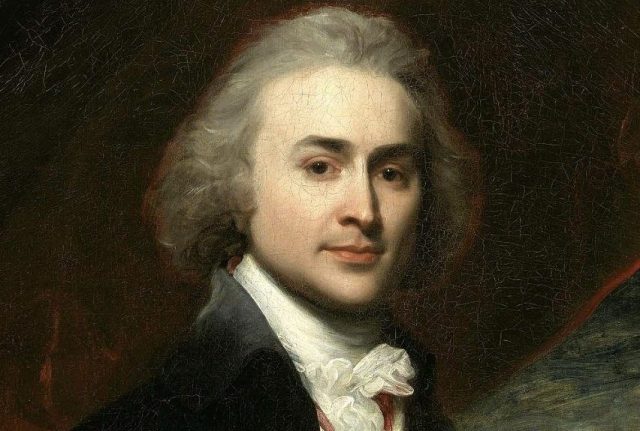
John Singleton Copley's portrait of John Quincy Adams. (Wikipedia Commons)




On the young side of the publisher’s box we see a delicately handsome fellow in v-necked black, with white lace flowering just below his throat. His wig is powdered and he gazes down and away with a quarter-smile. His expression would have been composed by arrangement with the painter, John Singleton Copley. But more than most of us he hated falsity, and the longer I study him the more I intuit some quietly, pleasantly unyielding quality, as might be expected from this brilliantly ambitious gentleman who was born for politics, taught and quizzed by his father’s law clerks, further educated by hearing the cannonade at Bunker Hill, taken to France by his father, who was treating with France, carried home and back again, by which time it was 1779, and John Quincy Adams was 12.
That was when he began his diary: 50 volumes, 14,000 manuscript pages, 69 years. He studied Latin in Holland, became a legate’s interpreter in Russia, whose diplomatic language was fortunately French (he had not yet learned Russian, but would be the only American president who ever troubled to do so); and after jaunting to the Hague, London and France, where his father signed a peace treaty between the United States and His Britannic Majesty, he sailed home and in 1785 was admitted to Harvard. He had gifts, he did.
Copley’s portrait dates from 1796. The subject had become a dour egghead in the Charles Osgood portrait of 1828: balding on top, thickly white-haired from the temples almost down to his naked chin. Old age caught him staring wearily, jowly but still pugnacious at the camera when Matthew Brady took his daguerreotype. The elderly side of the publisher’s box flatters him with the smooth, ruddy baldness of middle age and an almost youthful half-smile, never mind that it is now more tightly accomplished by thinner lips. He was 59, with 40 years to go.
Thus the front and back of his life-box. Within it stand a two-volume selection of his mental remains.
His world is dead, his diplomatic triumphs grown as antique as some oil painting cracked and crazed, his one-term presidency stymied like his father’s, his hopes disappointed, but only provisionally: he being one of those who entrust the future to God. His written thoughts have faded in proportion to their historical context, and his exposition is archaic (Ben Franklin once complained that capitalizing nouns was going out of style in our language, but Adams kept the faith); whenever I tune my eyes to them, they fascinate, then astonish me with true stories of stubborn patience and toilsome courage, for a good cause. There goes Don Quixote Adams again, doing battle with monsters disguised as windmills!
I inhabit evil times. I watch the ruination of my planet and the moral suicide of the nation which Adams sometimes fought against to fight for, and it makes me cynical. Being cynical is not all bad. Sometimes it can be fun. But it is mostly sad and tiring to stop believing in whatever it was I believed in, such as that I could still “make a difference”, or could at least be brave. Both of which remained possible, but with everything around me getting worse so rapidly, it was convenient to pretend that trying to do anything worthwhile would be comical. But then I opened the diaries of John Quincy Adams, and met someone who had also sorrowed over the degradation and oncoming violence in the America he loved.
As David Waldstreicher, the diaries’ present editor, tells it: “Confronted by the implications of American expansionism, Adams found his room for maneuver increasingly narrowed… His speeches and messages during the years of his presidency sought to advance union, ‘improvement’ and good government while carefully stepping over the trip wires of slavery and partisanship.” In my version, Adams finally stepped off the narrow path, bushwhacked into radical compassion and became a hated heroic failure, or if you like a successful practitioner of moral politics. You see, he got sadder, not least on account of his own disappointments — his political defeats, money troubles, his beloved wife’s miscarriages, the stunted or abbreviated lives of several of their children, his two brothers who drank themselves into the grave — and thanks to these losses he could finally revolt against the stench of injustice. So he turned his back on party loyalty, faced the evil thing, took up arms against it and kept fighting it for the rest of his life. I, his reader, know as he could not that we would eventually see his cause as right and righteous. It made headway in his time, and partially succeeded. Sometimes somebody succeeds. Sometimes a dead man’s words can raise me up by proving that it is not too late to do something right.
***
Nowadays we would dub him a “workaholic”: Minister Resident to the Netherlands in 1794, Minister Plenipotentiary to Russia three years later, while his father commenced being President; Senator from 1802 until 1808, when he resigned because his party was about to discard him for anti-Federalist heresies. (Throughout his life, with noble disgust, he declined to put himself forward for office. If asked to serve, he would do it, but never stumped or canvassed. “In the mean time,” he told his diary, “I implore the Spirit from whom every good descends to enable me to render essential Service to my Country, and that I may never be governed in my public conduct by any consideration other than my duty.”)
In 1809, he returned to Saint Petersburg, where he and Tsar Alexander sometimes greeted each other on the street. Declining an appointment to the US Supreme Court, he stayed in place for Napoleon’s invasion. Meanwhile, the War of 1812 was raging, and the British were invading Detroit. We find him in Paris when Napoleon escaped captivity at Elba and began the Hundred Days: “There was a great crowd of People upon the Boulevards; but the cries of Vive l’Empereur had already been substituted for Vive le Roi.” Then at the Court of Saint James, already balding and careworn, Adams negotiated peace with the British at Ghent. The diaries bring to life his exhausting grind of facing down the old enemy’s resentment and contempt. Adams dug in his heels as stubbornly as would the 20th century’s Molotov. In 1817-25, he became President Madison’s Secretary of State, crafting not only the Adams-Onís Treaty that secured Florida from Spain but also the famous Monroe Doctrine: “You Europeans stop meddling on our territory and we’ll return the favor.” He tried and failed to persuade America to adopt the metric system. His baldness widened and elongated.
Then he became a president aspiring to bless his country with canals and roads, a national university, an academy for the young Navy, an astronomical observatory; but got stymied by his enemies, who reveled in accusing this incorruptible man of corruption. Losing his reelection, he retired just in time for the suicide of the son he had named after George Washington. Unmoved by sneers about his fall from president to congressman, in 1831 he entered the House of Representatives, and in 1844 he became its dean, or longest-serving member. They called him “Old Man Eloquent”. He futilely denounced the Mexican War, and opposed slavery in defiance of censure, execration and threats. He worked himself into ancientness, dying of a brain bleed in the Speaker’s chamber of the House. Don’t pity him; his work was his pleasure. In his mid-thirties, he admits to his diary: “…The interest with which my mind seizes hold of the public business, is greater than suits my comfort or can answer any sort of public utility.”
***
Before I get down to the diaries themselves, please let me compare them to his public speeches, in which he could be bitterly funny, as in these remarks to other Representatives in 1842:
He talks to us about the star of Texas, which he calls “the lone star of Liberty.” Liberty of Texas! The star illumined by the radiance of slavery restored!… [Mexico had recently abolished slavery.] So, I suppose, if war shall come, we shall not only acquire this solitary brilliant star of Texas, but we shall have all Mexico added to the United States. Sir, the Isthmus of Panama will hardly stop our victorious arms, and I really wonder the gentleman did not carry us on to Cape Horn. [A laugh.]. And he means, in this heroic enterprise, to lead on the brave spirits of thousands from the great valley of the Mississippi, inspired by the hope of robbing churches and priests. So it is to be a religious as well as a civil expedition — a sort of crusade, in which the gentleman from Virginia is likely far to transcend the exploits of Tamerlane and Genghis Khan… I look forward to the time when the gentleman’s name shall be placed side by side… with that of a still more glorious conqueror by the name of Tom Thumb. [Roars of laughter, long and loud.]
In distinction to these scintillating razor-cuts, the diaries often come across as melancholy and bitter. John Quincy Adams was so modest that he often disappointed himself. He certainly disappointed others. He and the slave-owning politicos hated one another — and he had a spiteful streak.
Like his father, he detested Thomas Jefferson, whose assertion in the Declaration of Independence that “all men are created equal” sounded phony — for Adams subscribed to republicanism, not democracy. “And that too great an equality of the Citizens, is prejudicial to the Liberty of the whole, the present alarming Situation of our own Country will I think afford us a sufficient Proof.” In other words, he had made up his mind about equality by the time he was 20 — for this diary entry dates from 1786, a year before the Constitutional Convention drafted its mealymouthed allusion to “the Migration or Importation of such Persons as any of the States now existing shall think proper to admit”, which referred to trafficking slaves from Africa. Though he continued “carefully stepping over the trip wires of slavery and partisanship”, he was, in private, an anti-slavery partisan. That Jefferson was the same in public rendered him to Adams an opportunistic, windy-minded hypocrite. Jefferson prated of emancipation while keeping slaves! In 1802, Adams anonymously published a vicious lampoon about the “sage of Monticello’s” bedroom sports with Sally Hemmings, a woman he owned.
Slavery simply incensed Adams. In 1819, haunted by what he could foresee, he advised the diaries:
His Declaration of Independence is an abridged Alcoran of political doctrine, laying open the first foundations of civil society — but he does not appear to have been aware that it also laid open a precipice into which the Slave-owning Planters of his Country, sooner or later must fall… Jefferson has been himself all his life a Slave-holder, but has published opinions so blasting to the very existence of Slavery, that however creditable they may be to his candor and humanity, they speak not much for his prudence… The seeds of the Declaration of Independence are yet maturing — The Harvest will be what West the Painter calls the terrible sublime.
These words inspire me with dread. I look around me, awaiting the next visitation of the “terrible sublime.” Nobody can stop it now. Maybe no one ever can. In 1861, Abraham Lincoln could not prevent the Civil War even though he promised never to interfere with slavery. Forty-two years earlier, Adams could not prevent it, either. But I love him because he kept trying. More principled in this than gentle, kindly Lincoln, whose heart bled for the slaves but who put the Union first, he wrote in 1820: “If the Union must be dissolved, Slavery is precisely the question on which it ought to break.”
***
I love Jefferson for what he wrote. His trust in people’s power is beautifully radical. When I quote him unattributed on, for example, the desirability of periodic revolts against government, some neighbors tell me that I sound kind of like one of them goddamned Communists. Adams was another radical. Why couldn’t those two have “done something?” His diaries ever so logically reply:
The Declaration of Independence, not only asserts the natural equality of all men, and their unalienable right to Liberty; but that the only just powers of government are derived from the consent of the governed. A power for one part of the people to make slaves of the other cannot be derived from consent, and is therefore not a just power.
Adams was still Secretary of State. Like Lincoln, he expressed his anguish but kept it in its place. But remember, Lincoln did emancipate the slaves. To do so, he needed to be elected President. That meant expressing disgust (which might have been unfeigned) at “Negro equality”. In the Lincoln-Douglas debates of 1857, he could always squeeze laughs out of the electorate at the thought of his marrying a Negro wench — no diamond ring for Sally Hemmings! As for Adams, what was he supposed to do about slavery? How could one even talk about it in government? His Southern colleagues could be charming enough on other subjects:
But when probed to the quick upon it they show at the bottom of their Souls, pride and vain glory in their very condition of masterdom — They fancy themselves more generous and noble-hearted than the freemen who labor for subsistence — They look down upon the simplicity of a yankey’s manners because he… cannot treat negroes like dogs.
As we have overheard him confessing, Adams was addicted to politics. He might not have been as ambitious as Jefferson, but then again, maybe he was. In that case he’d better be careful.
***
One of the diaries’ pleasures is watching his empathy grow in private, and discovering that maturation’s public fruits.
He seems to have followed his conscience from the beginning. In 1808, when the Federalists turned him out of the Senate because he supported certain measures of the hated Jefferson, Adams made the following neat dark wormtracks in his diary:
He said my principles were too pure for those with whom I was acting — and they would not thank me for them — I told him I did not want their thanks — He said they would not value me the more for them — I told him, I cared not whether they valued me for them or not — My character, such as it was, must stand upon its own ground, and not upon the bolstering of any man or party —
He opposed female suffrage. And he had nothing against Indian removal, because why should savages remain in possession of all those unimproved forests?
…In repelling an insolent charge of the British Plenipotentiaries against the Government of the United States of a series of perpetual encroachments upon the Indians under the pretense of purchases, I had taken the ground of the moral and religious duty of the Nation to settle, cultivate and improve their territory…
That was in 1814. But by 1839 he had long since woken up to the cruelties contingent on that “moral and religious duty”:
I told them that the case of the Seneca Indians was hopeless. That a fraudulent Treaty coaxed, and bullied and bribed out of perhaps one tenth part of their chiefs and Warriors, was already sweeping them away beyond the Mississippi… I told them it was painful to me… but it was in vain to disguise or suppress the truth. — An inflexible determination to extirpate the race of Indian Savages was the white [man’s] law on the continent, and I feared it would be so till the race itself shall be exterminated from the face of the Earth.
That sounded hopeless. Being unable to “do something”, why did “Old Man Eloquent” not quit? A diary entry explains: “I received two days since a Letter from a Stranger” (a threatening letter, I presume) “advising me now to retire from the world, the only reason for my postponement which is that I cannot afford it.” Well, in fact there was a second reason: “More than 60 years of incessant intercourse with the world has made political movement to me as much a necessary of life as atmospheric air — This is the weakness of my nature, which I have intellect enough left to perceive, but not energy to control.”
As I said, John Quincy Adams was modest — more credit to him. His money troubles and addiction to politics were real enough, but so was his noble pugnacity. In 1831, aged 64, he had braced himself up for doom much as might have Odin awaiting the unconquerable monsters of Ragnarok:
My life has been spent in stemming currents of popular opinions and until lately, with occasional and great success — But the runs of luck in life, are as at whist — The tide in the Affairs of men when it has once begun to ebb, will go down. This free and bold expression of my opinion which I disdain to withhold will hasten my downward course, and nothing can redeem it — Let me fulfill my destiny; and so far as may be possible sustain my character.
Both of those he did. In 1840 he received petitioners:
The two Seneca Indian chiefs… came this morning… to urge the presentation [against]… the fraudulent Treaty, by which they are to be driven like a herd of swine from their homes to a wilderness west of the Mississippi… I promised to speak for them… I was twice in the Supreme Court library room,… to open a Steam-battery, upon the argument in the case of the Amistad captives — but Oh! how impotent is my voice to fulfill the purpose of my heart!
La Amistad was a slave ship. Her cargo had risen up, killed most of their tormentors and demanded to be ferried back to Africa. Tricked and captured in America, they were deposited in prison pending their probable extradition to the slavemasters of Spain.
[They] urged me to assume as assistant Counsel… the defense of the Africans captured in the Amistad, before the Supreme Court… — I endeavored to excuse myself upon the plea of my age and insufficiency [for by now Adams was 73]… — But they urged me so much and represented the case of these unfortunate men as so critical, it being a case of life and death, that I yielded,… and I implore the mercy of the Almighty God, so to control my temper, to enlighten my Soul and to give me utterance that I may prove myself in every respect equal to the task —
Please remember that this was the infamous “Taney Court”, whose Dred Scott decision of 1857 would decree that slaves remained slaves even where slavery was not the law of the land. Yet despite that, and despite his age, in February 1841, Adams described in his diary what happened.
With grateful heart for aid from above, though in humiliation for the weakness incident to the limits of my powers, I spoke for four hours and a half, with sufficient method and order to witness little flagging of attention, by the judges or the auditory… The structure of my argument… is perfectly simple and comprehensive — admitting… one fundamental principle,… invoking Justice, specially, aware that this was always the duty of the court; but… an immense array of power,… instigated by the Minister of a foreign Nation has been brought to bear in this case on the side of injustice…
On March 9 Adams “waited upon tenterhooks, half an hour before the meeting of the Court,” until Justice Story pronounced the Amistad mutineers free people. They could go home after all. Meanwhile, Adams was lamenting to his diary: “It is impossible to separate the discussion upon the African slave-trade, from the moral and political aspects of slavery; and that is with us a forbidden topic.”
***
That was literally true. To prove that America honored equality and freedom of speech, in 1837 a Representative from South Carolina introduced the notorious “gag rule”, which prevented all mention of slavery in the House. With the same tenacity he had shown against the British plenipotentiaries at Ghent, Adams punched back for almost nine years. As he wrote in March 1841:
I find impulses of duty upon my own conscience, which I cannot resist, while on the other hand,… the danger, the insurmountable burden of labor to be encountered in the undertaking to touch upon the Slave-trade. No one else will undertake it. — No one but a spirit unconquerable by Man, Woman or Fiend, can undertake it, but with the heart of Martyrdom… Let me but die upon the breach.
So he went on, in April 1841:
The leading men of the North are all truckling to Southern slavery — They are all willing to desert Seward in the stand he has taken [against extraditing three free blacks to Virginia for helping a slave run away]. I see what it will cost me to stand by him, but I have so little political capital left, that the remnant is not worth saving — Especially at the cost of base desertion from the cause.
And again, on 18 January, 1842:
I presented the petition of sundry citizens of Massachusetts praying that the benefits of the naturalization Laws may be extended to persons of color — [Virginia Representative Henry] Wise made objection to its reception…
On 24 January:
. . . And I presented sundry other petitions — One from Benjamin Emerson of 45 others of Haverhill, Massachusetts, praying Congress, to take measures for peacefully dissolving the Union [so that Massachusetts would be no longer slavery-stained]…. — I moved its reference to a select Committee with instructions to report an answer assigning the reasons why the prayer of the petition should not be granted — Then came another explosion, and after snarling debate a Resolution offered by Thomas W. Gilmer, that I deserved the censure of the house…
The next day:
At one Gilmer’s resolution of censure upon me was taken up — Thomas F. Marshall offered a much more violent one with a flaming preamble, charging me… with subornation of perjury and high treason… I finished [my reply] and was followed by Henry A. Wise, [who] in a speech of personal invective against me took nearly two hours…
And on into the following month. Here’s an excerpt from 4 February, 1842:
I occupied the whole of this day in continuing my defense before the house [of Representatives] —… I specially refuted the pretence that the Union could be dissolved only by force, and cited the example of the peaceful dissolution of the confederation Union, by the present Constitution of the United States.
Two days later, Adams wrote:
One hundred members of the house, represent Slaves, four fifths of whom [that is, of the members] would crucify me, if their votes could erect the cross — forty members representatives of the free in the league of Slavery and mock democracy, would break me on the wheel if their votes or wishes could turn it round — and four fifths of the other hundred and twenty are either so cold or so lukewarm, that they are ready to desert me at the first scintillation of indiscretion on my part. The only formidable danger with which I am beset is my own temper.
On 7 February, the Representatives wearied in their persecution and tabled a motion to censure Adams. Yet his enemies weren’t done yet. In May 1842, he described receiving:
…from the South almost daily letters of insult, profane obscenity and filth… Threats of Lynching and Assassination are the natural offspring of Slave-breeders and Slave-traders…
In September, he had attracted the ire of an even greater foe.
I have now on hand a controversial warfare with John Tyler, President of the United States; bitter personal hatred of five of the most depraved, most talented, and most influential men of this Country, four of them open and undisguised…
In October:
I have deliberately assumed an aggressive position against the President, and his whole executive Administration — against the Supreme Court of the United States, and against the commander in chief of the army — I am at issue with all the organized powers of the Union — with the twelve hundred millions of associated wealth, and with all the rabid democracy of the land… But my cause is the Cause of my Country, and of human liberty. It is the cause of Christian improvement — the fulfillment of the prophecies, that the day shall come when Slavery and War shall be banished from the face of the Earth.
1843 would begin with Adams — now in his 75th year — promising legal advice to one “George Lattimer, arrested and claimed as a slave”. The very next day, a certain Moses Bell, having sued his master, was declared free by an all-white jury, after which the master appealed to the Supreme Court. Adams again “promised to do for him what I could.” Next came John Davies, whose wife’s son Joseph Clark was promised by his master that on the latter’s death he would work three years for a brother, then be freed. But the brother sold him, “and he is now in irredeemable Slavery for life… — Can I not possibly do something for this man?”
***
On December 3, 1844, Adams moved that the gag rule be rescinded. “The question was then put on the resolution and it was carried 108 to 80 — blessed ever blessed be the name of God!” He finally died, aged 80, in February 1848. He never did see the light when it came to women’s suffrage, and it would surprise me to learn that he desired full social equality for African Americans (his satire against Jefferson and Sally Hemmings had a racist tinge.) He was, then, of his time — yet better than his time.
Let me leave you with one more of his sayings:
I believe the best guard against prejudice is a frequent examination of our opinions, and a cool estimate of the arguments opposed to them — You must as Cicero says identify yourself in imagination, first with your adversary and then with your judge — and above all you must have resolution to abide by the result even if it should be adverse to your preconceived opinions.
Join the discussion
Join like minded readers that support our journalism by becoming a paid subscriber
To join the discussion in the comments, become a paid subscriber.
Join like minded readers that support our journalism, read unlimited articles and enjoy other subscriber-only benefits.
Subscribe