




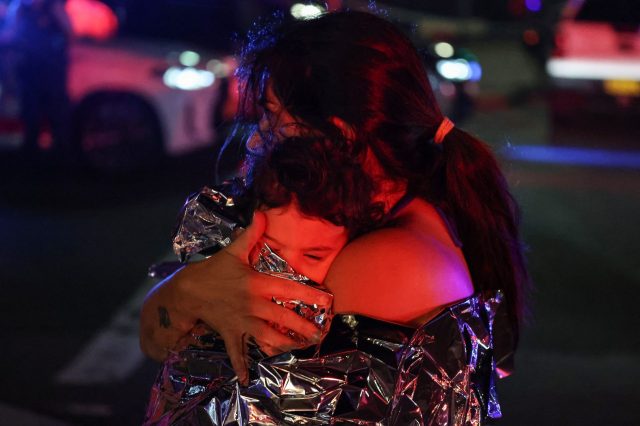
Jews in the diaspora perceive Islamist terror as the principal danger. Credit: David Gray / Getty Images




Yom Kippur, it is said in the Talmud, is the happiest day of the Jewish year. Once upon a time it might really have seemed it, when the fair maidens of Jerusalem, all clad in white, would frolic and dance in the vineyards. The atmosphere in any modern-day synagogue on Yom Kippur could hardly be more different. You will see haggard faces and hear rumbling stomachs; since it is forbidden to shower and brush teeth, the smells are noticeable, too. Leather shoes aren’t allowed, so it’s not uncommon for the shul bigwigs to pair their finest suits with rubber Crocs. The service is mournful; the Kol Nidrei declaration, set to music, has something of the funeral dirge. The whole hungry, thirsty, tiresome day is a long meditation on mortality. “Who will die at his time,” one prayer asks, “and who before his time; who by water and who by fire; who by sword and who by beast; who by famine and who by thirst.” The conventional greeting is G’mar chatimah tovah: “A good final sealing in the book of life.”
The presence of death has become more tangible in recent years. The first thing a Yom Kippur shulgoer will notice now is the security. There may be a police car or two in sight, and watchmen at the door, eagle-eyed for suspicious behavior. In order to enter a Yom Kippur service at a synagogue in Germany earlier this year, I had to present my passport to a gruff Israeli bouncer. He was satisfied by my Jewish name and countenance; another man in the queue behind me was patted down.
Over the years, Jews have had to grow accustomed to such inconveniences and precautions. Jewish schools have tight security, and they have emergency procedures in place, in case that security were to fail. They run drills and “invacuations”. In 2015, after a spate of antisemitic attacks on the Continent, it was reported that children at Jewish primary schools were being trained to play “sleeping lions” when the alarm sounded.
But Yom Kippur, the holiest day in the calendar, is both a moment of heightened vigilance, and a moment Jews have their guard down. The Arab states worked this to their advantage in 1973; and vigilance was proved necessary, again, by Jihad al-Shamie at Manchester’s Heaton Park synagogue earlier this year.
Hanukkah is the opposite of Yom Kippur: it is frivolity. Some Jews gripe about its commercialization, the way religious Christians do over Christmas. But Christmas was the birth of the Messiah, the Incarnation of God; Hanukkah celebrates a historical event, the Maccabean wars, which do not even merit mention in the canon of Jewish scripture. It is widely admitted that Hanukkah attained its prominence, both among Jews and in the non-Jewish cultural imagination, as an explicit counter to Christmas. Shorn of long prayers and arbitrary restrictions, and bringing with it a bounty of gifts, doughnuts, and chocolate coins, it is naturally the festival that children most look forward to.
This was the jubilant mood, blessed with Antipodean sunshine and golden sands, that a father-and-son pair of Islamists, Sajid and Naveed Akram, saw fit to desecrate. The attack at Bondi Beach on the first night of Hanukkah was the deadliest terror attack in Australian history, and the second-deadliest mass shooting. It was an attack on a robust Jewish community, with the largest per-capita population of Holocaust survivors anywhere outside Israel. One of those Holocaust survivors, Alexander Kleytman, was killed while shielding his wife of sixty years, Larisa, from the bullets. Another of those murdered was Eli Schlanger, a rabbi born in London. It speaks to the smallness of the Jewish world that one of Rabbi Schlanger’s relatives served as rabbi at Heaton Park.
Jews are frightened and angry, and they recognize where the threat is coming from. Of course they are concerned about the far-Right, and the Pittsburgh attack in 2018 gave them ample reason to be — not to mention the subsequent rise of Nick Fuentes. They have reason to worry about the far-Left, too: when Aaron Bushnell set himself ablaze for the sake of Palestine, it was feared that such propensity for violence would soon turn itself outwards; and so it did when Elias Rodriguez killed a young couple working at the Israeli Embassy in Washington, D.C. But Jews in the diaspora perceive Islamist terror as the principal danger. They saw what happened in Israel on 7 October 2023, and they now see similar occurrences closer to home. The rap sheet is long. The Jewish school in Toulouse. The Jewish Museum in Brussels. The kosher supermarket in Paris. The Great Synagogue in Copenhagen. The synagogue in Colleyville, Texas. The synagogue in Manchester. Bondi Beach in Sydney.
A report published earlier this year by the Counter Extremism Group — “Islamist Antisemitism: A Neglected Hate” — found that, in Britain, “speakers in certain mosques have promoted the idea that Allah is pleased by the killing of Jews, led prayers for the Mujahideen (without directly naming Hamas), and promulgated conspiracy theories about the 7 October atrocities”. Plenty of those who recite the slogan “globalize the intifada” on London’s never-ending Saturday marches do so out of conformity and ignorance. They might prefer not to give much thought to what it means in practice; but others take the precept very seriously indeed.
The modern Hanukkah may be a frivolity, but it imparts a powerful message. Partly that is one of hope, of light in the darkness: hope found, in Sydney, in Ahmed al-Ahmed, the heroic fruit-vendor who disarmed one of the attackers.
The Hanukkah story is not just a generic “festival of light”, however: it has teeth. It is the classical expression of Jewish defiance. No matter that it is uncanonical: the story is known to every Jewish child. It is the story of Judah Maccabee — Judah the Hammer — and his brothers redeeming their homeland, by force of arms, from the Seleucid Empire. It is, in a sense, a national epic, whose heroes win the day through sacrifice, valor, and divine favor. There is an episode, in the first book of Maccabees, when Eleazar Avaran, one of Judah’s brothers, charges at a Seleucid war elephant, and stabs it at the belly; he brings the beast down but is crushed beneath it. Al-Ahmed clearly possessed that Maccabean courage.
The Maccabees story is rousing stuff. Emma Lazarus — the poet best known for her sonnet “The New Colossus”, now inscribed on the pedestal of the Statue of Liberty — was much moved by it: “Wake, Israel, wake! Recall to-day / The glorious Maccabean rage, / The sire heroic, hoary-gray, / His five-fold lion-lineage.” So was another, lesser-known 19th-century Jewish woman poet, Marion Hertog: “And still the Festival of Lights / Recalls those deeds of yore / That make our history’s page sublime / And live for evermore.” Probably the most consequential echo of the Maccabees story occurs at the crescendo of Theodor Herzl’s clarion-call for Zionism, Der Judenstaat. “A wondrous generation of Jews will spring into existence. The Maccabeans will rise again; the Jews who wish for a state will have it.”
Jews know well what Maccabean defiance looks like: it looks like Israel. If each Jewish holiday will now be seen by antisemites as an opportunity for terror, then the prognosis for diaspora Jewry is bleak. There will be fewer public events, and, generally, less fun. There will be more drills, more alarms, more bag checks at doors; there will have to be more security and more police. There will, for all this, be more attacks and more deaths: no matter how much security is tightened, something will always slip through the cracks. There will be a lamentable turning-inward. Some Jews may choose, this Hanukkah, not to put their Chanukiah on the windowsill, lest it be seen by malevolent passers-by. Unless things change, Jewish life in the diaspora will come more closely to resemble Israel: sealed off from the world, armed to the teeth, and terrified, with some justification, of the enemy at its doorstep.

Join the discussion
Join like minded readers that support our journalism by becoming a paid subscriber
To join the discussion in the comments, become a paid subscriber.
Join like minded readers that support our journalism, read unlimited articles and enjoy other subscriber-only benefits.
Subscribe