




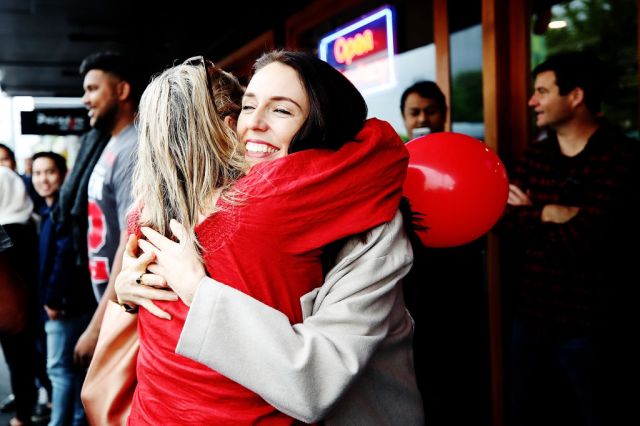
Millennial role model Jacinda Ardern. Hannah Peters/Getty Images





Today, any politician interacting spontaneously with the public has one thing in mind: look normal. Don’t be weird, don’t be snobbish. Don’t look like a freak when you eat your bacon sandwich. All these things are at least as important as your beliefs.
We are a long way from the stiff-lipped loftiness of political eras past — particularly if you happen to be a woman, in which case you must now try your darndest to impress on the electorate that you are a “human”. How better to sugar the pill of making difficult decisions than to give voters behind-the-scenes access to your hopes, dreams and struggles with breastfeeding? Without these essential insights, we might think you’re slashing public services just to be mean. A century after women entered Parliament, half the battle seems to be an interminable task of identifying with the electorate.
This has been the approach, since the beginning of her political career, of the former leader of New Zealand. A flattering new documentary about Jacinda Ardern, Prime Minister, out in UK cinemas on Friday, does this relating thing relentlessly for nearly two hours. It succeeded enough to scoop a Sundance award and earn plaudits from reviewers for its “tender” portrayal of Ardern’s time in office and beyond: the slings and arrows of the electoral battles, volcanic eruptions, terror attacks and the Covid pandemic — plus the small matter of having a baby. Much of the footage is shot by her now husband Clarke Gayford, who captures her looking exhausted in various locales — bed, a taxi, an office. When Ardern announces her pregnancy, she starts by derpily telling the snappers outside her front door: “Well, this is normal!” She brings said baby to the UN General Assembly, and she cries to Crowded House in the final scene.
In one early clip, Ardern snaps back at snarky reporters who asked, before her precipitous rise to the top of national politics, whether she could lead a government at the age of 37. “Would you like to tell me why you don’t think I can?” Girlboss alert! When she wins, the moment is set to the strains of New Zealand’s most authentic daughter, Lorde (who has also perfected the art of the public personal struggle). After resigning in 2023, Ardern becomes a fellow at Harvard and marauds Massachusetts armed with a coffee, dangly earrings swaying. As if to explain the existence of this film, she tells seminars “we have to rehumanize one another again”. She also tells the UN that politics must start on a foundation of “kindness”, whatever that means.
Rarely, if ever, are Ardern’s political decisions critiqued. This is a film about and for her, nevertheless its claims about her tenure are not explained or tested, heard only out of her mouth or those of fuming protesters. We hear, for example, that she “lifted” children out of poverty; we hear that her election-winning strategy, cobbled together seven weeks before polls opened due to the sudden resignation of Labour leader Andrew Little, consisted only of being “myself”. The viewer is asked to accept sentimentality in place of rigor. It is almost impossible to imagine a man asking the same. “I am human. Politicians are human,” Ardern says. When’s the last time you heard a bloke make that appeal? Why, then, must women?
Of course, as the story unfolds there are moments of delicious irony. Gayford snaffles Ardern’s favorite “pregnancy biscuits”, which are fortified to help women prepare for breastfeeding; in the dim light of the family kitchen Ardern teases him “are you worried about your lactation?”. How ridiculous that a man could lactate, right? But beyond those four walls, where throwaway jokes speak to sanity and reality, Ardern promoted gender politics where male breastfeeding would not be ridiculous at all. Her government conscientiously promoted self-ID. She removed the cap on how many gender-affirming surgeries the public could be expected to pay for. She introduced a sweeping ban on conversion therapy, heedless of the chilling effect on clinical or therapeutic caution. She also backed Laurel Hubbard’s selection to represent New Zealand in women’s weightlifting at the Tokyo Olympics. Hubbard is over six foot tall and a man. So why is the idea of a man breastfeeding so funny? It’s his human right.
Trading off political coherence with tenderness, humanity or the like is not a good deal, for the viewer or the voter. The fact is that those in high office are not just like us: they have immense power and bulging portfolios, and face relentless pressure from a public poised to despise them. They have armies of advisors, drivers and aides. They don’t go to supermarkets. If they go to the pub, it is to a private room — or else in the presence of a bank of photographers yearning to snap foam on the leader’s lip. It is a politician’s privilege to be more important and more lucky than most of her constituents. The perks of power — chauffeurs, caterers, the rare ability to afford childcare — ensure a government has no excuse but to do a good job. These public-funded luxuries allow us to hold leaders to higher standards. I don’t want “one of us” to hold the nuclear codes: this person must be exceptional.
So why is “rehumanizing” such a high priority for the political class today? The Left is withstanding a positive epidemic of relatability. Everywhere we look, our elected officials are stooping to our level to pinch our cheeks; it’s grimly undignified for all involved. Britain’s Prime Minister, flanked by his dour Education Secretary, is flailing his hands in a mimed juggling motion in a Peterborough primary school: “Everybody, six-seven,” Starmer bleats in desperation, like a sheep wedged in a ditch. Our Chancellor, to fend off backlash before a Budget which snatches thin gruel from young Brits to further fatten plump pensioners, gives interviews to national newspapers in which she complains about “mansplaining” from her critics. Any appraisal of Rachel Reeves’s policy, the comment suggested, was personal, sexist and unjust.
In fairness, the Times interview which drew so much ire did include some professionalism: urged by the reporter to talk about “my recipe for Yorkshire puddings or what really made me cry” (at the dispatch box in July), Reeves counters that “people don’t want to read about [that]”. She wanted to show them, instead, “that they can trust me with their money”; “I’m not a public personality. I’m not in showbusiness. I’m the chancellor.” Quite right, Rachel! Reintroducing a frosty remoteness to public office would lend politics, and in particular this beleaguered Chancellor, some “headroom” to get on with the job — a little personal distance would go a long way. A shame, then, that in order to drive this point home Reeves continued: “I’m a mom with two kids. I’m a wife and a daughter. I wasn’t born into this and I’m just trying to do my best.”
Oh, as long as you’re trying your best! Whoever the public elects, man or woman, should be effective enough not to have to constantly appeal to their humanness and vulnerability. Situating the struggles of being a female politician in particular within the compensatory context of family life is a dire and regressive technique; were it Richard Reeves we were dealing with, we would never expect him to sweeten the pot of debilitating tax rises by reminding us that he is “a son”. The entire performance of relatability, endemic in contemporary politics, smacks of a hostage looking a gunman in the eye to stop him shooting: when women do it, what it reveals is not that these are exceptional operators who do it all and want us to bloody well know it, but that these are women scared of the public and insecure in their positions. In this, the vitriolic and often violent electorate is also to blame.
For schoolgirls following the tenure of the first female British chancellor, or the Millennial role model Jacinda Ardern, or indeed any number of Labour women — Jess Phillips, Stella Creasy, Angela Rayner — who constantly appeal to their inspirational stories of personal strife, the message is not that women can do anything. It’s that if you insist on doing it, you must also constantly roleplay apologetic femininity. How often do we hear these women speak about “imposter syndrome” — about how lucky they are to be there at all? The logic is that this framing excuses a shoddy job, or ideological lameness, or media mistakes. Male politicians, particularly white ones, almost never retreat to aspirational stories about their boyhood ambitions because they don’t have to explain why they’re there. Women do not either. To restore some of politics’ prestige and mystique, we must insist on a new contract with the public: seriousness, distance and inscrutability in exchange for a baseline of respect.
