




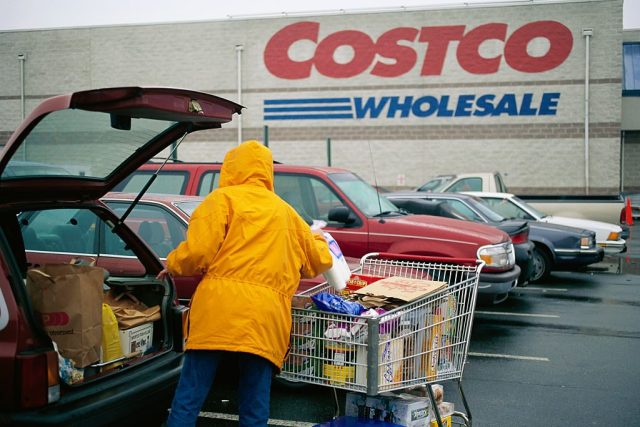
'One can only carry so many 5kg blocks of cheddar.' Mark Peterson/Corbis /Getty Images




In a Croydon car park, an aerospace professional is brandishing an enormous side of raw salmon. Where else, he asks, could you buy something like this? Where could you find such size and quality? The salmon, I must admit, is gloriously pink. The man has taken it from a shopping cart the size of a small bathtub, which he is emptying into the trunk of his car. It is like watching an epicurean prepare for the apocalypse. Behind us in the gray dusk looms the gigantic metal shed which divulged this bounty: Costco, an American wholesaler that is luring British shoppers away from traditional supermarkets and high streets.
My interviewee is explaining Costco’s appeal. It’s convenient: everything is in one place, and since you have to buy in bulk, you don’t need to come often (the store is meant to supply small businesses, though everyone I talk to here is shopping for personal consumption). Then there are the deals: even for electronics, it often has the best prices and warranties. It all sounds like a perfect exercise in prudence, getting the most out of your time and money. Except, did he really mean to buy all of this? Does he really need quite so much salmon? “That is the drawback,” the man says ruefully. “You see things as you walk around, and you end up spending a lot. I came here just to buy some chicken, some meat, and I’ve just spent £360.” I point to a pair of olive-green chinos recently added to the trunk. “They’re nice,” he objects. “I thought I could wear them for work.”
It is not the only time I will hear such a tale of accidental indulgence. In fact, it almost becomes a running joke during my afternoon at Costco. Everyone says they are here to save money, before acknowledging that they treated themselves to something they couldn’t resist. “The problem is you get carried away,” says an elderly woman who comes with her neighbor to stock up. A builder eating pizza in his van tells me, as though I’m an idiot for asking, “it’s cheaper. You buy in bulk.” Then I raise the matter of spontaneous purchases, and he goes quiet. “Yeah, that does happen,” his friend chimes in. One man who complained of being broke was nonetheless leaving with a liter of Jack Daniels and a crate of Nigerian Guinness. These were, he assures me, excellent value for money.
Costco has, it seems, cracked the secret of selling to a population which is increasingly concerned with belt-tightening, as living standards are ground down by taxes and inflation. It lures people in with the prospect of cheap stuff in large quantities, and then overwhelms them with temptation. And frankly, there is such insane abundance here that I struggle to believe anyone could avoid this trap. Fancy three liters of vodka in a glass skull? Australian abalones? A “giant treat tower” comprising “3kg of festive treats”? And while you’re here, what about a 10-player poker table, or an oriental rug?
Everything about Costco is big: the stores, the products, and the money. It is currently the third-largest retailer in the world by revenue, behind only Walmart and Amazon. Much of its success comes from its membership model, whereby you pay £42 annually to access its stores (or £30 if you run a business), allowing it to operate with smaller margins on its products. The company came to Britain in 1993, a decade after it first opened in the United States, and has been steadily expanding since. Long ago, when my parents first got hooked, they made pilgrimages to Costco in Watford two or three times a year, but with each decade another branch has opened closer to home. There are currently 29 stores in Britain, and more than a dozen new ones at various stages of planning and construction. Last year, Costco managed sales worth £5.3 billion in the UK, almost double its turnover in 2019.
Croydon offers some insight into this success. Occupying a liminal zone where London bleeds into Surrey, people of every conceivable class and background live or work around here, from gilet-wearing rugby dads to African Muslims, from civil servants to white-van men. And despite the fact that Costco officially restricts its memberships to individuals from certain occupations, I found virtually all of these groups shopping there.
It is safe to say that few people approach this place on foot — one can only carry so many five-kilo blocks of cheddar — but doing so is revealing, if you want to see the hinterlands where retail is migrating. The Croydon Costco, a rectangular fortress, is nestled among acres of dual carriageway and brick warehouses, school sports fields and self-storage facilities. Around the corner is the surreal Grand Sapphire “Hotel and Banqueting” venue, essentially a Travelodge with lots of neoclassical columns and pediments tacked onto it. This masterpiece of banality, I later learn, was due to host a Reform UK Christmas party, but pulled out after a campaign of complaints.
We are a long way from the reassuringly suburban forms of the Tesco, Asda or Marks & Spencer superstore, with their gabled roofs and detailed taxonomy of class signifiers (cheese and onion or cheddar and chive?). These remain a familiar setting for British life, but their position is being steadily eroded by the rise of warehouse shopping. Whereas the traditional supermarkets still gesture towards the ideal of the friendly local community of shops (which they in reality replaced), hiding their brutal efficiency behind a chatty marketing style and an emphasis on British produce, their challengers cut the frills and let the prices speak for themselves. Ikea’s giant edge-of-town warehouse-stores were pioneering in this regard, teaching the middle classes to swallow their pretenses for the sake of a bargain. Lidl and Aldi brought the warehouse onto the high street, their chintzy copycat branding made more palatable by the ravages of inflation. With Costco, the trend approaches its zenith. Retail collapses into logistics and infrastructure; architecturally, Costco stores are cousins of the data center and the Amazon fulfillment hub.
Look at the trolleys leaving Costco and you will see plenty of evidence of our straightened economic times. The company’s obvious audience in Britain are the comfortable but concerned; natural denizens of the M&S food hall who have been driven in search of bargains by the high cost of everything, and who have the current account balance and the cupboard space to buy several months’ worth of cashew nuts at once. According to market researchers, high earners are more likely to shop at Costco. But most of the shoppers I see at the Croydon store are not in this category. Unlike that gentleman with the green chinos, they cannot spend several hundred pounds on a whim. Rather, many have come to stock up on a small number of products — one family appears to be living off Yazoo milkshakes and tins of baked beans — even if they pick up a few treats along the way. The most common items appear to be toilet paper, laundry detergent, and above all, crates of bottled drinking water. (The people of South London, it seems, do not trust what comes out of their taps. I’m not sure why, though one young woman, a nurse, describes herself as “prone to typhoid”.) No doubt some Costco members like the idea that they have hacked grocery shopping by going wholesale.
Still, we have by no means entered an era of Gradgrindian retail, where enjoyment counts for nothing and all that matters are the numbers on the sticker. At Costco, the sheer volume and variety of products creates its own kind of pornographic spectacle, which is only heightened by the lack of ceremony. Add some promotional giveaways and an in-store canteen, and you get something like an experience. I have barely arrived when I find myself looking at a case of diamond jewelry — placed near the door, along with the fancy perfumes, for Christmas — trying not to think about what I paid for my wife’s engagement ring. Moments later, I am sampling coffee from a ludicrously discounted espresso machine, joking with two ladies in headscarves and their trolley full of young infants. With the aisles stretching ahead of us, there is a sense of anticipation almost like the start of a big night out. I later manage to sample a steak, a chicken Kiev, and a tot of Panamanian rum. I wasn’t planning on buying anything, but by the time I reach the vats of olive oil my resistance is broken and I fetch a trolley.
After 45 minutes in the store, my theory of Costco has changed. I no longer think that people are being seduced into spending more than they wanted to; I suspect that, on some level, they come here to be seduced. The genius of warehouse retail is that it makes shoppers feel like they are behaving as purely rational economic agents, which seems like the responsible way to act when money is scarce. In truth, they are engaging in a kind of leisure, enjoying the chance to browse, fantasize, and buy things that they believe they probably shouldn’t. This is not without social and political significance. It suggests that, for all the manifest anger and unhappiness at our system today, a major plank of capitalist society — the desire to possess and to enjoy commodities — remains firmly in place. On the evidence of Croydon, American-style supersized consumerism is probably a more unifying cultural force in modern Britain than the vague British values which people are always trying to formulate.
Leaving the store, I join a chaotic queue of trolleys as it converges on a handful of overworked cashiers, frantically sifting through the mountains of goods with their barcode scanners. My turn comes and it turns out I’ve managed to spend £100. I check my receipt in disbelief, convinced there is a mistake. Is this actually saving me money? Probably not. Do I regret it? Not really.
Wessie du Toit writes about culture, design and ideas. His Substack is The Pathos of Things.
 wessiedutoit
Join the discussion
Join like minded readers that support our journalism by becoming a paid subscriber
To join the discussion in the comments, become a paid subscriber.
Join like minded readers that support our journalism, read unlimited articles and enjoy other subscriber-only benefits.
Subscribe