




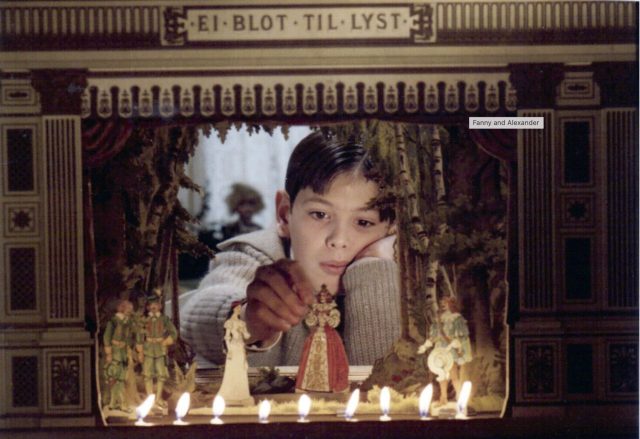
The best European Christmas movie. Credit: ingmarbergman.se




The best Christmas movies encode something deep about our aspirations and drives as a civilization, and the psychology and meaning of family. It’s a Wonderful Life is the best American Christmas movie because it crystallizes something about the relationship between family, Christianity, tradition, and free enterprise in American life. The best European Christmas movie, meanwhile, is part one of Ingmar Bergman’s Fanny and Alexander, which appeared in theaters in 1983, adapted from a longer Swedish television version. Otherwise utterly different from Frank Capra’s American masterpiece, Fanny and Alexander also tells us about the magical world of the late 19th century, and the self-enclosed, miraculous space of the bourgeois family.
Set in Uppsala, Sweden the film follows the sprawling Ekdahl family through the eyes of 10-year-old Alexander (Bertil Guve) and his younger sister Fanny (Pernilla Allwin). Their father, the bohemian Oscar (Allan Edwall) runs a charming, ramshackle family theater; their grandmother Helena (Gunn Wållgren), the family matriarch, presides over lavish dinners and her son’s productions, while entertaining the discreet presence of her lover, the Jewish art dealer Isak Jacobi (Erland Josephson). The first part the film, which I’m concerned with here, shows us the course of Christmas Eve, from dawn to early morning Christmas Day: meal preparation, rehearsal at the theater (including a moving speech by Oscar), the arrival of the extended Ekdahl family, Christmas dinner (toasts, jokes, songs), coffee and gossip for the adults while the children pretend to fall asleep.
Fanny and Alexander is Bergman’s last major film (he continued directing for the stage and television), and it inverts much of what we think of as Bergman-esque. It is shot in vivid color, and part one especially does not show us the psychological and spiritual torsion produced by an unbearable, isolating modernity (think, most famously perhaps, Persona); instead it offers a cozy, loving (albeit imperfect) family ecology in which Christmas, through ritual and tradition, is the center of the energy and spirit of the Ekdahl clan.
Bergman’s nostalgic but still realistic depiction of what Christmas looked like without electronic technology — and, by extension, without the constant overhang of global anxieties, global threats, and globalized media culture — returns the focus to the house and the family. The family is most relevant to us because of its anti-relevance, because it’s so alien to our own sensibilities. The long takes with depth of field, overlapping dialog, motion, and frames crowded with fabric, wood, candlelight, food, color, highlight the importance of the home during long, snowy Nordic winters, and display the plenitude of bourgeois life and the humanistic warmth of the Ekdahl family.
This theatrical Christmas, as the camera shows, flows throughout the entire house: bedrooms, servants’ quarters, kitchens, drawing rooms, dining rooms. We hear the jingle of sleigh bells outside. Even though the world of adults that young Alexander encounters is lurid, deceptive, and in some cases embittered (Bergman rarely idealizes), the wider field of family is soulful and alive. The warmth of tradition overrides the neurotic contradictions of the everyday bourgeois world.
Bergman’s convincing recreation of the late 19th century or early 20th century household appeals to us because it shows us what Christmas was before mass media, and indeed before Christmas movies themselves. The irony of Fanny and Alexander is that it exists before cinema, or it takes place before cinema was created. Because movies haven’t been invented yet, Alexander must rely on watching a magic lantern projected against his bedroom wall; in 1900, life itself was the Christmas movie.
Bergman’s message is ambivalently bound up in his medium. Many of the best Christmas movies, in other words, are acts of mourning, which locate moments when some bit of cultural innocence or candor, exuberance, and intensity were shed in exchange for something more efficient. Though shot in the early 1980s, Fanny and Alexander represent the world of yesterday. There is something of a straight line from it to American Christmas movies of the ’80s and ’90s, which are almost entirely about the tragicomedy of small nuclear households trying to survive the absurdity of maintaining Christmas traditions and getting everyone the gifts they want (Home Alone, Jingle All the Way, The Santa Clause, Christmas With the Kranks).
Fanny and Alexander is almost unbearably moving because of the intergenerational tenderness and care displayed by the extended family in the film. The domestic arrangements of Bergman’s masterpiece seems much further away from us even than the idealized nuclear family in It’s a Wonderful Life, and certainly from the screen-alienated modern family. Here, young Alexander Ekdahl, the son of a man of the theater (who later in the film dies of a heart attack), experiences Christmas at home as a dense maze of conversations, games, song, and hijinks late into the night. Family life is a multi-generational web; his experience of a single night is rooted in centuries of Christmases and of Ekdahls.
Christmas movies show us how families respond to pressure, and how families recover from the pressures and torments of ordinary life. They are idealized on the whole, because the larger thrust of Christmas is in the direction of charity, forgiveness, and communion, both secular and sacred. Audiences in the ’80s watching Bergman’s film knew that the bourgeois world ended and had to end, and watching the movie again in our decade, in our new century, we also know that the bourgeois world ended and had to end.
Christmas movies are compensation. We have them because we can no longer have the past. That, I think, is inarguable. But I also think we can look at Christmas movies as codes or scripts or algorithms, in a sense, which we can use to reprogram our lives, borrowing from them to restore both material and spiritual vital components.
What strikes me maybe most about rewatching Fanny and Alexander in 2025, on the cusp of 2026, is how much the actual material costs of having a 19th-century Christmas have fallen; if we wanted to, Christmas could be something like this: convivial, screen-free, humane, sacred and profane at once. The obvious critique of the 19th-century Christmas is that it would have only been available to a few, or a smaller section of society (maybe 20% or 30% of society in 1900). Candlelight, singing, food from farms, children, big families, people of all ages gathering together: none of these things are beyond the means of the average household in 2025, only beyond our imaginations.
So there it is: the uncomfortable irony of Bergman’s classic. The world of today does not use its resources very well. And Christmas is not a celebration of the plenitude and solidity of the well-appointed household, but an insane and alienated striving after stuff and entertainment, in which the last days of December provide considerably less solace, joy, and closeness than they used to.
It might be the case that we are at the point in our civilization where Christmas is a broken technology that we no longer know how to use. Movies or novels — think Dickens, for instance — contain records of how that technology used to work. And I would suggest that we might allow ourselves to be romantic enough to try to learn again what Christmas was, motivated by the depressing contrast with what it is.

Join the discussion
Join like minded readers that support our journalism by becoming a paid subscriber
To join the discussion in the comments, become a paid subscriber.
Join like minded readers that support our journalism, read unlimited articles and enjoy other subscriber-only benefits.
Subscribe