




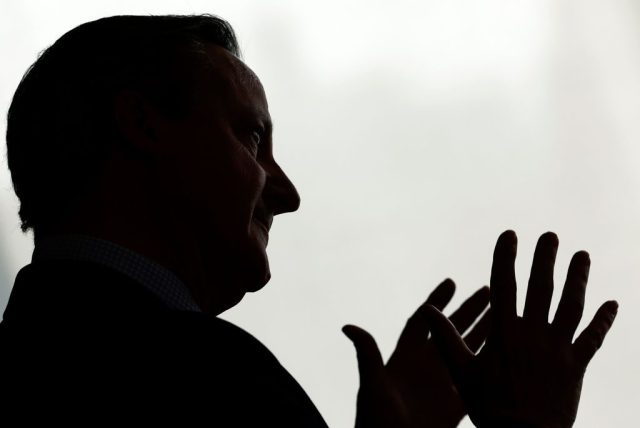
Cameron: a practical Euroskeptic. (Credit: Benjamin Cremel-WPA Pool/Getty)





You are no one in British politics if you haven’t been Cockerelled — or so they say in Westminster. Michael Cockerell, reporter and documentary-maker, has spent 50 years poking around behind the scenes of our political system, charting the trajectories of so many political figures. One man whose career he followed particularly closely from the start is David Cameron — who became leader of the Conservatives 20 years ago today. As prime minister, Cameron dragged his party into the 21st century and his country out of Europe. Here, Cockerell assesses the man who described himself as a “political decathlete”.
* * *
Over the five past decades, I have asked a series of ambitious political leaders the same question: “Do you have any doubts about your ability to fill the role of Prime Minister?”
All but one of them admitted to having qualms: David Cameron. It was exactly two decades ago, and the 39-year old had just been elected Tory Leader. “If I had any doubts,” said Cameron, “I wouldn’t have put myself forward to lead our party in the first place. You have to be absolutely ready to take the difficult and big decisions – including sending troops to war. And I decided I was ready for that.”
Described by his wife, Samantha, as “the most glass-half-full person in the world”, Cameron will go down in history as the man who took Britain out of the EU. But there is much more to him than his role as the accidental Brexiteer.
Like nearly half of Britain’s Prime Ministers, Cameron was educated at Eton — where he did not distinguish himself and might well have been expelled for smoking cannabis. But he slipped the noose. At Oxford he was elected to join the notorious Bullingdon Club. “When I look at the photograph of our group of appallingly over self-confident sons of privilege,” said Cameron later. “I cringe. It’s cripplingly embarrassing. The Bullingdon has haunted me for most of my political life.”
Despite the hijinks, Cameron managed to get a First in PPE, much to the chagrin of his Eton and Oxford contemporary, Boris Johnson, who only achieved a 2:1 in classics. The two men were to have a prolonged love-hate relationship for years to come. As schoolboys, both had declared they wanted to become Prime Minister, although Johnson upped the ante by saying he also sought to be World King.
When Cameron came down from Oxford, he joined the political finishing school of Conservative Central Office. He was snapped up to become a Spad, working to polish the image of top Tory Cabinet ministers, then left to take a job at the media company Carlton TV, where he became head of communications from 1994-2001.
After failing to win a Tory seat in the Blair landslide of 1997, Cameron watched with growing admiration the presentational skills of the New Labour troika of Tony Blair, Alastair Campbell and Peter Mandelson. When he did finally become a Tory MP in 2001, he privately proclaimed he was “the Heir to Blair”. When elected Conservative leader four years later, Cameron sought to detoxify the Tory “Nasty Party” brand. He wanted to create a party in his own image. The New Conservatives would be modern, diverse, caring and environmentally aware. On his debut at PMQs as the new Leader of Opposition, he said to the Prime Minister Tony Blair: “I want to talk about the future, after all he was the future once.” A year later, he drove a sleigh in the Arctic pulled by snow-white huskies. His new slogan was: “Vote Blue, Get Green” — swiftly lampooned as “Hug a Husky”.
When Cameron fought his first general election as Tory leader in 2010, he feared the result would be a hung parliament. He privately asked the German Chancellor Angela Merkel, who was accustomed to coalitions, how they worked. She summed it up succinctly: “Well, David, the way it works is that if things go well, then the big party gets the credit — and if they go badly, the small party gets the blame.” “Sounds a good idea to me,” responded Cameron.
As PM, Cameron invited Merkel to Chequers. One summer evening they were watching the sun go down over the Chiltern Hills, an area of outstanding natural beauty, and Cameron joked: “Just think Angela, if things had turned out differently in the Forties all this could have been yours.” Merkel laughed out loud; the Germans do have a sense of humour.
At that time, after years of trying, I had been given access to make a fly-on-the wall series, Inside the Commons, filming in areas where TV cameras were normally strictly verboten. In his grand wood-panelled Westminster office, I asked the PM how he rated the Commons as an institution. “You do feel a real sense of history in this place,” he said. “It’s half like a museum, half like a church and half like a school.” Clearly an unusual school where three halves make a whole. When I asked Cameron what he thought of Prime Minister’s Questions, he replied: “There isn’t a Wednesday where you don’t feel total fear and trepidation about what is going to happen. I am normally sitting here preparing for PMQs and about five minutes beforehand you think: ‘Oh no, have I got to do this again?’”
He admitted that each week, one of his staff would email Tory backbenchers a list of questions that the PM would like to be asked. When I suggested that this made a mockery of PMQs, Cameron said: “If you’re saying it’s appalling, I would say that politics is about the team putting across team messages. So people shouldn’t be too worried about that happening in PMQs.” He saw himself, he said, as “a political decathlete, switching from one discipline to the next trying to give every single one of them my best”.
But the subject the PM found the most problematic was Britain’s relationship with the EU. He had promised when he became leader that the Tories would: “Stop banging on about Europe.” But he was up against his own party becoming increasingly pro-Brexit — and he was also up against Nigel Farage, whose UKIP party was making dramatic gains at the ballot box. Seeking to pooh-pooh the pretenders, Cameron said: “UKIP is sort of a bunch of fruitcakes and loonies and closet racists.” But Farage seized on Cameron’s words as proof that the political elite despised ordinary Britons who were concerned about the EU and immigration. In speeches, interviews and rallies, Farage sardonically used the PM’s description of Ukippers as a badge of honour.
Cameron told me he saw himself as “a practical Eurosceptic” who wanted to stay in a reformed EU. He decided to hold an in-out Referendum which he was confident of winning. The two people he most wanted campaigning for the Remain side were his very close friend Michael Gove and his fellow Bullingdon man, Boris Johnson. But Gove was playing a slippery game and refusing to commit himself. Cameron sent Gove a text saying: “You must realise I divide the world into team players and wankers. You’ve always been a team player, please don’t become a wanker.” Gove admitted he was moving towards Leave, but he promised Cameron: “If I do decide to opt for Brexit, I will make one speech. That will be it. I will play no further part in the campaign.”
This was the opposite of what Gove actually did when he became full-time leader of the Leavers. Failing to land Gove made Cameron all the more determined to bag Boris. The PM had long envied Johnson’s charisma and campaigning skills. But Johnson was keeping his powder dry. On 17 February 2016, as Cameron prepared to announce the date and details of the Referendum, Johnson went to see Cameron in his study at No. 10. The PM told Johnson that if he agreed to campaign for Remain: “You can have a senior role to play after the referendum. I am offering you any post you want in the government – except the top one.” Johnson said he would think about it and they should stay in touch.
Ten days later, Johnson pinged Cameron a text saying: “I have been a tortured soul, but I have to go with my heart and support Leave.” But, then, barely two hours later, a fresh text from Johnson appeared on Cameron’s device saying “depression is setting in” — that he was “dithering” and might change his mind and back Remain after all. The following day, Johnson messaged the PM yet again, saying that he could not look at himself in the mirror if he campaigned to Remain. Cameron said publicly he was “disappointed” by Johnson’s decision. That was putting it mildly. The word I got from No. 10 was: “The fury here is uncontrollable.”
The Referendum campaign coincided with a record number of illegal immigrants trekking across Europe and crossing the Channel in small boats to come to Britain. Film of their arrival on BBC, ITV and Sky inadvertently resembled a daily party political broadcast for the Leavers. It chimed with the simple message from Johnson and Gove: “Take Back Control”.
Cameron accused the Leavers of “resorting to total untruths to con people into taking a leap in the dark”. He authorised a poster showing Johnson rolling the dice, Gove drinking whiskey and Nigel Farage smoking cigars in a casino together with the slogan: “Don’t let them gamble on your future.” Cameron later said: “The campaign turned into this terrible Tory psychodrama and I couldn’t seem to get through to people. It was like one of those dreams where you’re trying to shout but no sound is coming out.” And he continued: “Johnson and Gove have behaved appallingly — attacking their own government and the pair seemed to be different people by the end of the Referendum. Gove, the liberal-minded, carefully-considered Conservative intellectual, had become a foam-flecked Faragist warning that the entire Turkish population was about to come to Britain.”
In the early morning of 24 June, the PM threw in the towel. The Leavers had won by 52 to 48%. On the steps of No. 10, a shell-shocked Cameron announced his resignation as Prime Minister saying: “The will of the British people is an instruction that must be delivered.” But he was not the man to do it.
Johnson left it for a few hours after the resignation and then texted Cameron: “Dave, I am so sorry to have been out of touch but I couldn’t think of what to say and now I am absolutely miserable about your decision. You have been a superb PM and leader and your country owes you eternally.” Boris’s 18-year-old nephew, Oliver, felt different. He told his mother Rachel: “Uncle Boris has just stolen our future.”
For many months after the Referendum result, Cameron would say: “not a day goes past without me feeling haunted by the demons of Brexit that were unleashed”. So does the ex-PM now wish he hadn’t called a Referendum? “If you are asking me do I have regrets — yes. Am I sorry about the state the country has got into — yes. Do I feel some responsibility for that — yes.” In another interview, he said: “It was my Referendum, my campaign, my decision to try and renegotiate with the EU. I accept all of those things and people will have to decide how much blame to put on me.”
Privately, however, Cameron was less self-culpatory. “Boris ruined my bloody career,” he told the former Europe Minister, Sir Alan Duncan, at a private breakfast. I watched Cameron at his final PMQs, in front of a packed House. He produced a bravura last hurrah: self-assured, witty and sometimes poignant. “I have done a bit of research, Mr Speaker,” said the PM. “I have addressed five thousand five hundred questions from this Despatch Box. I’ll leave it to others to work out how many I have actually answered.”
Riding the mixed cheers and jeers, the departing Prime Minister said: “I will miss the roar of the crowds — I will miss the barbs of the Opposition. And the last thing I’d say is that you can achieve a lot of things in politics, you can get a lot of things done. Nothing is really impossible, if you put your mind to it. After all, as I once said: ‘I was the future once.’” Twenty years on, Cameron and Britain are still deciding how much blame he deserves for the future he delivered.