




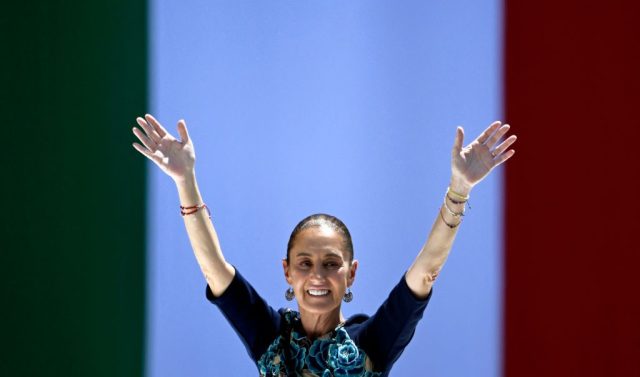
Has Donald met his match? Alfredo Estrella/AFP via Getty.




“I have great respect for the president, a woman that I think is a tremendous woman,” Donald Trump said of Mexico’s president Claudia Sheinbaum in October. A year earlier, he announced he would hit Mexico with a 30% tariff on goods. Yet while other world leaders facing similarly high rates floundered, Sheinbaum has received praise for negotiating the threat of tariffs without substantial concessions. Even so, what has puzzled some is that a Leftist president has been able to establish the semblance of a working relationship with a neighboring hostile administration.
To understand Claudia Sheinbaum’s place in Mexican politics, one must first situate her government, party, and movement within the broader landscape of the Mexican Left. Sheinbaum’s party Morena represents the electoral Left and the broader phenomenon of “Obradorismo”, named after Mexico’s former president, Andrés Manuel López Obrador. “Obradorismo” is a political movement motivated by state developmentalism and committed to pursuing the interests of the working classes and the poor through democratic means. While a certain sense of class interest animates the project, this does not entail outright confrontation with capital, but a conviction that class interests must be harmonized, and that the state must be re-legitimized as the central social actor capable of carrying out its aims. In essence, Morena represents an effort to construct a post-neoliberal social pact, one predicated on returning class politics to the mainstream political arena, and re-invigorating the state.
But what about other factions of the Mexican Left? One crucial distinction is between the electoral Left and what might be termed the autonomist Left, which operates as an informal social movement rather than organizing under a formal party structure. More fundamentally, it rejects state power outright. The most celebrated example of the autonomist Left is the Zapatista movement in the state of Chiapas, which has pursued autonomous communal power — a form of local self-government that explicitly refuses incorporation into any broader national project. But the Zapatistas are not the only ones. Similar orientations can be found in movements such as the self-defense units in Cherán in the western state of Michoacán, where residents have for years taken up arms to protect their communities from drug cartels while simultaneously rejecting the state’s role in security provision, seeing it as complicit with organized crime. These communities have famously expelled all political parties from their territory.
The autonomist Left also has an urban branch, though the term “branch” might overstate the degree of coordination between rural and urban variants. What unites them is a negative view of the state. What separates them is their social composition and the structural basis of their politics. The rural autonomist Left’s skepticism toward the state is materially grounded. They have historically experienced the state as an external intervention. The term “community” in this context carries real meaning: it refers to specific forms of collective land tenure and self-governance, often institutionalized through the legal category of usos y costumbres (“customs and traditions”), which grants certain communities the right to govern according to traditional practices, such as decision-making governing assemblies instead of elected delegates. Even where communities fall outside this formal category, the historical lineage of communal organization provides a material foundation for their political orientation. This structural position explains, for instance, the opposition of certain communities to developmentalist projects like the Tren Maya, where questions arose about who constitutes the relevant political unit for consultation. Individual residents as in a liberal democratic model? Or communal representatives as in a corporatist one?
The urban autonomist Left, by contrast, lacks this structural grounding. Cosmopolitan progressives with small social bases adopt the language of social movements and civil society while remaining numerically marginal and primarily active in intellectual circles. At its best, it draws on anarchist ideals and sophisticated critiques of the bourgeois state as the node organizing capital. More commonly, however, it is characterized by its “Brahmin Left” dispositions: highly educated, credentialed, invested in cultural capital, oriented toward, for lack of a better term, identity politics.
Morena and the electoral Left emerge from an entirely different historical trajectory. The party can be credibly traced to a split from the Institutional Revolutionary Party (PRI) in the Eighties. The PRI had governed Mexico for over 70 years, institutionalizing the Mexican Revolution and carrying out Keynesian welfare-state projects from the Thirties through to the Seventies. While the party contained a broad ideological spectrum, it was sometimes a contradictory mix of Mexican Cold War anti-communist and national state developmentalism. This began to change in the Seventies and accelerated in the Eighties, as a neoliberal wing became dominant within the party. In reaction, the nationalist wing broke away in the mid-Eighties, forming the party that would contest the 1988 elections and eventually consolidate into the Party of the Democratic Revolution (PRD).
The political career of Sheinbaum’s predecessor and political mentor, President Andrés Manuel López Obrador, otherwise known as AMLO, traverses this history. He began in the PRI in Tabasco, joined the Eighties splinter-faction, and became a founding member of the PRD, with which he won the mayoralty of Mexico City in 2000. What makes AMLO difficult to categorize for both domestic and international observers is precisely this trajectory: he does not come from the socialist or social democratic Left as his European counterparts might; he does not emerge from militant union leadership like Lula in Brazil or Evo Morales in Bolivia; he was not formed in the rural or urban guerrilla movements of the Seventies like Mujica in Uruguay, Dilma Rousseff in Brazil, or Petro in Colombia. Instead, he comes from the nationalist, developmentalist wing of the PRI — a Left that operated within the paradigm of the Keynesian welfare state and never let go.
Sheinbaum’s own trajectory intersects with this lineage while adding distinctive elements. An academic by training, with a career in energy engineering and climate studies, her first entry into high-level politics came when AMLO appointed her Minister of Environment during his tenure as Mexico City mayor. Earlier, she had been involved in student movements focused on resisting the privatization of higher education — movements with significant ties to the emerging PRD. Sheinbaum thus shares certain affinities with the urban progressive Left in her background, yet she was politically formed within “Obradorismo”. This duality has proven advantageous in her first year in office, allowing her to retain AMLO’s base while recapturing sectors of the professional classes that had drifted from the Left coalition.
Situating Morena within the broader Latin American context requires attention to Mexico’s peculiar timing. The Pink Tide of progressive governments that swept Latin America beginning in the late Nineties never reached Mexico during its height. The conventional explanation for the Pink Tide emphasizes the conjuncture of democratization — the famous third wave — with the growing inequality and lackluster growth produced by neoliberalism. Mexico possessed these same conditions: democratization following PRI rule, poverty and inequality caused by neoliberalism. Yet the electoral Left repeatedly failed, with three consecutive center-right governments taking power after 2000.
This anomaly can be explained, ironically, by the PRI’s own legacy. The electoral Left in Mexico developed without a social base of its own because the PRI had already organized and neutralized what would theoretically constitute the Left’s natural constituency. Through patronage, clientelism, and a combination of carrots and sticks, the PRI had captured the working classes within its own corporatist structures. The PRD therefore faced the more difficult task of contesting an already-organized social base against an established hegemon, rather than simply mobilizing an available constituency. Only as neoliberalism eroded the material basis for the PRI’s clientelist networks did these social blocs become available for rearticulation.
There are also important structural differences between Morena and the earlier Pink Tide governments. The first wave governed during a period of extraordinary economic growth, particularly tied to the commodity boom in Brazil, Bolivia, and Venezuela. Sheinbaum, by contrast, comes to power after years of lackluster growth that estimates indicate is likely to continue. This means that the basis of legitimacy of the project must rest on a continued redistributive management of the existing “pie”. It is therefore all the more remarkable that despite these disarticulated working classes, a dilapidated state, the Covid pandemic, and subsequent inflationary pressures, the Obrador administration managed to increase real wages by 30%, lower poverty by 13%, and shift the balance between labor and capital’s share of income by 8% in favor of workers.
Moreover, Mexico’s integration into the global economy differs fundamentally: 20-plus years of NAFTA have restructured the economy entirely, dilapidating the countryside and national industry, and converting the country into a cheap foreign manufacturing center and import economy. Between 40 and 60% of Mexicans work in the informal sector, primarily in services and retail rather than production. The government’s relationship with NAFTA has been ambivalent — defending and legitimizing it while using it as leverage to advance pro-worker positions, as when the 2018 renegotiation was used to secure major labor reforms that previous Mexican delegations had rejected.
Sheinbaum’s handling of the Trump administration’s tariff threats reveals both the continuities and distinctive elements of her approach. Her negotiation tactics have been simultaneously overrated and underrated. They are overrated insofar as her approach largely follows AMLO’s playbook, yet the international press has treated her more favorably, perhaps because her technocratic background makes her more legible to the journalist class. They are underrated because, unlike many world leaders who responded to Trump’s protectionism by doubling down on free trade orthodoxy, Sheinbaum has used the moment — without knee-jerk anti-Trump posturing — to advance a post-neoliberal economic order, including tariffs against Asian imports accompanied by actual industrial policy, in the form of a return to a mild import substitution industrialization. In this sense, Sheinbaum represents both the inheritance of Mexico’s national developmentalist tradition and its adaptation to contemporary conditions. A year into her administration, Sheinbaum’s project is still finding its footing, and while the prospects of economic growth remain low, the strategy of strengthening its autonomy in its interactions with global markets will prove invaluable.
Edwin Ackerman is an associate professor of sociology at Syracuse University and the author of Origins of the Mass Party: Dispossession and the Party- Form in Mexico and Bolivia in Comparative Perspective.
 edwinackerman
Join the discussion
Join like minded readers that support our journalism by becoming a paid subscriber
To join the discussion in the comments, become a paid subscriber.
Join like minded readers that support our journalism, read unlimited articles and enjoy other subscriber-only benefits.
Subscribe