








December 25 2025 - 8:00am
For all its earthy merriment, Christmas is a festival which emerges from mystery. The prologue of John’s Gospel — meditating on the divine Logos taking flesh — was for centuries the source of Christian Neoplatonism, legitimizing and Christianizing ancient Greek ideas of spiritual reality hidden behind the everyday. Throughout the Middle Ages, mystics deep in prayer and meditation on the mysteries of the Incarnation and the Nativity claimed to have encountered the Christ Child — rather like the legendary giant St Christopher, the patron saint of travelers, who was said to have carried the infant Christ across a raging river.
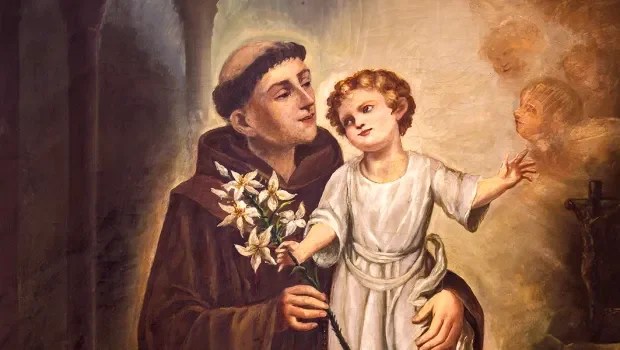
To this day, the 13th-century St Anthony of Padua is often portrayed holding the Christ Child he saw materialize in his hermit’s cell. But several other medieval saints also reported encounters with the infant Christ, sometimes when deep in prayer on Christmas Eve, such as St Catherine of Bologna, St Agnes of Montepulciano, and St Nicholas of Tolentino.
Not every mystic experienced an actual encounter with the Christ Child, but medieval theologians and artists were intensely focused on the inner meanings of the Christmas story. One approach was to look for “types” of the Nativity in the Old Testament — narratives that foreshadowed the arrival of the Messiah, such as the story of Noah’s Ark. For medieval interpreters, the Ark as the bearer of salvation presaged Mary’s role as Christ’s mother, while God’s promise to Noah never to destroy the Earth again anticipated the angels’ proclamation of peace and goodwill to the shepherds.
Mary became a particular focus of hidden meanings and mystical titles; in litanies sung in her honor she was the Mystic Rose, the Lily of the Valley, the Ark of the Covenant, the Morning Star, and so on. Some medieval artists produced even stranger images. One such was a portrayal of Jesus and Mary as plants growing out of the ground, based on the idea of the Incarnation as the fulfillment of God’s plan, coming to fruition in due course like planted seeds.
In more recent centuries, the mystery of Christmas became a popular theme for poets. Robert Southwell’s strange mystical Christmas poems, such as “The Burning Babe” in which the narrator has a vision of a burning child, are still read today at carol services, as is John Milton’s daringly speculative ode “On the Morning of Christ’s Nativity”.
Yet most people who have encountered a mystical side to Christmas are more likely to have met it in the great children’s literature of the 20th century. From the “always winter, but never Christmas” of C.S. Lewis’s Narnia to the strange midwinter time slips of John Masefield’s The Box of Delights and the deep mysteries of the winter solstice in Susan Cooper’s The Dark is Rising, Christmas is often a serious matter in classic children’s books, signifying a time of deep magic.
This modern mysticism of Christmas is not wholly Christian in character, however. Like Walter de la Mare’s poem “Christmas Eve”, with its meditation on “the Birthday of the Sun”, modern efforts to re-imbue Christmas with meaning often draw on sources older than the Christian faith, or on the natural mystery of the winter solstice itself. Contemporary Pagans believe the Oak King is reborn at Yule — as they call the midwinter festival — as the Holly King gains his full strength, focusing on vital principles of nature rather than scriptural promises. Mystics of all faiths have always striven to see the unseen light hidden by seeming darkness; the turning point of midwinter, therefore, is rightly their festival.
Join the discussion
Join like minded readers that support our journalism by becoming a paid subscriber
To join the discussion in the comments, become a paid subscriber.
Join like minded readers that support our journalism, read unlimited articles and enjoy other subscriber-only benefits.
Subscribe