




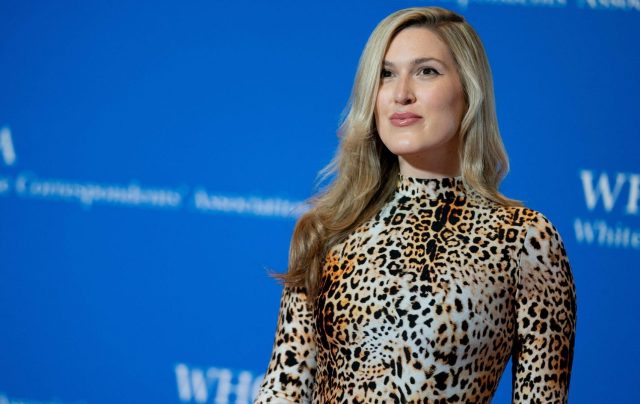
'She had nothing to gain, and everything to lose.' Stefani Reynolds/ Getty Images. Olivia Nuzzi.




In 2011, the online lifestyle magazine xoJane launched a much-lauded — and, later, much-parodied — personal essay series called “It Happened to Me”. The authors of these essays were always young, always women, always offering up humiliating and intimate narratives from their lives for a pittance (the site paid about $250 per essay) and the slim but tantalizing possibility of going viral enough to launch a career that led to a book deal (this rarely happened, but a girl could dream).
Olivia Nuzzi, the former New York Magazine political correspondent-turned-social pariah, launched her career at about the same time. Of this personal essay industrial complex, she writes: “I could not participate because I did not care to write of my own life and experiences because I did not find any of it terribly interesting and certainly not more interesting than whatever I might learn about the world from other people and their experiences.”
The above passage appears early on in Nuzzi’s new book, American Canto, and let me be the first to say: it’s true. She could never have participated in this particular literary trend, and I know this not just because she said so, but because American Canto — or parts of it, anyway — reveals what happens when she tries. The result is cacophonous: mixed metaphors, run-on sentences, insights intended to come off as confessional or vulnerable that instead read as solipsistic bordering on delusional.
Well, she did warn us.
For those not in the know — or not in the media, where this story has played out over the past weeks like something between a soap opera and a trainwreck — the controversy surrounding Nuzzi dates to just over a year ago, when rumors began to circulate that she’d been involved in a long-distance sexual entanglement with Robert F. Kennedy, Jr., who she had profiled for New York some months before. That the affair was allegedly never consummated was a bizarre twist, but one that paradoxically made the whole thing seem more, not less, sordid, not least because it conjured images of RFK hiding in a closet somewhere in the Hyannis Port Kennedy compound, clutching a smartphone in one meaty hand, whispering dirty little nothings in that voice.
Nuzzi was suspended and then fired from New York for the ethical breach, whose revelation she blamed on her then-fiancé Ryan Lizza; around the same time, she filed for a protective order that accused Lizza of threats, stalking and hacking her personal devices in order to blackmail her. Lizza denied these charges, and Nuzzi eventually withdrew her petition. Then, she disappeared.
For a while, at least. When she resurfaced again nearly a year later, it was as the new West Coast Editor at Vanity Fair — and with a surprise book deal. A memoir, written in secret, about the series of events that led to her downfall.
The controversy surrounding Nuzzi’s return to the media has been even more messy than the one that surrounded her ouster. The release of American Canto, which dropped 2 December, is messier still. The book was preceded by one week with a sensational excerpt in Vanity Fair, which was in turn immediately eclipsed by the counter-publication of a florid, multi-part series on Ryan Lizza’s Substack featuring previously-unknown details of Nuzzi’s misdeeds. The first installment, titled “How I Found Out”, ended with the shocking allegation that Nuzzi had also had an affair with a certain governor known for philandering, hiking, and lying about hiking when he was actually philandering.
The second, which reproduced various correspondences between Nuzzi and RFK, Jr., was basically highbrow revenge porn. (Lizza may or may not have tried to actually blackmail his former fiancée, but he’s definitely not beating the charges of having dug through her phone in search of the kind of material one might use to do this.)
At this point, the only character in this saga who has yet to weigh in is RFK, Jr. — perhaps because he’s busy doing other things, or perhaps because the only good response to having your terrible filthy poetry published to a global audience is no response at all.
But then, nobody seems to care what Kennedy thinks of all this. The vast majority of the opprobrium, maybe even all of it, has been reserved for Nuzzi. The consensus seems to be that this is a story about a woman doing a bad thing — and that the idea that the men in it might have been active players, too, is ridiculous and impossible. The consensus also seems to be that if you’re willing to admit Nuzzi had some power in this equation, you might as well go ahead and insist that she had all of it. And having identified her as the sole architect of this entire drama, the discourse then turns to outrage: how dare she do this! And worse, having done it, how dare she write a book about it!
The thing is, arguably, she didn’t. Write a book about it, I mean. Whatever American Canto is, it is not a tell-all memoir, a notion the author explicitly balks at. “When your privacy is violated, there emerges the expectation that you must respond by further violating it. I thought of that phrase, Tell all, often over the months that followed. Tell what, exactly? Tell why, exactly?” she writes. “I could tell you the facts. I could tell you the truth. I could tell you that where facts end, truth begins. I could tell you, probably, nothing that you would like. I could tell you, almost certainly, nothing that would redeem me.”
In fairness, the outrage surrounding American Canto is a valid response to the book’s Nuzzi-tells-all marketing, including in that much-discussed Vanity Fair excerpt — which is actually not an excerpt at all, but rather a series of disparate passages cobbled together to sell a sort of alternate-universe version of the story, like one of those goofy trailers that recut Mrs. Doubtfire to look like a horror film. These are the weakest, worst-written parts of the book.
Unfortunately they’re also the only parts most people have read.
That includes critics, many of whom rushed to publish their takes on American Canto based only on the excerpt, rather than the full text. The upshot is that a substantial portion of the critical response to American Canto amounts to lamenting the shortcomings of a book Nuzzi didn’t write, and had no intention of writing.
At the same time, to expect anyone to engage generously with this book was always a losing bet. For most people, any insights American Canto might have offered are nullified by the loathsomeness of its author, which is to say, people hate Nuzzi so much that she could be the second coming of Joan Didion, and she’d still get panned.
Of course, she’s also not the second coming of Joan Didion, at least not in this iteration. Perhaps there’s a version of this book that with the benefit of more time and more editing would have approached the sublime. But the book Nuzzi did produce was reportedly written both in secret and in haste, on an iPhone, and it shows.
And yet: what also shows, albeit much too fleetingly for a work of this length, is the same skillful prose styling and uncanny instincts that made Nuzzi a star to begin with, and which the landscape of American political journalism is poorer without.
Critics have scoffed at the notion, articulated in the book’s introduction, that this story is about more than its author’s ill-considered sexual choices: that it’s about America, and Donald Trump, and how the latter irrevocably and forever altered the former. But it’s Trump, not Kennedy, who dominates this narrative, who is the only person in Nuzzi’s cast of characters who is identified by name. It occurred to me more than once while reading that maybe the protagonist of this story is actually Trump, not Nuzzi. If nothing else, she certainly seems to understand him far better than she understands herself.
That understanding is a valuable thing. Unfortunately, if understandably, it’s also a thing Nuzzi is no longer trusted to do. She’s simply too easy to slot into the archetype of the Unreliable Narrator, with a side of Machiavellian Slut for good measure, even though — and this is what makes American Canto less a memoir than a tragedy — she doesn’t actually fit that role. The whole reason this scandal is a scandal is that what Nuzzi did was so unstrategic, so stupid; it was a baffling act of self-sabotage where the consequences were potentially catastrophic and the upside was nonexistent. She had nothing to gain, and everything to lose.
But she did it anyway. There’s a group of people, about 50% of the population, who are understood as particularly prone to this sort of recklessness — which is why it’s often referred to, pardon the expression, as “thinking with your dick”. But Nuzzi doesn’t have that particular body part, which raises the question of not just how best to describe her behavior, but whether we might be unfairly ascribing to the penis an impulse that actually lives somewhere else. In the veins; in the heart; in the battle between good judgment and desperate desire that characterizes so much of the human experience. It’s not so much there but for the grace of god go we all. Most people never even have the opportunity to blow up their lives à la Nuzzi, and those who do mostly don’t take it, and that is for the best.
But if the specific object of Nuzzi’s life-immolating sexual obsession is neither universal nor relatable, its broad contours are. Who among us hasn’t desired someone we couldn’t have, or shouldn’t have; who among us hasn’t been driven so mad by that desire that we make ourselves look like idiots, if not to a national audience, then certainly to anyone close enough to the situation to see it for what it is. We know how that feels: foolish. Familiar. Maybe too familiar. Boring, even.
And if American Canto is meant to be received as a memoir, this is where it fails. It’s not a tell-all. It’s not a tell-nothing. It’s just that what it does tell us, when it comes to love as an instrument of destruction, is a story we already know.
Kat Rosenfield is an UnHerd columnist and co-host of the Feminine Chaos podcast. Her latest novel is You Must Remember This.
 katrosenfield
Join the discussion
Join like minded readers that support our journalism by becoming a paid subscriber
To join the discussion in the comments, become a paid subscriber.
Join like minded readers that support our journalism, read unlimited articles and enjoy other subscriber-only benefits.
Subscribe