




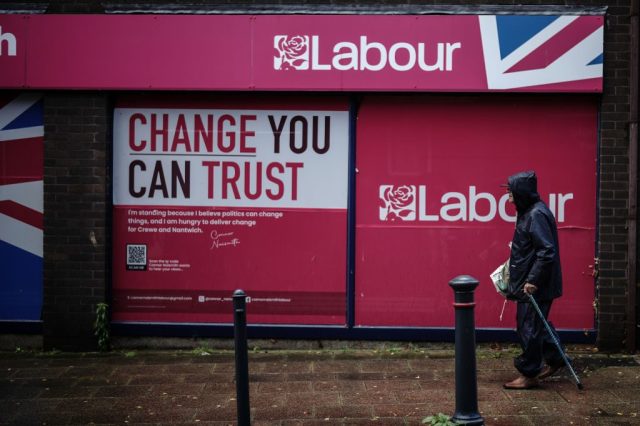
Broken promises. (Christopher Furlong / Getty)




What do we think of when we think of Britain? Not the white cliffs of Dover or red phone boxes; it’s shared institutions that truly define a nation. For a certain kind of middle-class dad, it’s “Auntie” or “the Beeb” that remains a lodestar in our national story — and a handy antidote to populist “misinformation”. Then there’s the rose-tinted world of postwar social-democratic nostalgia, with the NHS as the nation’s heart — think the London 2012 opening ceremony. But beneath the longing for comforting certainties, there’s a more disturbing and accurate symbol of the contemporary British body politic. Our broken social care system isn’t so much a single institution as a threadbare patchwork of public and private dysfunction, the epitome of our era of political inertia and decimated state capacity.
All the quagmires of government failure are distilled into this sector. An aging population puts the Treasury under ever more strain, but successive governments are too afraid of upsetting the asset-rich gray vote. Staffing crises are assuaged by importing cheap foreign workers, and local authorities are bankrupted by ballooning costs. All the while, council tax payers wonder where on earth their money goes.
Health Secretary Wes Streeting wrote in The Guardian at the beginning of the year to tell us how seriously he was taking the crisis. Despite our aging population, the number of people receiving state-funded social care has fallen by 10% in a decade, adding huge demand pressures on hospitals and GPs. Around one in seven hospital beds are taken up by fit patients with no discharge plan in place. What’s more, social care costs are expected to double by 2038. But there’s no idea about what to do. As the ratio of workers to pensioners becomes more and more lopsided, fewer taxpayers will have to foot the bill for larger numbers of dependents. One of the larger items on the bill will be a rapidly expanding workforce in an already enormous sector; while over 1.5 million people work in social care today, even amid chronic shortages, by 2040 that number is expected to rise by 470,000 to over two million.
Meanwhile, ultra-liberals wrap their gratitude for bargain-basement social care workers in paeans to diversity and cosmopolitan tolerance. I’m thinking, of course, of Zack Polanski. “One in five care workers are foreign nationals,” he reminded a Question Time audience earlier this month. “I don’t know about you, but I don’t particularly want to wipe someone’s bum, and I’m very grateful for the people who do.” It seems the progressive mindset is now so flexible that it can accommodate an attitude to labor relations that would be familiar in an autocratic Gulf petrostate: grossly underpaid foreign workers are invited and maintained as a vast, low-waged service army, while the middle classes engage in more dignified work, like making podcasts about “eco-populism”.
There’s a more essential challenge here, too, as services including residential care homes are hollowed out by parasitic ownership models, hedge funds and private equity — a model which has been adopted across the public sector, not just in social care. Councils often award contracts to large providers based on “value for money”, handing over service provision to private firms that can supposedly deliver with economies of scale. But studies have shown that the outsourcing of provision almost never has a positive impact on quality of care — it simply increases costs for service users. Currently, anyone with assets over £23,250 contributes to their own costs of care, while local authorities shoulder much of the increasingly heavy burden. To make matters worse, research released last month found that, over the course of just three years and in only three English regions, £250 million in profit was extracted from social care provision, often by companies registered in tax havens.
This is the end result of a particular kind of political economy. It was in the 19th century that Joseph Chamberlain, then the Liberal mayor of Birmingham and later a prominent pro-imperialist Tory, pioneered what was called “gas and water socialism”: municipal authorities would provide basic public utilities directly. Yet somehow we’ve regressed over the last century and a half, with anyone now proposing a model like Chamberlain’s liable to be dismissed as a socialist fantasist. Instead, for almost 50 years we’ve advocated a model that sells England by the pound: the government structures that once promised cradle-to-grave care are now emaciated and powerless in the face of foreign investors. Everything is put out to tender and outsourced, with the local and national state as the customer. Around a third of government spending now goes on procurement from the private sector. And ultra-dry Thatcherites, the Blairite modernizers, and their Cameroonian heirs have all played their part, extending the practice and allowing the core capabilities of the state itself wither. The taxpayer pays, but it’s often an opaque world of para-state private behemoths delivering everything at the coalface, disguised behind a government logo.
The results are mixed, at best, and the only sure winners are the investment groups themselves, and perhaps the expensive lawyers that oversee the Byzantine tendering process. As for the state’s own capacity, institutional memory, expertise and personnel — all these are now woefully inadequate.
In social care, it wasn’t until the Eighties that local authority-run homes began to be sold off. The NHS and Community Care Act of 1990 took away councils’ responsibility to provide care directly, replacing it with a requirement simply to buy care from private providers. Where 89% of care provision used to be delivered by public providers or charities, today the proportion of private provision stands at 83%. Service users are left vulnerable, as care homes are taken over by the sovereign wealth funds of more entrepreneurial, agile states — ones that patiently invest in long-term assets rather than rushing to sell them off to the highest bidder.
Taken together, the sector encapsulates our embrace of the twin liberalisms that have defined the last decades. The economic liberals first insisted we break up the state monoliths, and introduce internal markets, the spirit of entrepreneurialism and healthy competition into public service delivery. Soon after, the social liberals demanded that we welcome historically unprecedented numbers of arrivals into the country. The British labor market at the lower ends of the wage scale has paid the price.
Perhaps unsurprisingly, successive governments have avoided tackling this crisis head-on. Fine words aside, Streeting is no exception, ordering yet another lengthy review, not due to report until 2028. Andrew Dilnot, the respected author of the last review, was openly disparaging of Labour’s delays. He has already offered his own solutions: one involves a national criterion of eligibility for care. Beyond replacing the current postcode lottery hodgepodge, this would, in effect, create a National Care Service of sorts, paid for with capped contributions from individuals with social care needs, and levied upon estates over a certain threshold. The Holy Grail for local authorities would be a truly integrated national service, taken out of the purview of cash-strapped municipalities. They would be then free to focus on the services used by the majority of people who do not use social care, but who nevertheless pay up to two thirds of their council tax bills toward its failing institutions.
At its best, care work could be transformed into a secure, decently paid profession, on a similar footing as nursing or teaching, ending the doom-loop of high turnover, chronic shortages and low skills. That would have a fiscal cost, of course, and may require controversial incursions into the enormous real-estate portfolios of human history’s most fortunate generation: the Baby Boomers. But the point is that Streeting already knows what needs to be done, and yet he is unwilling to expend the political capital to do so. Memories of Theresa May’s ill-fated “dementia tax” are raw.
Such timidity is grimly to be expected. For if it’s impossible to escape the feeling that nothing now works, it’s equally hard to avoid the fact that our politicians seem totally adrift, powerless amid the global forces swirling around them. What’s worse is the growing realization that this impotence has been self-inflicted. It’s the result of conscious decisions to wind down and outsource the direct functions of state, to diminish the powers of the executive, to degrade and then offload assets, in effect to sell the family silver. We’ve got ourselves in chronic indebtedness and at the mercy of international lenders and speculators — only to then turn around and cry “not me, guv” when things fall apart.
One might expect a Labour government that talks of “resilience” to grasp the nettle and finally start rebuilding the capabilities of the British state, taking on private interests and rebuilding the public realm in public hands. But why wreck a career on social care, as so many senior ministers have before, especially for a man as clearly ambitious as Streeting? The dysfunction is such, after all, that any attempt at reform may open a Pandora’s Box, leaving even the best of our secretaries of state without a future. And so, when it comes to social care, nothing is to be done, and nothing sums up our very British dysfunction quite like it — the truest icon of our national decline.
Jonny Ball is a Contributing Editor at UnHerd. He formerly wrote under the name Despotic Inroad.
 DespoticInroad
Join the discussion
Join like minded readers that support our journalism by becoming a paid subscriber
To join the discussion in the comments, become a paid subscriber.
Join like minded readers that support our journalism, read unlimited articles and enjoy other subscriber-only benefits.
Subscribe