





'The ideal that Komisar describes is a kind of hostage situation.' Getty Images





Earlier this year, an interview on The Diary of a CEO podcast with the psychoanalyst Erica Komisar, one of the leading voices in the “attachment parenting” movement, went viral. With her steel-gray bob and tasteful blazer, speaking in calm and measured tones, Komisar came across as the Upper West Side self-identified feminist that she is. But her argument cut against decades of feminist messaging. She is unequivocal: it’s critical for mothers to stay at home with their children for at least the first three years of their lives, and it is selfish to choose otherwise if you have the option. The use of daycare, she believes, leads to long-term psychological damage — attachment issues, mental illness or ADHD. Children were “dropped” and “abandoned”, she says, when “women decided that it was cool to go to work and work full-time out of the home”. To Komisar, it is “the shift in society towards self centeredness, toward narcissism, towards individualism, toward me me me” that has convinced women it’s okay to continue their careers while they have young children.
The interview with Komisar has accumulated 3.5 million views on YouTube, and clips of her regularly circulate on Instagram and TikTok. She was even on a recent episode of The Kardashians. Online mom groups are full of discussion about her. “I’ve seen snippets of her before and she increases my mom guilt 1000%. She shames parents without considering that we’re all just trying our best,” wrote a representative poster on the Reddit r/workingmoms forum. “Most women work because they have to, FFS,” a Mumsnet user wrote. “They don’t have the option of staying at home for 3 years.”
In her 2017 book Being There: Why Prioritizing Motherhood in the First Three Years Matters, Komisar is equally blunt about the tradeoffs that she believes must be made: you can’t “have it all” if you have kids as a woman. “You may never be the CEO of the bank or corporate law firm if you choose to make your family your first priority,” she writes. This is a refreshing departure from the message of 2010s girlboss feminism, and it’s easy to see why Being There struck a nerve, published as it was in the heyday of Sheryl Sandberg and Marissa Mayer glamorizing non-stop corporate achievement in tandem with motherhood. Komisar acknowledges reality. And her argument doesn’t overtly push a particular political agenda. Nearly everyone would agree with her that motherhood has been devalued in modern society and should be treated like the valuable vocation it is, and that mothers are incredibly important to young children. Her desire for women to have access to longer maternity leaves is sensible and uncontroversial.
But when it comes to the kind of mothering Komisar promotes, Being There is political. The ideal that she describes is a kind of hostage situation. For Komisar, staying home is not enough; you must be wholly focused on your child at every single moment. No scrolling on your phone while breastfeeding. No chores while you’re with your child. “If you are doing the dishes and talking to your child, or cleaning while talking to your child, you are not being present, you’re distracted,” she writes. Playing with your baby is a critical opportunity for optimal parenting. “You need to focus on eye contact, touch, your tone of voice, facial expression, body language, and awareness of your own mood and emotions,” she writes. The baby will “mourn” you if you aren’t there for any length of time. If you need any help, the baby’s father is an acceptable short-term substitute, or another relative. If you really must, a nanny. Komisar has said in interviews that babies “feel like you have died” when they are sent to daycare.
This is the kind of constant vigilance promoted by the attachment parenting movement, which advises maximum responsiveness and proximity in childrearing. It is rooted in attachment theory, which originates in Fifties and Sixties research that showed the crucial impact on development of infants’ bonds with their primary caregivers. American pediatrician William Sears borrowed the label in coining the term “attachment parenting” to describe his core recommendations of co-sleeping, extended breastfeeding and babywearing. He discourages parents from using strollers and describes babies sleeping in cribs as being “behind bars”. Sears’ books have been bestsellers. He was the subject of a 2012 Time magazine profile that ran with a cover photo of a mother breastfeeding a three-year-old that set off a fierce media uproar at the time.
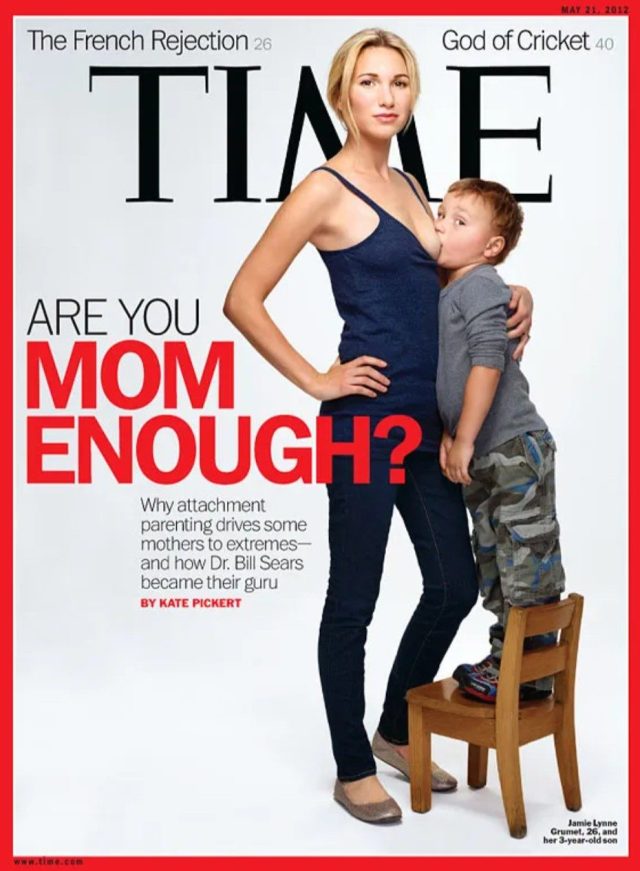
Time was covering the movement as a curious new trend, but since then it has become hugely influential in parenting culture. Its connection to a legitimate branch of psychological research gives attachment parenting a science-y sheen that attracts educated women who want to do everything possible to optimize their children’s development. There’s a lot of talk in these circles about cortisol levels and whether things are “biologically normal”.
Alongside its cousin “gentle parenting”, which discourages traditional methods of discipline like time-outs or saying no, attachment parenting has taken off in the social media era. Like with anything else, this has much to do with the algorithms’ inexorable push towards extremes. On parenting TikTok and Instagram there is an arms race underway for who can be the most responsive, the gentlest, the most self-sacrificing. One of the main battlegrounds these days is sleep. Advocates of co-sleeping commonly equate sleep training to child abuse. “In this group we do not tolerate Ferber method, CIO, or any forms of sleep training,” read the rules for a 12,000-member attachment parenting Facebook group. “It is cruel and not biologically normal. Infant sleep is developmental and you cannot train a baby to not need you.” The group also forbids any discussion of weaning. When followed to the hilt, this type of parenting — and really it should be “attachment mothering”, since fathers play a supporting role at best — is a totalizing endeavor that leaves no room for anything else.
These intensive parenting philosophies succeed where conservative arguments rooted in tradition or religion do not in persuading professional-class women that they must sacrifice everything for motherhood. Women who might have “leaned in” 10 years ago are now applying that anxiety and perfectionism to childrearing, fearful of traumatizing their child because they let them cry for five minutes. While apolitical and science-based in theory, attachment parenting results in practice in the gender roles sought by traditional conservatives; it has thus become a vehicle for a retrograde brand of gender politics to make inroads in unexpected quarters. Mothers who follow these parenting styles might not themselves be trads — but they often end up in the same place the trads envision, bound to the home and detached from the public sphere.
Most “mommy wars” skirmishes stay contained to parenting forums and comment sections, but the issue of group childcare has within the last half-decade entered the heart of political discourse. Expanding access to it has become a signature policy of Anglosphere liberals. Zohran Mamdani just won the mayoralty of New York City on a platform that included universal childcare, modeled after a recent successful statewide initiative in New Mexico. In the UK, the Labour government increased the number of free childcare hours available to qualifying families this autumn. Australia’s Labor government has been designing a universal childcare plan it has said it seeks to unveil next year. Proponents of these projects point to data about increased labor participation and alleviated economic pressure on working families. In a society where more and more people say they can’t afford to have kids, lightening the burden of paying for childcare seems like a sensible policy.
But its critics are many, especially in the US. On the Right, the idea is seen as a bourgeois priority of coastal liberals who selfishly want to pursue careers instead of family. “‘Universal child care’ is a massive subsidy to the lifestyle preferences of the affluent over the preferences of the middle and working class,” Vice President JD Vance tweeted in 2021 while still in the Senate. He called it “terrible for children” on another occasion. The Heritage Foundation’s Project 2025 policy wish list called for shifting government funding to in-home childcare or to pay stay-at-home parents and for ending the federal Head Start low-income early childhood education program. A recent leaked Heritage position paper titled “We Must Save The American Family” calls for a “Manhattan Project to restore the nuclear family” by incentivizing couples to have one partner stay at home to raise the kids.
This is the backdrop against which Komisar’s anti-daycare position has gained steam. The Right have already begun to instrumentalize attachment parenting, correctly observing that its arguments resonate with mothers choosing whether to stay home or not. Komisar for example, despite her apolitical presentation, is affiliated with the conservative Institute for Family Studies and speaks at Right-leaning conferences. Dr Sears appeared this year on conservative activist Lila Rose’s YouTube show. And the MAGA movement has embraced “crunchy moms”, a group that tend to be vocal in their embrace of attachment parenting practices.
The irony is that this type of all-consuming mothering isn’t traditional at all. I doubt there has been any time in history when women stared into their newborn’s eyes during the entirety of the dozen daily feeds or refrained from housework in order to focus on their children’s enrichment. Women may have not always had careers, but they have always worked. Even the concept of daycare isn’t particularly new; the US opened federally-funded daycares during the Second World War for the mothers who were working as the men fought overseas. But it has come to be seen as a harmful modern innovation. Of course the quality of a daycare matters, and the amount of time a child spends there. No one thinks that it’s desirable for six-week-olds to enter daycare — a sad reality that some American families are forced into because of paltry parental leave protections.
But the fear-mongering about daycare and the growing demands on mothers to be absolutely everything for their children has turned the conversation into a zero-sum game in which women will lose. It is here that the Right has made a tactical error. If falling birthrates are a crisis and convincing women to have children is a priority, it is perhaps not the smartest move to portray motherhood as an act of complete self-effacement that makes work impossible. It’s no wonder that, when faced with this, many young women are opting out entirely.
