




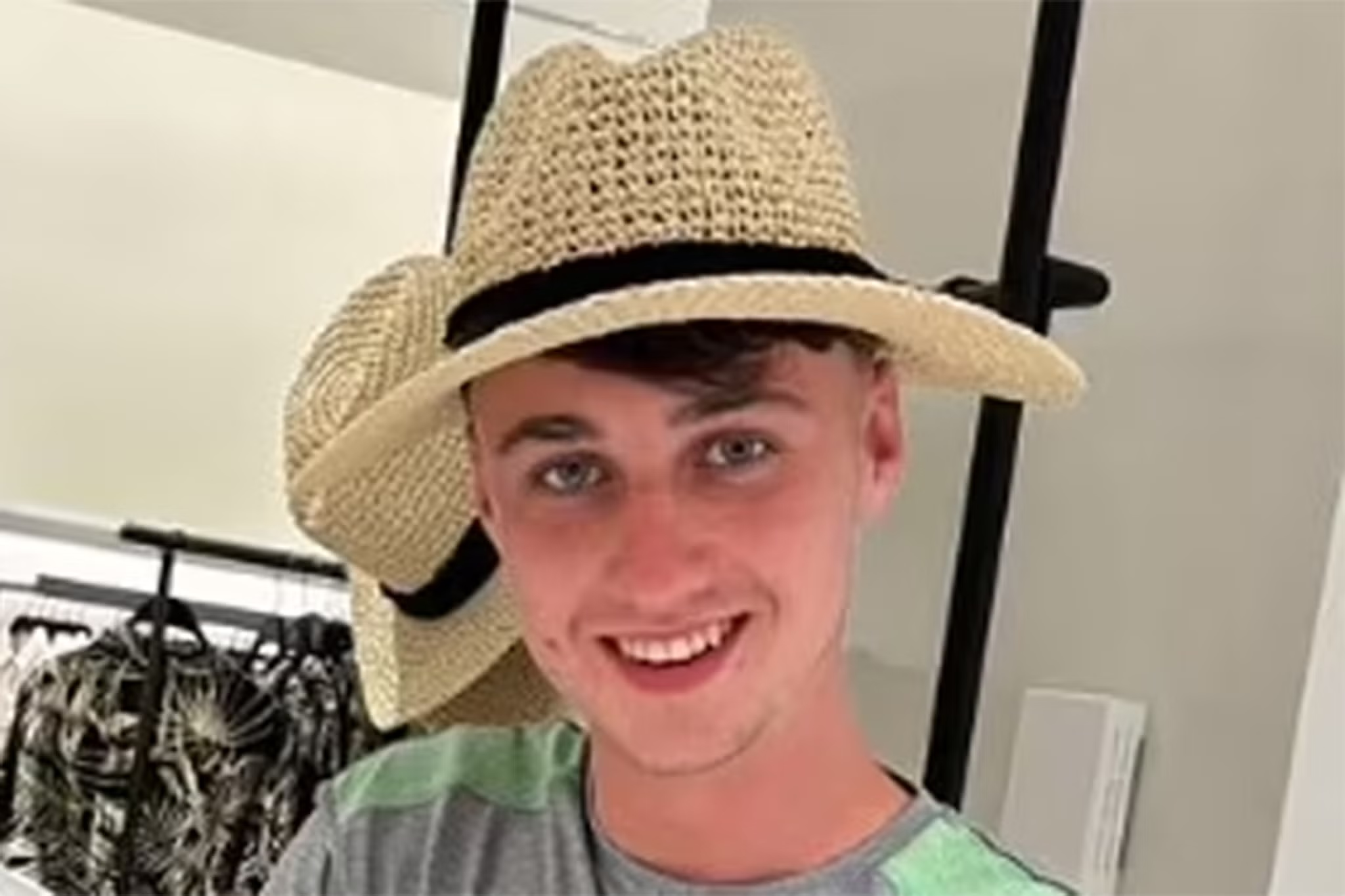
19-year-old Jay Slater died in exactly the kind of misadventure young people go on holiday to have.





In the end, it was just a stupid accident. Nineteen-year-old Jay Slater died in exactly the kind of misadventure young people go on holiday to have: a night out in Tenerife, an impulsive decision to leave the club with two acquaintances and continue the party, the desperately unwise choice to walk back across the island the next morning to find his friends. Slater had no water and little battery on his phone; the terrain in the mountains was brutal, the heat punishing. Within a few hours, he fell into a ravine and suffered an instantly fatal head injury.
For 29 days last year, Slater’s body lay undiscovered on the mountainside. And for those 29 days, his family — most prominently his mother, Debbie Duncan — did everything they could to keep attention on their son, in the hope that he was still alive and might be brought home safely. The kind of attention they got, however, was beyond anything they could have imagined; certainly, it was beyond anything they could control. Slater had become the focus of social media’s “armchair detectives”, for whom his disappearance was not so much a tragedy as a content generation opportunity.
By googling Slater, the armchair detectives learned that in 2021, he had been convicted of violent disorder. Did that fit with the image of the happy-go-lucky young man that Duncan was presenting? The armchair detectives thought not. A GoFundMe to support the family inspired claims from the Miss Marples of social media that the entire thing was a grift, with Slater waiting in hiding until he could reemerge and pocket the lot. (The family says they used the money to fund a private search team and cover their own expenses while in Tenerife.) Or maybe he was dead, but his family had killed him in order to pull off the scam: Duncan was accused of murdering her own son.
Now, Duncan is campaigning for “Jay’s law”, which would in theory protect families like hers from social media trolling. Like most “apostrophe laws”, it feels misbegotten: laws on malicious communications, stalking and harassment already exist, and marking out a special class of victim here would do little to help. Nonetheless, she has the support of her MP, because it’s very hard not to sympathize with what Duncan has been through. Effectively, she’s had her son taken from her twice over. First he died, and then the “armchair detectives” hijacked him.
Of course, if you are one of those “armchair detectives”, it’s actually very easy not to sympathize with Duncan. If you allow yourself to be absorbed into the vortex of true-crime TikTok, where the Slater case continues to do significant numbers, you’ll enter a parallel world in which the only certain thing is that Debbie Duncan can’t be trusted. I watch one young female influencer insisting that “anyone can see [the family’s story] doesn’t add up”: her videos offer wildly conflicting speculation about Slater’s death. As for Duncan’s pleas to be left alone, they receive short shrift. “The family pushed out content themselves,” says the young woman, in a contemptuous reaction video to the Jay’s Law campaign, “but now they want everybody to stop talking about it.”
Bereaved families are just another species of celebrity. They don’t get to say no. Every parent who loses a child suffers an indescribable private tragedy. But every parent who turns recovering their child into a public quest steps unwittingly into a tangle of pre-authored storylines, and that is especially true for mothers. In 2007, the novelist Anne Enright wrote for the London Review of Books about the widespread hatred for Kate and Gerry McCann, whose three-year-old daughter Madeleine disappeared from their holiday apartment in Portugal. Between the still-powerful tabloids, the burgeoning influence of social media, and the incompetence of the Portuguese police (who named the McCanns as suspects on the basis of a highly implausible theory), a strange shadow version of these grieving parents took hold.
As with Slater, there was a missing person, the compelling contrast of holiday pleasure with tragedy, and a silly season news void to fill. Like Duncan 17 years later, the McCanns threw themselves into publicizing the search for their daughter: in the circumstances, what else could they do? Then they were punished abominably for the crime of having their child taken. First, they were judged for leaving their children (including baby twins) in their villa alone while they went to dinner in the resort restaurant, less than 100 meters away. Then they were judged for trying too hard to get their daughter back.
“Disliking the McCanns is an international sport,” wrote Enright, who admitted that she had “disliked the McCanns earlier than most people”. Kate McCann was disliked most of all. She was deemed too beautiful, too groomed, too poised. People damned her for wearing a yellow ribbon in her hair (it was a symbol of hope for Madeleine, she said), for smiling with her twins (the McCanns said they were trying to “stay strong”), and for holding hands with her husband. Kate McCann failed to act as a heartbroken mother was “supposed to”, whatever that might have looked like. (But then, Duncan was later judged for being too scruffy and too common.) Like Duncan, Kate McCann was accused of murdering her own child.
At the bottom of this loathing, Enright realized, was “a recent but potent form of magic”: “Distancing yourself from the McCanns… keeps our children safe.” The more you could prove to yourself that you were unlike the McCanns, the less you had to fear that the same thing could happen to you. There was something affronting about their insistence on being seen. “I thought I was angry with them for leaving their children alone,” wrote Enright. “In fact, I was angry at their failure to accept that their daughter was probably dead. I wanted them to grieve, which is to say to go away. In this, I am as bad as people who complain that ‘she does not cry.’”
The McCanns had unwittingly made a terrible bargain: seeking publicity had been a way to keep the hunt for Madeleine active, but it had also made them famous. As Janice Turner noted astutely in The Times, “in allowing themselves to be creatures of the media, the McCanns have become the Beckhams of grief, prey to the celebrity culture that trivializes all in its wake”. And like all celebrities, the McCanns attracted fans (though “supporters” would be a more tasteful word), haters (like Enright) and obsessives — groups that still persist almost 20 years later, such is the strength of feeling about the case.
At the beginning of this month, a young Polish woman was found guilty of harassing the McCanns. For two years, Julia Wandelt had maintained an Instagram account with the handle “iammadeleinemccann”, through which she promoted her claim to be the McCanns’ lost daughter. She also contacted the McCanns repeatedly, demanding to be acknowledged. That had brought her to the attention of the rival McCann fandoms, and in particular to the anti-McCanns, who tended to claim that the McCanns themselves were culpable in Madeleine’s disappearance. One of them, a Welsh woman named Karen Spragg, was with Wandelt when she accosted Kate McCann in person at the end of last year.
In court, Spragg was described by the prosecution as a “true-crime tourist”; she told police that she believed the McCanns had arranged Madeleine’s abduction. Spragg had befriended Wandelt online and supported her claims. Whether Spragg truly believed Wandelt’s improbable account or not is unclear, but you can easily see how the McCanns’ “rejection” of this imposter Madeleine served the narrative of them as bad, unnatural parents: why wouldn’t they at least want to be certain? (Spragg was charged alongside Wandelt but found not guilty.)
Watching Spragg smiling as she left the court, it seemed doubtful that her encounter with the law had done anything to cool her obsession. More probably, it had reinforced it: I suspected that, like the Slater armchair detectives, she would probably perceive this attempt to “silence” her as proof that there was something to hide. No matter that the most likely explanation for Madeleine’s disappearance, as with Slater, is the sad, terrible, obvious thing — in this case, an opportunistic snatching by a predator and the disposal of her body. The lure of the conspiracy is too powerful to be quelled.
There are material rewards for influencers in the true crime ecosystem: attention, clout, money (if they monetize their channel). That helps to explain the supply, but not the demand. Why should anyone want to believe dreadful and unlikely things about people like Duncan or the McCanns, when they have already suffered the worst thing imaginable? The answer is, precisely, because they have suffered the worst thing imaginable. To accept that Kate McCann or Debbie Duncan are just like any other mothers would be to accept that what happened to them could happen to anyone.
Which it could. In the real world, a young man can die of one idiotic choice, and a small girl can be lost because her parents were ever so briefly inattentive. In the real world, there is no way to be “good enough” to prevent such horrors: they happen regardless of how virtuous you are. Believing in conspiracist explanations is a literal-minded way of asserting the “just-world fallacy”. It is nicer to tell ourselves that such events can only befall the wicked, and once the wickedness of the bereaved has been assumed, any depraved acts can be attributed to them. Conspiracy-world is a more moral place than the real world, governed by the same reassuringly strict rules of action-and-consequence as a chutes-and-ladders board.
Conspiracy-world is also a more interesting place than the real world. Accidents and abusers are quotidian and grubby. A killer mother, though? That’s a thrilling proposition, a giddily exciting inversion of the expected order where a woman’s function is to love and nurture. The need to hate these mothers of the missing is so profound that the cycle seems irresistible. Regrettably, Duncan is learning, as the McCanns learned before her, that the truth will always be overpowered by the seduction force of a mystery.
