








November 27 2025 - 6:00pm
Earlier this year, there was a campaign across Britain called “Operation Raise the Colours”, where activists erected Union Jacks and the flag of St George in public places. Supporters claimed it was an act of patriotism to promote unity. Critics accused it of being racist and exclusionary, with many local councils taking them down swiftly.
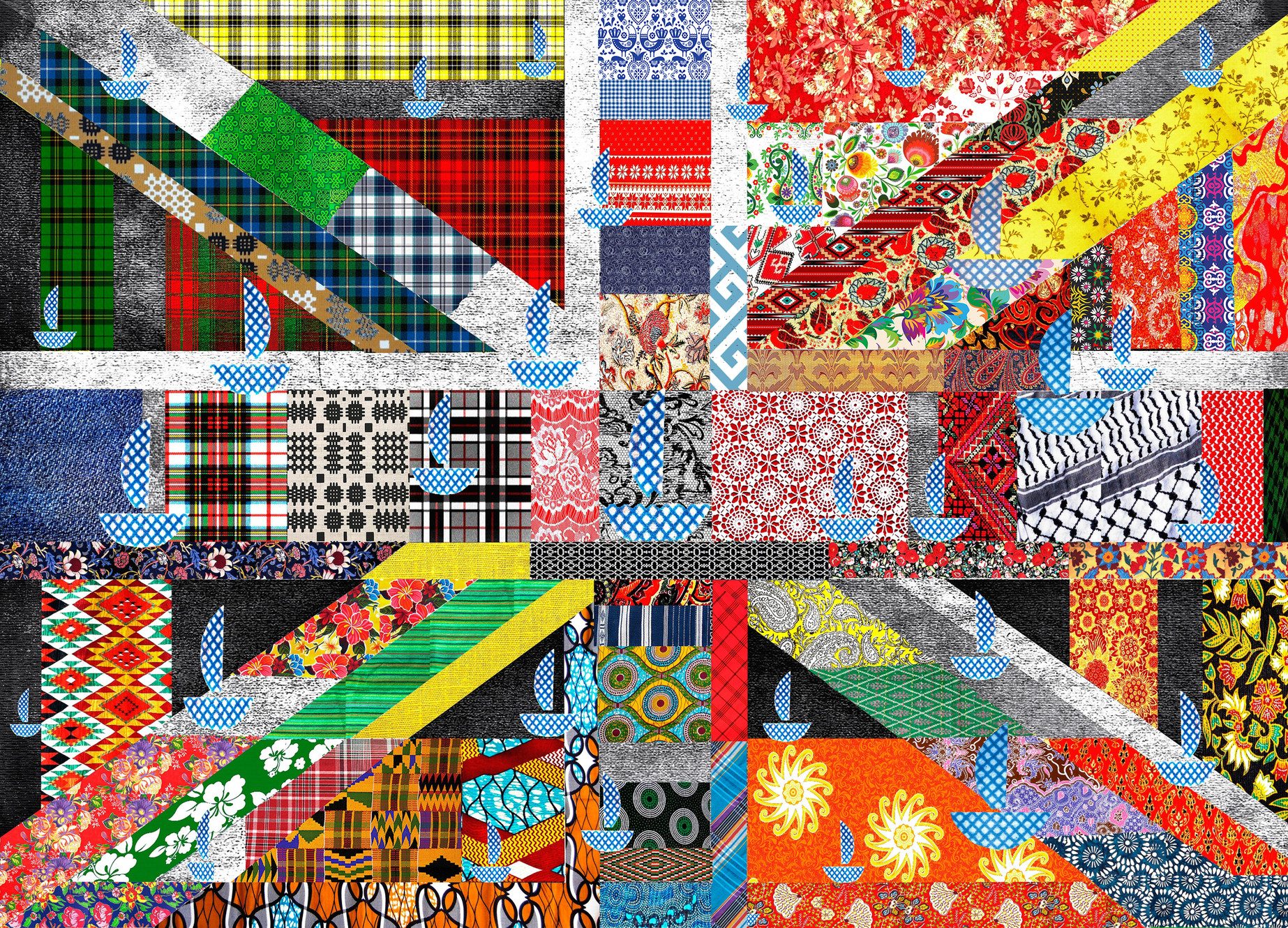
This week, Brighton and Hove Council — a progressive stronghold — removed from a public library a patchwork recreation of the Union Jack made using textiles which represent diverse communities across the country. Naturally, the council has been accused of censorship.
Its removal is at first surprising. Artist Gil Mualem-Doron describes his practice along the themes of “Identity / Social Justice / Decolonize / Transcultural”, and this particular piece was made in collaboration with the charity Stand up to Racism. Banning art which claims to celebrate cultural diversity seems to be a political curveball. But then one remembers that progressive bureaucrats are terrified of anything even obliquely nationalistic.
A council spokesperson explained in a statement that the artwork might “be taken out of its artistic context” and that “unlike a gallery or museum, library visitors might encounter the work unexpectedly and take offense.” The implication is that either the flag — in any form — is unavoidably wicked, or the visiting public is too bovine to discern this new progressive inversion of the familiar symbol. In other words, they may be too impressionable to populism and it’s the council’s job to prevent that.
The debacle highlights the vacuum of logic that underpins institutions staffed by fearful technocrats, and a lack of self-confidence in the face of risk. Action is driven by panic — a determination to avoid conflict, at any cost — rather than pausing to reflect. Parallels can be drawn with the actions of the Royal Academy (RA) when online activists accused them of supporting a “transphobic” artist, Jess de Wahls, in 2019. The RA’s immediate response was to remove the items from its gift shop — a decision on which it later reneged after issuing an apology.
Strong emotional responses cloud rational judgment, and the fear-induced blindness has cast an emotional smokescreen through which both sides use the same words but no longer speak the same language. Both sides of the controversy cite safety as a defense — the council for putting “visitors and their belongings at risk”, and Mualem-Doron who says that the removal has made him afraid. The idea that displaying flags could trigger violence, as suggested by the council, or that the removal was an act of racially-motivated censorship, as suggested by Mualem-Doron, are equally ridiculous and mutually incompatible.
Frankly, progressive artists “reappropriating” the Union Jack for didactic purposes is dull, and the public is becoming tired. Polls show that Britons dislike political preaching in galleries because they visit primarily for leisure. The success of the current Gilbert & George exhibition at the Hayward Gallery — from an artistic duo whose works are resplendent with cobalt, ruby, and ivory colors and symbolism of the Union Flag — is due to its comedic effect, and their undiscriminating mission to explore all political angles.
In a strange way, banning this patchwork flag is a return to political neutrality in the cultural sector, even though it’s motivated by progressive policies. The spokesperson explained that council libraries “need to remain neutral spaces and a safe space for all our customers”. No country’s flag is neutral, but there ought to be enough latent patriotism that it is at least not torn down in the name of “safety” when it appears.

Join the discussion
Join like minded readers that support our journalism by becoming a paid subscriber
To join the discussion in the comments, become a paid subscriber.
Join like minded readers that support our journalism, read unlimited articles and enjoy other subscriber-only benefits.
Subscribe