




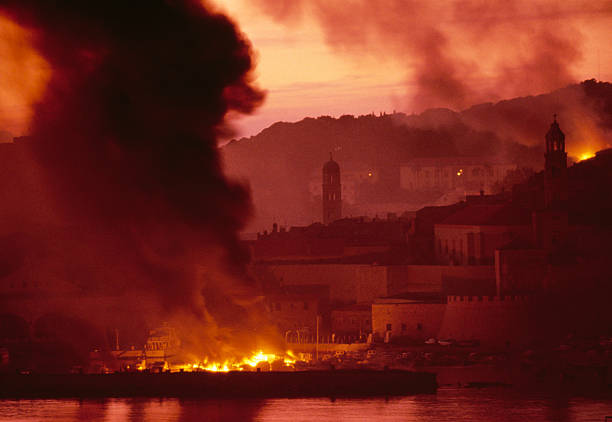
Night bombing of the city of Dubrovnik in 1991 (Jon Jones/Sygma via Getty Images)





Imagine: the border with Scotland is closed and your home city of Manchester besieged. Before you know it, you and your family are having to flee to Wales to escape bombs and full-blown civil war. Such is the scenario of First World Problems, a dystopian BBC radio thriller following the plight of the fictional Fletcher family in the midst of a brewing civil war in the UK. Seeking to forestall a Scottish declaration of independence, the Westminster government of “Greater England” invades Scottish soil, before dissolving Parliament and — horror of horrors — assuming full control of the BBC itself.
To tell the tale of how a modern, multinational European country could slide from normalcy into the terrible vortex of civil war, the drama drew on the personal experience of BBC correspondents during the Balkan Wars of the Nineties. Broadcast in 2019, at the height of the Brexit crisis, when the atmosphere in the UK was indeed that of a cold civil war, the BBC dramatists succeeded in showing not only how little they understood Brexit but also how little their correspondents had learned about the collapse of Yugoslavia and the ensuing Balkan Wars.
The history of Yugoslavia still provides fodder for fictional accounts of a second British civil war because it offers a convenient moral fable. There is the dangerous allure of nationalism, the pernicious role of charismatic demagogues, and the collapse of multicultural harmony. It is the smug conceit of a liberal West that thought it had escaped history through globalisation and European integration across the Nineties. But now that the story of both Britain’s national decline and Yugoslavia’s collapse looks very different, what — if anything — can the 21st-century British public learn from the collapse of Yugoslavia?
Unsurprisingly, the standard fable bears little correspondence to the historic reality of Yugoslavia’s collapse. While the nationalist passions created during the war were real enough, they were modern rather than deeply historical and were weaponised by the hackish nationalist leaders. More scheming bureaucrat than inspired orator, Serbian strongman Slobodan Milošević dredged up Serbia’s defeat in the 1389 Battle of Kosovo Polje to reignite Serbian nationalism 600 years later. Seen as the point at which the Serbs martyred themselves before the invading Turks, that tale of rekindled historic grievance was clearly insufficient as an explanation of national collapse. If an independent Scotland ever did go to war against a Rump England, we can be confident that The New York Times would soon be carrying sombre stories about Edward Longshanks and Robert the Bruce, accompanied by chin-stroking editorials about ancient rivalries stretching back to the 1314 Battle of Bannockburn, adorned with quotes from Mel Gibson. But it would not serve as a useful explanation.
The reality is always more prosaic. Yugoslav ethnic grievances were bound up with centrifugal political dynamics between core and periphery. In 1974, the Yugoslav communist leader Marshal Tito sought to dilute Serbia’s preponderance as the largest constituent republic of the Yugoslav federation by imposing devolved provincial administrations within Serbia itself. This inter-ethnic asymmetry would play out in the collapse of Yugoslavia across the Nineties, as the secession of the smaller republics of Slovenia, Croatia and Bosnia-Herzegovina were all afforded international recognition, while the secession of minority Serbs within Croatia and Bosnia was denied. To this day, the EU protectorate over Bosnia-Herzegovina expends much of its political energy in keeping Bosnia’s Serb population bound up in that rickety mini-federation, despite the Serbs’ hostility to the central state in Sarajevo.
Thus there is a lesson in Tito’s efforts at constitutional rebalancing. The attempt to boost peripheral smaller nations at the expense of the largest constituent nation risks precipitating a vicious cycle. The rights extended to smaller nations in order to placate and bind them more tightly to the central state can never be extended to the largest nation without disproportionately strengthening it, thereby risking the integrity of the central state. At the same time, the failure to extend the same rights equally across the constituent peoples of the state undermines the reciprocity and equality that is supposed to bind the state together.
We see this dynamic at play in the toing and froing over English representation in the union. Should we establish an English parliament? And what about the constitutional anomaly of the so-called West Lothian question, whereby Scottish and Welsh MPs have a right to legislate on English matters while English MPs do not with respect to Wales and Scotland? Devolution is indeed a nationalist cause, but, unlike in the narrative of First World Problems, not one of a “greater England”. It is the cause of Scottish and Welsh separatism, propped up by English metropolitan liberals who nurture Celtic separatism as a way of checking the despised voters of the English heartland outside of London.
In the Yugoslav situation, there was a critical catalyst which contributed to the process of decentralisation. According to Croatian political scientist Dejan Jović, the Yugoslav Communists’ political commitment to the Marxist “withering away of the state” propelled Yugoslav decentralisation further than mere administrative reforms. It was the Yugoslav federal state that bore the brunt of this forced degeneration, while leaving the constituent republics of the federation intact. Whatever the whining of former prime minister Liz Truss about socialist Britain, there is no Communist Party seeking to shrivel the British state. But there has been a parallel process of state shrivelling in Britain — which ironically was part of the very same neoliberal programme that Truss herself strove to revive.
The neoliberalism espoused by successive Tory leaders from Thatcher through to David Cameron’s tinpot version with the “big society” programme shares with Marxism a commitment to the vanishing state. The difference lies in the timing, function and ultimate end-state. Unlike the Marxian vision, in which under socialism the state is gradually absorbed by civil society itself, the neoliberal version seeks to defeat socialism by stripping back public power, especially state oversight of the national economy. This is done not by working-class revolution, but via state-led privatisation of state-owned industry, integration into the supranational EU, and the devolution of state authority to independent regulatory agencies such as an independent Bank of England or Office of Budget Responsibility (OBR). In the neoliberal vision, this shrunken state remains in place to enforce social order — and private property.
In practice, the neoliberals never succeeded in repressing state spending as a proportion of GDP. They did, however, succeed in gouging state capacity and stripping back public authority far beyond their original intent. We can see the results of the neoliberal effort to wither away the British state all around us: in the closure of national industries, dingy high streets with boarded-up shops, pot-holed roads, a crumbling public health service, the disgorging of convicts from prison, and police forces incapable of policing. Instead of a vigorous civil society emerging to supplant the central state, the neoliberal decimation of the state only weakened civil society further — look at how George Osborne’s programme of austerity cascaded state failure across the nation as a whole. Today, a central state still strives to divest itself of its sovereign power. As Rachel Reeves empowers the OBR, Keir Starmer’s localist agenda intends to drive devolution further, all while sidling up to the EU and Nato, the better to outsource Britain’s foreign and defence policies.
Despite enduring a parallel process of state degeneration, Britain enjoys a geopolitical advantage that Yugoslavia did not. As a Nonaligned power perched between East and West, Yugoslavia was left exposed to geopolitical realignment with the end of the Cold War in 1992, and in particular to the hubris of a newly reunified Germany. Chancellor Helmut Kohl decided he would signal Germany’s return as a great power by flouting US Secretary of State James Baker’s instruction that no one was to recognise any of the break-away Yugoslav republics. Germany’s recognition of Slovenian and Croatian independence in 1991 lit the kindling that would send Yugoslavia up in flames. In the end, Yugoslavia burned for nothing as Kohl’s bid for European leadership floundered. The US re-established hegemony over its European allies by leading the Nato bombing campaigns first against the Bosnian Serbs in the Nineties, and then Serbia itself in 1999. Today, Germany lets its own energy infrastructure be bombed.
Here Britain is fortunate. It was our withdrawal from the EU in 2020 that has allowed us to swerve the dystopian scenario of a future civil war. By enforcing the principle of loser’s consent on those who wanted to rejoin the EU, and by undercutting the appeal of Scottish separatism, our withdrawal from the EU preserved the authority of the central British state and, with it, British democracy. If we are to make good on this historic fortune, then we must reverse the process that led us here by an energetic programme of centralised nation-building that will necessarily involve strengthening the state. This does not mean strengthening the state’s already bloated bureaucracy, but rather boosting the state as an authoritative and representative public power. If we can do this, not only can we reap the political blessings of independence, but we might also be spared any more BBC fables about the former Yugoslavia.
Philip Cunliffe is Associate Professor of International Relations at the Department of Risk and Disaster Reduction, University College London. He is the author of seven books, including, most recently: The National Interest: Politics after Globalization.
 thephilippics