




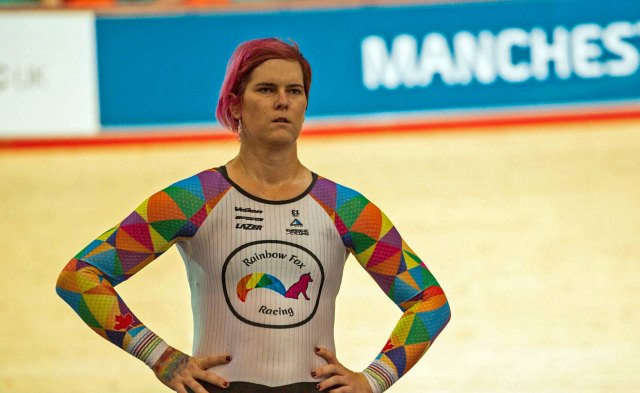
Veronica Ivy, the first transgender world track cycling champion (OLI SCARFF/AFP via Getty Images)





What if you woke up one morning and found you’d swapped bodies with someone else: your mum, the boy next door, “a monstrous vermin”, an older version of yourself? Would you still be “you”?
There’s a reason this setup is a classic. Most of us feel that there’s an “us” conceptually distinct from the body we inhabit. In fact, anthropologists suggest it’s a belief held in some form or other across all human cultures.
This ancient dichotomy crops up in Different: What Apes Can Teach Us About Gender, a new book from primatologist Frans de Waal. Most of the book is about sex differences in our closest cousins. But de Waal briefly touches on the experience of transgender humans as evidence, supposedly, of innately gendered brains that can be effectively the opposite sex to the rest of the body.
The hypothesis he advances is a steelman of gender identity theory: the idea that whether we’re “really” a man or woman depends on an internal state knowable only to ourselves. In de Waal’s conception (the “scientific” version of the theory), gender identity isn’t an immaterial essence but is physically located in some part of the brain. Supposedly this brain module develops in utero and tells women and girls “this brain is in a female body”, and men and boys that their body is male — but it is possible for this module to find itself in the “wrong” body. De Waal suggests that “in a fraction of human pregnancies, the body takes off in a different direction to the brain”, and this physical mismatch is the cause of gender dysphoria.
De Waal’s argument rests on claims, made by a number of studies, that the brains of transgender people are closer in structure or function to their target sex than to their natal sex. But, unsurprisingly, this is far from settled science.
For one thing, studies of the brain involve either the very expensive process of imaging living brains, or brain tissue from deceased donors. It’s hard to get a decent sample size — and harder still when the group you’re interested in makes up just a tiny minority of the population. Plus, the pressures on scientists and journalists to produce eyeball-grabbing #content to keep their careers afloat can lead to conclusions being brazenly over-interpreted, especially in areas in which research often attracts media buzz.
On top of this, there are a number of complicating factors, which most of these studies are much too small to control for (if they even attempt to — plenty don’t). Hormones are one such complication: if people have medically transitioned, it’s difficult to say whether any resemblance to their target sex is because they were born that way, or because of their newly cross-sex hormonal profile. Many studies acknowledge this problem, but small sample sizes mean that their efforts to address it are often not statistically meaningful.
The fact that trans people are more likely to have autism or mental illnesses is another potential confounder, one that’s rarely mentioned. These diagnoses are thought to be associated with physical changes in the brain, so any study of average differences between trans people and control groups would need to rule them out as explanations.
Sexual orientation, too, should be taken into account. People who are trans are much more likely to be non-heterosexual pre-transition; if they are only compared to heterosexual controls, then it’s impossible to tell whether differences are down to gender identity or sexuality — especially if your experiment, like this one, is based on volunteers’ responses to an erotic film. This particular study found that trans women responded differently from straight men and similarly to straight women. Is this a sign of a “female brain”, or could they just be attracted to men, like straight women are? We don’t know, because the paper doesn’t say.
Since sexual orientation is the single most binary psychological variation between men and women (well upwards of 90% of women are attracted to men, and vice versa — a fact often considered so obvious that it goes without saying), you’d think it would be important to carefully control for. Most studies don’t adequately do this, though, and at least one actually does the opposite. The methods section of this paper published in Nature explains that for trans women to participate as subjects, they had to be exclusively attracted to males (i.e. they had to be homosexual), while to be in the male or female control groups, participants had to be heterosexual. The confounding variable of sexual orientation is therefore completely baked into the study, so that it’s impossible to draw separate conclusions about gender identity.
On the other hand, the first study to explicitly factor this into the experimental design reports that once sexual orientation is accounted for, the brains of trans people were sex-typical in most of the variables measured. In other words, comparing like for like, trans people’s brains were similar to people of the same (natal) sex and sexual orientation, rather than the opposite sex.
I don’t think it’s implausible that gender dysphoria could be caused in some cases by some kind of neurological similarity to the opposite sex —just that the evidence for it is currently not especially convincing. On top of this, there are a few troublesome observations that suggest the “brain in the wrong body” narrative can’t be the whole story.
Why have gender clinic referrals skyrocketed for girls in particular — in the UK, there’s been an increase of 4,400% in less than a decade — when gender dysphoria used to be diagnosed primarily in boys? This looks suspiciously similar to documented cases of peer-to-peer social influence in teenage girls (which can be facilitated by social media), but is usually explained away as a decrease in the stigma that would otherwise prevent people coming out. If this is the case, though, then where are all the middle-aged women who should also be coming forward after years of repressing a trans male identity?
And what about the large numbers of male-to-female transitioners who do not seem to suffer from gender dysphoria, may have no desire whatsoever to alter their male anatomy, and behave in strikingly male-typical ways? News of women arrested for sexual crimes — especially those involving a penis — used to be a rarity; now it is increasingly commonplace. One such headline from a few weeks ago reads: “Ex-soldier exposed her penis and used wheelie bin as sex toy in public”. Are we really meant to believe this is the behaviour of a “woman trapped in a man’s body”?
Undeterred, however, de Waal concludes that “it seems […] the brain offers a better indicator of the gender people claim for themselves than their genital anatomy.” This statement borders on the pseudoscientific. How can we believe that the brain, with all its vagaries, is a “better indicator” of whether the average person describes themselves as a man or a woman than the simple binary of what’s in their pants?
But let’s say it’s true that gender identity is an immutable physical property of our brains, and one day we will be able to point to it on a fancy type of scan. Even with this newfound neurological knowledge, wouldn’t we still need to recognise that male and female bodies are different, for instance in contexts such as sports?
De Waal doesn’t think so: to him, rulings that restrict female sports to people with female bodies are no more than “attempts to demonise [transgender people] and make their lives more difficult”. This is despite a less conspiratorial explanation being within reach — as he himself states in another chapter: “body strength is a glaring exception to the general rule that gender differences are gradual and overlapping […] More than two out of three men can lift 110 pounds directly off the ground, but only 1% of women can do the same.”
De Waal refers here to a gender difference, though actually it’s a difference of sex, caused by the physical characteristics of our bodies. Such mix-ups are not infrequent. And matters are not helped by a glossary inset. “Sex”, we are told, refers circularly to “the biological sex of a person”; “gender” is “the role and position of each sex in society” (emphasis mine), while a “gender role” apparently is something else entirely. With a guide like this, the blind are led by the blind.
Perhaps the strangest thing is how at odds this all is with the rest of the book, in which de Waal is scathing of over-simple politicised narratives from all sides. In a final chapter titled “The Trouble with Dualism: Mind, Brain, and Body Are One”, he argues that thinking the human mind can be separated from our bodies and our animal natures is an arrogant form of “neo-creationism”. The neuroscientist Antonio Damasio is approvingly quoted as saying that “a mind is so shaped by the body and so destined to serve it that only one mind could possibly arise in it”. In other words, you are your body, and the idea of being born in the “wrong” one is a logical impossibility.
It’s hard to believe this chapter is written by the same man who uncritically adopts the language of “boys born with female anatomy”. It’s as if there is a set of beliefs on gender identity which have been downloaded as a self-contained unit, prevented by some kind of firewall from mingling with pre-existing knowledge.
Perhaps this makes sense. Many universities officially subscribe to this set of beliefs (in fact, in the UK they’re likely to pay money to do so, via Stonewall’s Diversity Champions scheme), and increasingly ask that new hires do, too. Students enforce the beliefs among their own ranks and among their lecturers. Research that asks the wrong questions may be pulled from publication, or have ethical approval retracted. You don’t have to understand — just profess your allegiance so that we all know you’re on the side of decency.
It’s no wonder that some intelligent and well-meaning people seem to decide, consciously or unconsciously, to think the right thing and reach the right conclusions without worrying about whether they’re sound.
When it comes to sex, gender and trans issues, it’s hard to know which information to trust. There is a clear market for non-partisan scientific expertise, to help us sift through the propaganda and hype. In books like Different, we trust that the authors will hand-pick reliable facts for us, rather than buying them wholesale from the merchants. But if even the experts are too befuddled to look at the evidence with a critical eye — or worse, self-censoring — then there is little hope for the rest of us.
