




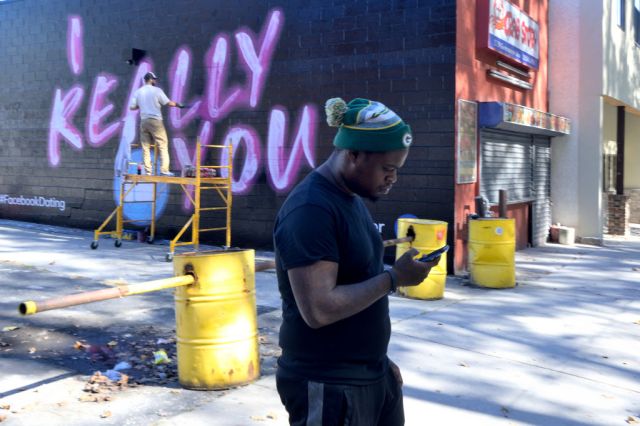
An advert for Facebook Dating. Credit: Bastiaan Slabbers/NurPhoto via Getty Images





It’s hardly surprising that, when third-rate celebrities are locked together in a house, and filmed 24/7, tensions and bizarre behaviour bubble to the surface. Celebrity Big Brother depended on this frame — and its victims didn’t disappoint (George Galloway expressing his kitten fetish being just one example). Conversations between the housemates can often became fractious; the tabloids often turned them into public controversies.
One such example was in 2018, when one of the housemates, India Willoughby, a TV journalist who was once a man but had transitioned into a transwoman, asked her fellow housemates whether they would go out with a transwoman.
“I believe it’s your choice… I would choose not to,” replied the RnB singer Ginuwine. Willoughby then asked: “You would go out with a woman?” “Yes,” Ginuwine replied. “But you wouldn’t go out with a transsexual woman?” Willoughby hit back. “No,” replied Ginuwine. As the awkward conversation rumbled on, Willoughby suggested that Ginuwine give her a kiss, but he leaned back and said “no”.
This encounter provoked a social media storm at the time. Some believed Ginuwine was transphobic for rejecting Willoughby. Others insisted he had a right to his preferences. Some even suggested that Willoughby was sexually harassing Ginuwine, by stepping over boundaries he made clear.
Unfortunately, two years on, the ethics of refusing transsexual people as dating partners remains a fraught subject: questions such as “Is it transphobic for lesbians not to date trans women?” are being discussed online. Again, they tend to arouse strong reactions. Some lesbians, for instance, have expressed concerns that raising the question of whether they ‘should’ be attracted to trans women is a surreptitious attempt to pressure, manipulate and guilt trip them into shifting their sexual boundaries into unwanted sex in the name of being more ‘open’.
Of course, there are lesbians who are reluctant to date trans women because they believe they are not actually women (or at least not women in the same way biologically born women are) . But it’s worth remembering that lesbians have endured a long history of attempts to control their sexuality, whether through hideous practices such as religious indoctrination, conversion therapy or ‘corrective’ rape to “make them straight”. And why focus the attack on lesbians, when many straight men would also reject trans women as a potential mate?
This obviously provokes a wider question: when does a preference become a convenient cover for bigotry and prejudice? On some level, as this tweet declares, “dating is discrimination”. But the question provoked by that Big Brother episode was: when is discrimination acceptable, and when is it unacceptable?
No one should dictate to others who they can or can’t date, love or sleep with. Historic attempts to do so — whether through slavery, arcane patriarchal customs or socially and religiously enforced ‘lifelong’ monogamous marriage — have led to oppression, trauma, unhappiness and neurosis. Think of the countless unhappy marriages many closeted gay people have had to endure — because they could not be honest about who they really wanted to love, because of the intense social stigma and shame attached to their sexuality. Without the freedom to choose who you date, the modern achievements of personal autonomy and individual liberty are negated.
That said, the question must be asked: are our dating and sexual preferences innocent? Where do they come from? Attraction is a biological impulse, but what lies behind it? Darwinists would say they grow out of our evolutionary origins. Since women are supposedly the ‘choosier’ of the sexes, they choose men who can ‘provide’ for them and protect them. Freudians would say our preferences originate from our childhood. According to the Oedipus complex, men unconsciously choose partners who reflect the most attractive qualities of their mothers (the Electra complex makes the same case about women and fathers.)
Frantz Fanon, meanwhile, would say that forces such as racism and colonialism play a big part in influencing people’s desires and attraction. A racist society constructs certain standards of beauty based on ‘whiteness’, which racial subordinates must conform to if they want to be respected as having any erotic worth. Whiteness equals desirability, so blacks must assimilate to gain recognition and respect. Historically, black women have bleached their skin and relaxed their hair to fit a Eurocentric image — which black men, in turn, have coveted it. As Fanon wrote in Black Skin White Masks:
I want to be recognized not as Black but as White. … who better than the white woman to bring this about? By loving me she proves to me that I am worthy of a white love. I am loved like a white man. I am a white man…Between these white breasts that my wandering hands fondle, white civilization and worthiness become mine.
Few people would need to read these theories to know that many of us have a ‘type’. You might prefer partners of a certain height, status, hair colour, body shape, and so on (there is even data to suggest that some people are attracted to those who look similar to them.) Such preferences may be oddly specific, and rather superficial, but they are mostly innocuous.
Some people seek a partner from a similar religious or cultural background — in the hope that this will make it easier for them to relate to one another, or out of a desire to pass on their heritage, traditions and values to future children. This is technically exclusionary for potential partners who lay outside this category — and may even be narrow minded — but such preference is not especially egregious. Still, can predilections mutate into something more sinister?
Because of globalisation, migration, social liberalisation and the rise of online dating, interracial dating has never been more prevalent; the stigma attached to it has mostly dissipated. In 2011 — the last time such statistics were recorded — it was found that nearly 9% of people in England and Wales were living as part of an interracial relationship (up from 7% in 2001). Moreover, there is data to suggest a correlation between the rise of online dating apps and an increase in interracial relationships.
Yet, there is a paradox. Christian Rudder, co-founder of the dating site OkCupid and author of the 2014 book Dataclysm, which uses data trends to analyse human behaviour, has argued people’s use of online apps doesn’t match up with their professed attitudes. Most people will say, when surveyed, that they are open to dating someone from a different ‘race’; in reality, they tend not to be. According to Rudder’s data, collected between 2009 and 2014 from DateHookup ‘Let’s Meet scores’, women in particular generally preferred men of their own ‘race’.
More brazen are those who, on dating apps such as Grindr, Tinder and Bumble, nonchalantly state their racial preferences on their profile. It’s not uncommon to see caveats like, “Not attracted to Asian men”, “ I don’t date black women”, “I only date white girls” — and it’s difficult to argue that this has nothing to do with racism, which has historically played a role in influencing ideas of who is desirable and who is not.
White women — or a particular image of white women — have been placed at the top of this aesthetic hierarchy as the paragon of human beauty, with black women languishing at the bottom, portrayed as ugly, unattractive and overweight, and Asian men stereotyped as ‘sexless’, meek and less endowed compared to other ‘races’. American research seems to confirm this, indicating that Asian men and black women are more likely to be excluded than their opposite-sex counterparts as potential dating partners on dating apps.
Herein lies the uncomfortable truth about our so called ‘dating economy’: discrimination is the name of the game. If you are considered attractive or ‘high value’ according to dating market logic, then you have myriad opportunities to meet new people, pursue novel erotic experiences and find romantic fulfilment. You don’t have to be restricted to people within your ‘community’. You can make your own choices and exercise your sexual autonomy to the fullest extent you desire.
But if you are considered unattractive and ‘low value’ then you will be excluded from what Henry Miller called ‘The World of Sex”, a place of freedom and adventure, erotic fufillment and pleasure, and love and companionship. To be deemed undesireable and ‘unfuckable’, of having no erotic worth at all is painful and soul crushing. This shouldn’t merely be sneered at as the delusional whining of losers drunk on entitlement. Human beings need to be loved by others, to pleasure and be pleasured by others, to develop intimate connections with others, to have fun with others. Being the social species we are it demands it. People are not wrong to want it and feel alienated when it proves extremely hard to achieve, because they are not desired by others for being who they are.
In modern society, our erotic selves and sexuality and our innate need for companionship are so intertwined with our personality that to not have the opportunity to fulfil them because you are a sexual minority rejected by the dominant culture, a racially stereotyped, or a socially awkward person is immensely alienating. These conditions will only be heightened even more with the economic decline and further atomisation resulting from Covid-19 and the restrictions meant to contain it.
Yet, discrimination is simply a fact of dating. It doesn’t matter if you are solidly monogamous, polyamorous or a promiscuous nymphomaniac: distinctions are made between those they are attracted to and those they are not attracted to. Dating is not a democracy and nor should it be. This is because choosing potential romantic and sexual partners is rather different from making friends or acquaintances, since these are people who become part of our intimate space, who we may share our bodies and the most personal aspect of our lives with. But, while we have a right to our preferences, we should also be able to critically reflect on why we desire what we desire and what influences it.
Ralph Leonard is a British-Nigerian writer on international politics, religion, culture and humanism.
 buffsoldier_96