



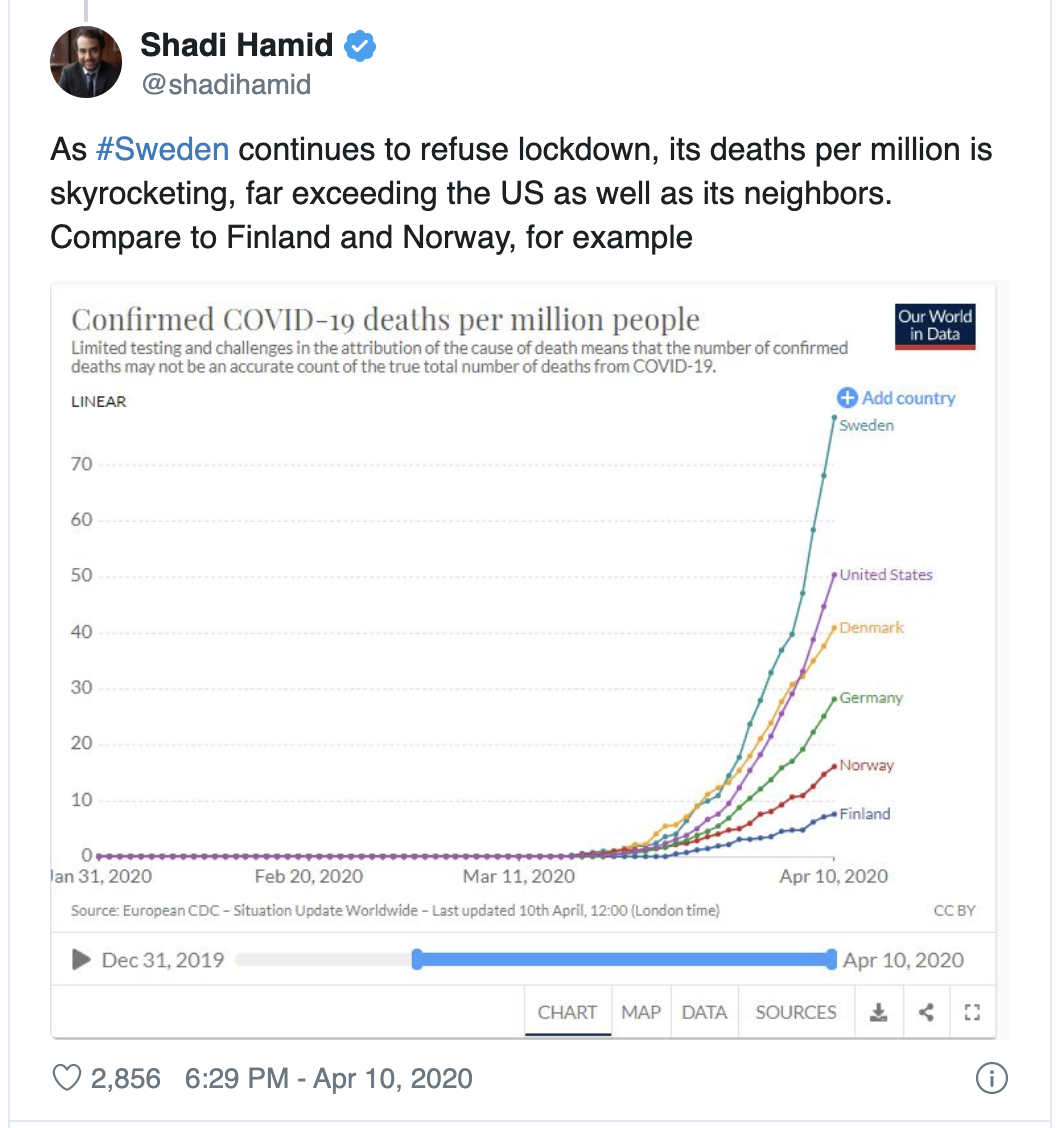
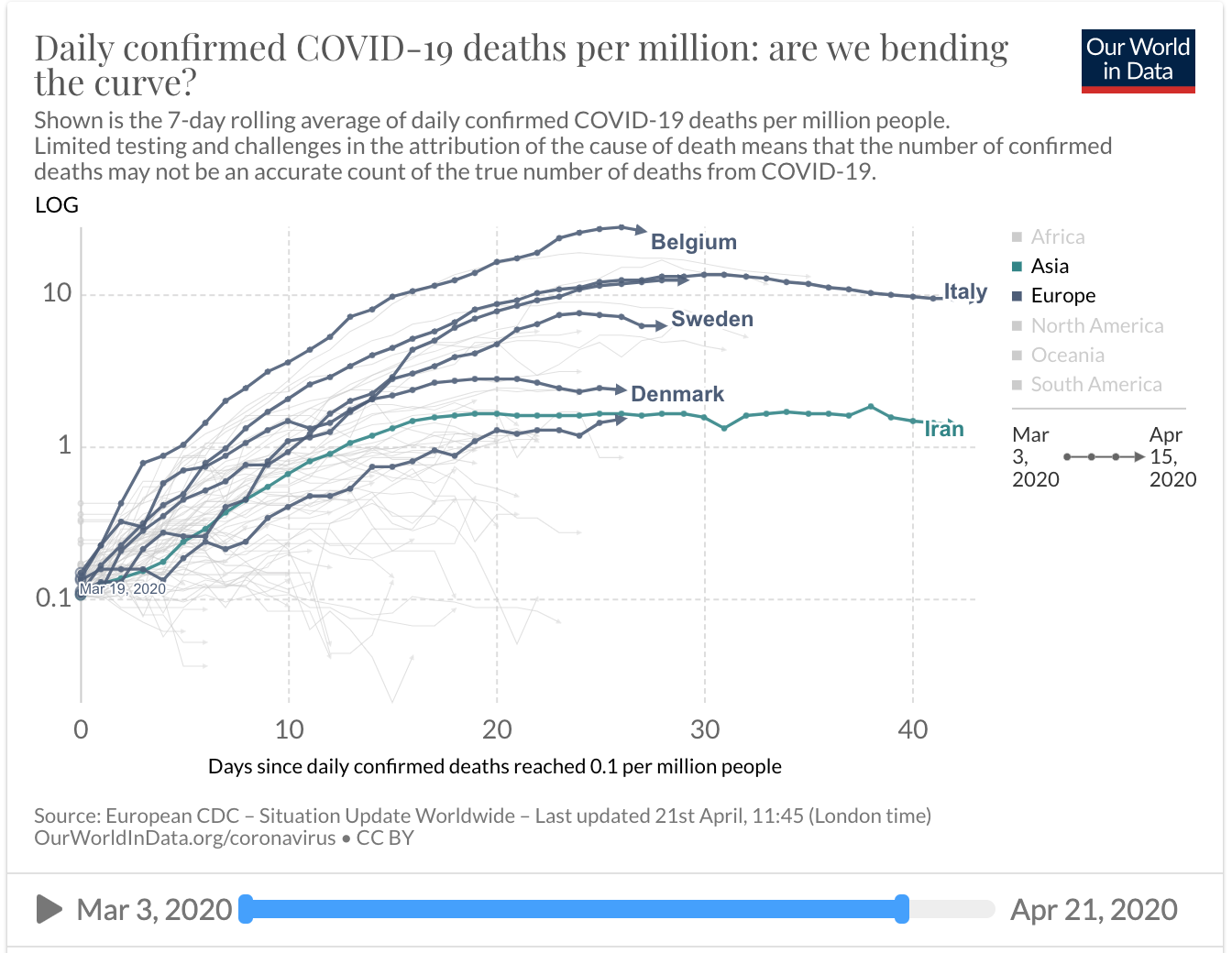
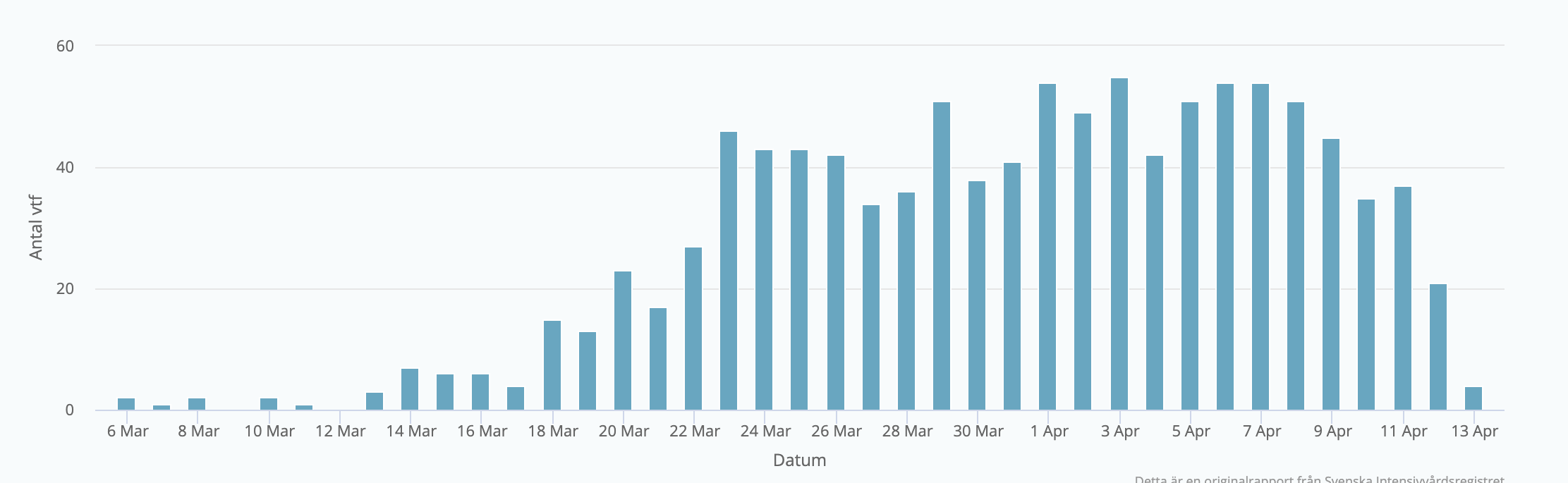
Spotlight Jury still out on Swedish coronavirus strategy In the race to condemn the Swedes for their approach to coronavirus, critics are missing the bigger picture BY Freddie Sayers . A restaurant in central Stockholm advertises its easter menu (Photo by Narciso Contreras/Anadolu Agency via Getty Images) Freddie Sayers is the Executive Editor of UnHerd. He was previously Editor-in-Chief of YouGov, and founder of PoliticsHome. April 14, 2020 freddiesayers April 14, 2020 Filed under: Global affairs Share: Over the past few weeks, a huge amount of energy has been spent trying to prove Sweden’s more lenient approach to the coronavirus a failure. Liberal news outlets in the US have commissioned opinion pieces from Right-wing Swedish commentators accusing the country of a pivot to national chauvinism; President Trump has talked about the Swedish “herd” approach and how “they are suffering very, very badly“; and Twitter is full of apocalyptic charts that are shared thousands of times and which seem to prove beyond doubt that the Swedes should have locked down better, and sooner: But hold on a sec. That chart is carefully designed to look bad for Sweden — the timeline is extended in a way that makes the curve appear more dramatic, and the countries it features are only those which have lower deaths per million. Here’s the same exact chart, from the same source, compared with a different set of fully ‘locked down’ European countries: Suddenly the Swedish curve looks the best — and flattening out rapidly. The truth is, the Swedish epidemic is far from the out of control disaster its critics would like to believe. Yesterday, there were 12 deaths from Covid-19; the previous day there were 17; the day before that there were 77 and the day before that there were 106. We could expect levels to catch up after this Easter weekend, but it can hardly be described as exponential growth. A clearer way of looking at death numbers, also courtesy of the excellent Our World in Data, is the daily trend of deaths per million. Here you get a good sense of the trajectories. All of the countries listed below, except Sweden, have full national lockdowns. And yet Sweden is roughly in the middle of the pack. This is quite remarkable in itself, when set against the dominant narrative that lockdowns are the only thing capable of ‘flattening’ these curves and preventing tragedies that are many times worse. More immediately useful than the death figures (which are three weeks or more out of date by the time they are published) is the chart which monitors daily new admissions into Swedish critical care with Covid-19. How many seriously ill people are presenting every day? Again, the chart depicts a far from exponential increase. It looks to have been roughly flat for the past couple of weeks: New daily admissions into Swedish critical care wards New admissions to Swedish critical care, daily, since 6th March This is why the Swedish state epidemiologist Anders Tegnell remains calm: he is not seeing the kind of rapid increase that might threaten to overwhelm the Swedish health service, and unlike policymakers in the UK, he has been entirely consistent that that is his main objective. At first that was also the stated objective of the UK lockdown — to “buy time for the NHS” and prevent it being overrun. But with the 4,000-bed Nightingale hospital still lying near-empty, not a single hospital so far reporting as being overwhelmed, that objective is apparently being met. But it is no longer clear what the goal is, other than to ‘get past the peak’; so, worryingly, there is now no obvious metric on which to make decisions about lifting the UK lockdown. Comparing Sweden with other countries produces a mixed picture: it shows that very early, very extreme lockdowns in smaller countries such as Denmark can be effective in arresting the virus completely. If numbers of deaths are the only measure of success, Denmark is “doing better” than Sweden here. By this measure, which many British commentators seem to consider the most important metric, the sign of good government simply becomes who can impose the strictest lockdown and reduce the number of Covid deaths closest to zero for as long as possible — but there is no sense in this discussion of a viable long term policy looks like, or what the trade offs or secondary effects might be. Anders Tegnell explicitly worries that the Denmark lockdown has been too effective, and that they will struggle to find a way out of it. The moment they start releasing the lockdown measures, there could be a panic as cases start rising again. Modelling released by the Danish government factors in an increase in transmission, and therefore cases, and therefore deaths, when they bring schools back after Easter. But they are still going ahead and there aren’t headlines of ‘blood on their hands’ because of it. The comparison of Sweden with other European countries also suggests that in those places where the virus was already widespread, such as the UK, the severity of the lockdown doesn’t necessarily correlate with a flatter curve. Belgium, which is fully locked down, has a much more worrying trajectory than Sweden, with no lockdown. The severest and most disastrous epidemics so far have been in Italy and Spain, the countries with the strictest legal lockdowns. In any case, it’s unclear whether the ‘Danish option’ would even have been available to the UK, with a city like London at its heart. The worst epidemics have been seen in global hubs such as London and New York — another reason why it is a fallacy to say that the size and extent of different national epidemics is simply the effect of differing government policies. That’s why it is important that some of the simplistic thinking surrounding this crisis needs to be challenged. If the only moral and virtuous policy is to minimise Covid deaths at all costs, as parts of the media imply with the endless game of ‘look how badly Britain is doing compared to X other country’, there can be no argument for releasing any part of the national shutdown at any point. The refrain at every point will be the same: why take a risk with people’s lives? And the Government will find itself backed into a corner. A better definition of success would surely be: which governments are getting the balance right between protecting their people as reasonably as possible against this new threat while not destroying too much of their country in the process? Death rates per million is not the only datapoint in this difficult equation; and right now, it is far too early to judge how successful Sweden, or the UK, will be. Join the discussion Excellent, Freddie. Your simple, evidence-based (how ‘progressives’ love using that term against their opponents) arguments shows just how much of an agenda the ‘mainstream’ media seem to have with their constant, extreme alarmism. A brilliant analysis of the media hysteria and bovine Government policy that has dominated this synthetic ‘crisis’.Was it not HMG that extolled us to bin our petrol cars in favour of wonderful clean diesel ones, only to rapidly reverse that decision and penalise diesel owners? Yet we are still expected to have faith in Government scientific advice?Perhaps in a nation that seriously believes that a man ‘rose from the dead’, and has just finished celebrating that preposterous notion, it is hardly surprising.No, we should swallow our pride, forget that we invented Penicillin and the Spitfire and follow the example of Sweden, the inventors of the Aga and Volvo amongst many other wonders. I agree with so much of this article -thank you for articulating a viewpoint that is hard to find in the mainstream -disgraceful though it is that such a thing should be true to say. As you write, ‘some of the simplistic thinking surrounding this crisis needs to be challenged’. In terms of ‘the government being backed into a corner’ however, it seems to me it’s doing a fine enough of a job of this on its own and without the need for any assistance. Today Sunak was making the plaintive case that given the choice between ‘people’s health’ and the ‘economy’ he would choose people’s health every day -bathing in virtuous self regard and moral sanctimony. This is not just in all probability, an outright lie (I’m sure he could be pretty Machiavellian with some economic decision making) but it’s an utterly false choice making out that the government in some way had its hands tied when it came to competent decision making by its moral duty. This government has messed up – but they need a narrative which will obfuscate the ineptitude of their fight/ flight response to date -and the ‘saving lives’ and ‘protecting the NHS’ will do. By the way, in terms of ‘protecting the NHS’ the vast majority of NHS staff are currently doing far less than they have ever had to do thanks to this lockdown. Almost all appointments have been cancelled, no referrals, no consultations, nothing! I imagine the NHS has collectively never been so unproductive in its entire history. Once the data is in -we can assess just how much harm this branch of inactivity has conferred on patients. And the media are meanwhile lapping it all up faithfully and feeding us stories about OAPs running around in circles in their back gardens ‘for the NHS’. A metaphor if you will for the aimless blind panic of the response to this crisis. Thanks for a well researched and balanced article. Your multi country logarithmic graph is the best presentation of daily death figures I have seen. Using a 7 day rolling average sorts out the weekend under reporting and consequent Monday surge effects. We used to see something similar at daily No 10 briefings, but it changed about a week ago for a cumulative which makes it impossible to see the peak – I wonder why? I doubt the Swedish approach would have worked in UK – we are just not that obedient or sensible. There is no doubt in my mind that it has worked brilliantly in Sweden with them “peaking” before us – may not be sustained, but clearly in a downtrend at the moment. It seems clear to me that whilst CV 19 is more dangerous than normal flu, it is nowhere near as deadly as people believe and Sweden shows the spread can be controlled by taking quite mild, simple and commonsense measures. The damage done to our economy already is bad enough to kill more people than the virus ever will. We need to lift the lock down, get the kids back to school and get back to work. Sensible restrictions can be put in place to allow shops, bars and restaurants to reopen and, having been through lock down, the majority should now respect them. I think the restriction on mass gatherings needs to remain eg football matches and concerts etc. Most of all I believe failing to grow herd immunity gradually over the summer months risks a far worse resurgence in autumn / winter when ordinary flu will be back to compound the problem and that really will overwhelm the NHS , as it often does already. We have built additional capacity which is not being used, we need to start using it and get all those cancelled operations back on. “A better definition of success would surely be: which governments are getting the balance right between protecting their people as reasonably as possible against this new threat while not destroying too much of their country in the process?” In short: we don’t want a victory over Covid-19 to be a Pyrrhic one, which it could well be if lockdown goes on much longer. It’s entirely possible that two countries could pursue wholly different strategies and both be right. Sweden’s population density is much lower than the UK’s, and therefore its R0 (transmission rate) would be lower, if both pursued the same (or no) mitigation strategy. Less change is therefore needed to get R0 below one, the point at which new cases decline, or to hold it around one, enabling it to pass through society at a rate that allows hospitals to provide suitable care to those infected while working toward herd immunity. The unstated question for the UK is whether we recognise the vast differences in population density across the British Isles by varying the degree of lockdown across the country. Encouraging the good people of Dartmoor or the Fens to meet friends at the pub while closing down the London Underground seems inconsistent but may be the optimum strategy, if we believe it can be communicated clearly and that people won’t game it by moving around the country (think furloughed London couple retreating to one set of parents’ holiday cottage in the Scottish Highlands). Unfortunately, policy can not be made retrospectively. A choice had to made before the data was available, and the conservative option had to be taken. I don’t think the government had a choice. Large parts of the media have been going with the ‘UK didn’t act quick enough to enter lockdown’ narrative and ‘country x did this, why aren’t we’ – Imagine the hysteria and the accusations towards the government if death rates were similar in the UK with a no lockdown policy. We have to learn from the data and outcomes, but let’s not play policy by hindsight. Yes, I don’t particularly blame the government for anything. They were in an impossible situation, not helped by the hysterical media you refer to. And I blame the NHS and PHE for the lack of PPE. They have plenty of money for countless unnecessary managers, diversity consultants and communications people, so they have money for PPE. All that said, Sweden does seem to have been the only country that has acted calmly and rationally. Well its not such a big mysteri for us Swedes…1: we trust Folkhälsoinstitutet (people’s healt institutet) and their guidlines how to tackel a pandemic of this sort 2: THE Swedish government trust us citizents to act and take the precautions needed to keep the most wonurable as safe as they can be and act om their recomendations who they get from the Folkhälsoinstitutet, how collects as much sientific evidens and solutions as possible 3: we report ALL cases of death where traces of Covid-19 is found, even patientes whos already terminal I’ll from other decisces, there is country’s right now in Europe who don’t even register eldery who dies even of traces of Covid-19 is found as Covid-19 victims. That is also a reson why we hade/have a high mortality rate but Still only om the middle as you could read in the charts I do do apologise for my Spellings 😊👠Apologies for the rapid response, but gardening finished earlier than expected.You misunderstood my point about Diesels. I am not claiming they are ‘clean’ it was the bovine behaviour of HMG and it’s subsequent volte-face on the subject that I found irritating.I personally like my kitchen to be as hot as the boiler room of the late, lamented, H.M.S. Hood (commissioned 1920) and the Aga (invented 1922) is perfect, if you know how to handle it/her.Volvo was sold to the Chinese in 2010. The only other Chinese thing about it is the Pangolin carrier in the boot.Given Germany’s history, I think I, and many others would rather be guided by Sweden. Need I say more? To view all comments and stay up to date, become a registered user. It's simple, quick and free. Sign me up

Excellent, Freddie. Your simple, evidence-based (how ‘progressives’ love using that term against their opponents) arguments shows just how much of an agenda the ‘mainstream’ media seem to have with their constant, extreme alarmism.
A brilliant analysis of the media hysteria and bovine Government policy that has dominated this synthetic ‘crisis’.Was it not HMG that extolled us to bin our petrol cars in favour of wonderful clean diesel ones, only to rapidly reverse that decision and penalise diesel owners? Yet we are still expected to have faith in Government scientific advice?Perhaps in a nation that seriously believes that a man ‘rose from the dead’, and has just finished celebrating that preposterous notion, it is hardly surprising.No, we should swallow our pride, forget that we invented Penicillin and the Spitfire and follow the example of Sweden, the inventors of the Aga and Volvo amongst many other wonders.
I agree with so much of this article -thank you for articulating a viewpoint that is hard to find in the mainstream -disgraceful though it is that such a thing should be true to say. As you write, ‘some of the simplistic thinking surrounding this crisis needs to be challenged’. In terms of ‘the government being backed into a corner’ however, it seems to me it’s doing a fine enough of a job of this on its own and without the need for any assistance. Today Sunak was making the plaintive case that given the choice between ‘people’s health’ and the ‘economy’ he would choose people’s health every day -bathing in virtuous self regard and moral sanctimony. This is not just in all probability, an outright lie (I’m sure he could be pretty Machiavellian with some economic decision making) but it’s an utterly false choice making out that the government in some way had its hands tied when it came to competent decision making by its moral duty. This government has messed up – but they need a narrative which will obfuscate the ineptitude of their fight/ flight response to date -and the ‘saving lives’ and ‘protecting the NHS’ will do. By the way, in terms of ‘protecting the NHS’ the vast majority of NHS staff are currently doing far less than they have ever had to do thanks to this lockdown. Almost all appointments have been cancelled, no referrals, no consultations, nothing! I imagine the NHS has collectively never been so unproductive in its entire history. Once the data is in -we can assess just how much harm this branch of inactivity has conferred on patients. And the media are meanwhile lapping it all up faithfully and feeding us stories about OAPs running around in circles in their back gardens ‘for the NHS’. A metaphor if you will for the aimless blind panic of the response to this crisis.
Thanks for a well researched and balanced article. Your multi country logarithmic graph is the best presentation of daily death figures I have seen. Using a 7 day rolling average sorts out the weekend under reporting and consequent Monday surge effects. We used to see something similar at daily No 10 briefings, but it changed about a week ago for a cumulative which makes it impossible to see the peak – I wonder why? I doubt the Swedish approach would have worked in UK – we are just not that obedient or sensible. There is no doubt in my mind that it has worked brilliantly in Sweden with them “peaking” before us – may not be sustained, but clearly in a downtrend at the moment. It seems clear to me that whilst CV 19 is more dangerous than normal flu, it is nowhere near as deadly as people believe and Sweden shows the spread can be controlled by taking quite mild, simple and commonsense measures. The damage done to our economy already is bad enough to kill more people than the virus ever will. We need to lift the lock down, get the kids back to school and get back to work. Sensible restrictions can be put in place to allow shops, bars and restaurants to reopen and, having been through lock down, the majority should now respect them. I think the restriction on mass gatherings needs to remain eg football matches and concerts etc. Most of all I believe failing to grow herd immunity gradually over the summer months risks a far worse resurgence in autumn / winter when ordinary flu will be back to compound the problem and that really will overwhelm the NHS , as it often does already. We have built additional capacity which is not being used, we need to start using it and get all those cancelled operations back on.
“A better definition of success would surely be: which governments are getting the balance right between protecting their people as reasonably as possible against this new threat while not destroying too much of their country in the process?” In short: we don’t want a victory over Covid-19 to be a Pyrrhic one, which it could well be if lockdown goes on much longer.
It’s entirely possible that two countries could pursue wholly different strategies and both be right. Sweden’s population density is much lower than the UK’s, and therefore its R0 (transmission rate) would be lower, if both pursued the same (or no) mitigation strategy. Less change is therefore needed to get R0 below one, the point at which new cases decline, or to hold it around one, enabling it to pass through society at a rate that allows hospitals to provide suitable care to those infected while working toward herd immunity. The unstated question for the UK is whether we recognise the vast differences in population density across the British Isles by varying the degree of lockdown across the country. Encouraging the good people of Dartmoor or the Fens to meet friends at the pub while closing down the London Underground seems inconsistent but may be the optimum strategy, if we believe it can be communicated clearly and that people won’t game it by moving around the country (think furloughed London couple retreating to one set of parents’ holiday cottage in the Scottish Highlands).
Unfortunately, policy can not be made retrospectively. A choice had to made before the data was available, and the conservative option had to be taken. I don’t think the government had a choice. Large parts of the media have been going with the ‘UK didn’t act quick enough to enter lockdown’ narrative and ‘country x did this, why aren’t we’ – Imagine the hysteria and the accusations towards the government if death rates were similar in the UK with a no lockdown policy. We have to learn from the data and outcomes, but let’s not play policy by hindsight.
Yes, I don’t particularly blame the government for anything. They were in an impossible situation, not helped by the hysterical media you refer to. And I blame the NHS and PHE for the lack of PPE. They have plenty of money for countless unnecessary managers, diversity consultants and communications people, so they have money for PPE. All that said, Sweden does seem to have been the only country that has acted calmly and rationally.
Well its not such a big mysteri for us Swedes…1: we trust Folkhälsoinstitutet (people’s healt institutet) and their guidlines how to tackel a pandemic of this sort 2: THE Swedish government trust us citizents to act and take the precautions needed to keep the most wonurable as safe as they can be and act om their recomendations who they get from the Folkhälsoinstitutet, how collects as much sientific evidens and solutions as possible 3: we report ALL cases of death where traces of Covid-19 is found, even patientes whos already terminal I’ll from other decisces, there is country’s right now in Europe who don’t even register eldery who dies even of traces of Covid-19 is found as Covid-19 victims. That is also a reson why we hade/have a high mortality rate but Still only om the middle as you could read in the charts I do do apologise for my Spellings 😊ðŸ‘
Apologies for the rapid response, but gardening finished earlier than expected.You misunderstood my point about Diesels. I am not claiming they are ‘clean’ it was the bovine behaviour of HMG and it’s subsequent volte-face on the subject that I found irritating.I personally like my kitchen to be as hot as the boiler room of the late, lamented, H.M.S. Hood (commissioned 1920) and the Aga (invented 1922) is perfect, if you know how to handle it/her.Volvo was sold to the Chinese in 2010. The only other Chinese thing about it is the Pangolin carrier in the boot.Given Germany’s history, I think I, and many others would rather be guided by Sweden. Need I say more?



