




Credit: Charles McQuillan / Getty




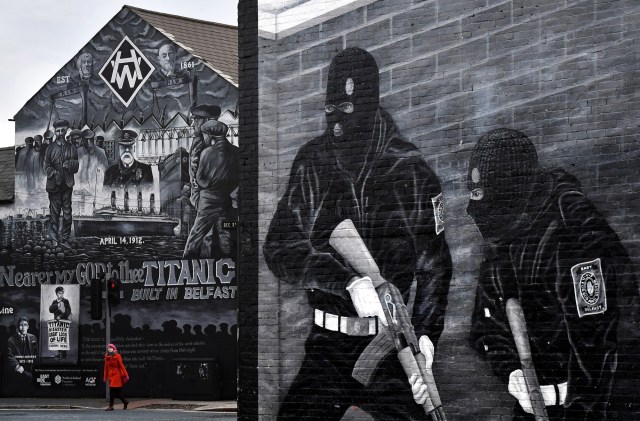
Take away the flags and murals, and there is little that discernibly separates the Falls and Shankill roads. Both stretch out from the centre of Belfast to the west; both are distinctly working-class; both are home to an assortment of shops, many with shabby frontages, and pubs with faintly menacing exteriors and dingy interiors; and in both the daily throng of people — young men in tracksuits being a common feature — can be seen going about their business.
Beyond the observable, there is, of course, another shared characteristic: a history of sectarian bloodshed and violence which disfigured each of these most notorious of streets until the truce of the Belfast — or Good Friday — Agreement a little over 20 years ago.
It is possible to travel, as I did, from one to the other simply by navigating through a few residential streets — though be sure to go by day, for any nocturnal expedition is likely to be thwarted by the closure of steel gates at various crossing points between the nationalist Falls area and the unionist Shankill.
A so-called ‘peace wall’ — in reality an imposing separation barrier — also bisects these neighbourhoods. Curiously, the number of these structures has increased across Northern Ireland since the Good Friday Agreement was ratified, and skirmishes are still a reality of life at some of the interface areas around the walls. Their presence serves as a jolting reminder that the old enmities haven’t gone away.
Yet, for all that, today’s Belfast is one in which an entire generation has grown up without the experience of bombs and bullets. In many respects, it bears all the hallmarks of a modest-sized contemporary European city at ease with itself — sections of it positively glisten with modernity.
But take a stroll for a couple of hours and its past will inevitably make itself known to you. Not just that of the Troubles, but also Belfast’s place in history as a global industrial centre.
A museum dedicated to the Titanic was opened seven years ago on the site of the former shipyard where she was built, and the towering yellow gantry cranes, Samson and Goliath, of the still-operating Harland and Wolff shipyard dominate the horizon to the north. Reminders of Belfast’s heritage as a hub of the international linen trade — the city was once known as ‘Linenopolis’ — are also plentiful.
The city’s emergence in the 19th-century as a major port and industrial powerhouse brought with it the trappings that inevitably came with such status, the type of splendour that can still be seen today in the buildings that drip with Victorian majesty: Ulster Hall, Queen’s University, Central Library and the Grand Opera House, to name a few of the more elegant.
Today’s Belfast, though — as with other of our industrial cities and towns which during the days of Empire became the workshops of the world and reaped the benefits long afterwards — finds itself trying to forge a new future in the cut-and-thrust of a global marketplace devoid of the old certainties.
Northern Ireland itself is an altogether more global, more diverse place these days. In the decade between 2001 and 2011, the percentage of the population born outside either the UK or Republic of Ireland tripled, with many migrants arriving from countries granted EU accession in 2004. It is estimated that 30,000 Poles alone have settled here.
But for all the progress of the past 20 years, a new anxiety exists across this province — one arising from recent developments over Brexit, and in particular the deal struck between Boris Johnson and the EU.
There is unease across much of the unionist community, which reckons the British government has sold them out. In most cases, these are Leave voters (the vote went 56%-44% in favour of Remain here, with the vote dividing conspicuously along orange and green lines). The plan to draw a customs border in the Irish sea will, as they see it, have the inevitable effect of weakening ties between Northern Ireland and the rest of the UK, and thereby calls into question the entire future of the union.
Three nights before my arrival, a hastily-arranged meeting, advertised as a “rallying call to all unionists” and attended by the alleged leaders of loyalist paramilitary groups, had taken place at the Constitutional Club in East Belfast. Reports suggest the place was packed to the rafters, with many expressing their fury at the “betrayal”.
One or two prominent figures have warned of a return to violence — though it is doubtful on this point that such voices are representative of the wider unionist and loyalist community. That said, the indignation is not confected and cannot be dismissed as mere posturing; it is plainly real.
I head to meet John McVicar, chairman of the Greater Shankill Community Council, at the organisation’s offices in the heart of the Shankill Road. This is staunch loyalist territory. McVicar tells me that he wasn’t in the least surprised when learning of the details of the revised Brexit deal. “After seeing Johnson and Varadkar cosying up, we always had the feeling that the government would ditch us,” he says.
McVicar believes that many in the unionist community are resentful at what they see as a “chipping away” by Sinn Féin at their sense of Britishness. “There is this incessant push by Sinn Féin for reunification. It makes people feel unsettled,” he says. The Prime Minister’s Brexit deal, he argues, has played right into the hands of the republican movement.
But is this resentment likely to see a return to violence, I ask, citing the words of the chief constable of the Police Service of Northern Ireland, Simon Byrne, who recently sounded the alarm over the threat from dissident loyalists.
“I think Byrne’s talking out of his arse,” McVicar snaps back. “You’re sitting a few hundred yards from the site of the Shankill bombing [in 1993 the IRA blew up a fish shop, killing ten]. I can tell you that nobody wants to see a return to that.”
McVicar knows what he’s talking about. He survived a shooting attempt as a young man back in the early 1970s and still has flashbacks. He lost friends in the Troubles. His father, born in Scotland, served in the RAF in the Second World War before becoming a trade union shop steward. “I have little in common with people in Dublin,” he says. “I don’t say that to be antagonistic, but I have more in common with people in Glasgow, Birmingham and London. We’re part of the UK, and we don’t want special treatment in any Brexit deal. If that means we have to take a hit economically, so be it.”
He says his father taught him the value of compromise, though McVicar himself is no fan of the Good Friday Agreement and thinks politicians cherry-pick it to suit their own ends. “The front cover of the document had a photo of a family looking out from the Giant’s Causeway at a lovely sunset. Well, they were facing north, and everyone knows the sun sets over Donegal towards the west. So the Agreement was built on a lie from the beginning.” He pauses. “We were never all just going to kiss and make up.”
The popular John Hewitt pub on Donegall Street is owned by the Belfast Unemployed Resource Centre. It has a distinctly political, though non-partisan, theme: a portrait of the late loyalist-paramilitary-turned-peacemaker Gusty Spence sits rather incongruously alongside one of Gerry Adams on a wall adjacent to the bar.
I join a group in a side room. Voluntary worker Anne, 60, is a Roman Catholic, not practising, just ‘cultural’. She was raised in the nationalist area of the city and voted Remain in the referendum. Although she thinks Brexit has probably brought the prospect of a united Ireland closer, she questions whether reunification will ever happen. “I think people here are political orphans,” she says. “Neither the British state nor the Irish state want us. Not really. I think lots of young people actually see themselves as Northern Irish above anything else. That’s probably a good thing.”
She thinks the DUP has overplayed its hand. “They should have voted for Theresa May’s deal. But Boris Johnson went to their AGM and won them over by criticising May’s deal. And now he’s sold them out.”
There is no disputing the DUP’s anger: it has certainly been scathing in its criticism of Johnson and the government. But where does it go now? It’s difficult to see the party, having supported Brexit for so long, suddenly start championing a return to the EU.
Joanne (not her real name), 37, grew up on a housing estate in a loyalist part of North Belfast, is on the Left politically and voted Leave because of the ‘undemocratic’ nature of the EU. She has little time for the old tribalism and is impressed with some of Sinn Féin’s ‘progressive’ policies, though critical of its ‘opportunistic’ position on Brexit. “They were traditionally in favour of leaving the EU, but now they suddenly support staying. It’s ridiculous. How can they argue for an independent Ireland while wanting to give power back to the EU?”
I ask whether she thinks violence will return as a result of Brexit. “No,” she replies emphatically. “It’s done. People just don’t want that stuff anymore.”
It is a message I hear time and again in this city. It seems that all but a few diehard recalcitrants desire a lasting peace and a future in which the ancient enemies don’t merely tolerate each other, but co-exist in a spirit of friendship and reconciliation. As ever, though, in Northern Ireland, the journey between word and deed is long, arduous and fraught with pitfalls. Here, even a dry and mechanistic matter like the particular nature of a customs border with the European Union can hold symbolic meaning and encourage people to retreat to their historical redoubts.
The violence may have subsided. But it is obvious that the hard task of building a common good between two communities that still live largely parallel lives and have spent much of the past viewing the other as some kind of existential threat confronts this province as surely today as it ever did. The apparent inability to resolve the deadlock at Stormont is a sign of how the politics of entrenchment can still dominate here.
Out towards the east of the city is a mural dedicated to CS Lewis, a native of these parts. It is said that Lewis’s sadness over the sectarian conflict drove him to adopt an ecumenical brand of Christianity and in turn choose the title Mere Christianity – borrowed from GK Chesterton – for his signature classic on religion. Chesterton himself used the phrase to emphasise the need for Christians to elevate their common core beliefs over narrow doctrinal differences. There may be a lesson there somewhere.
Nobody to whom I spoke wanted nor foresaw a return to the ‘bad old days’. But neither is a lasting peace a nailed-on certainty. The people of this beautiful, scarred, enchanting, troubled land have for two decades been walking nervously across a room while holding a precious vase. And though the floor beneath them just became a bit more slippery, they remain determined to make it to the other side.
Paul Embery is a firefighter, trade union activist, pro-Brexit campaigner and ‘Blue Labour’ thinker
 PaulEmbery
Join the discussion
Join like minded readers that support our journalism by becoming a paid subscriber
To join the discussion in the comments, become a paid subscriber.
Join like minded readers that support our journalism, read unlimited articles and enjoy other subscriber-only benefits.
Subscribe