





JakeOlimb, Getty Images




Brits and Americans are united on one thing – 80% of respondents on both sides of the Atlantic agreed that terrorists were among the most dangerous people in the world today. No surprise there. But after that? ComRes presented a list of other possible ‘baddies’. The full list was…
- Big businesses… or High-taxing governments;
- Capitalists… or Communists;
- Fake news;
- Left-wing unions, politicians and campaigners… or right-wing pundits, politicians and donors;
- Military leaders;
- Religious leaders;
- And then Terrorists.
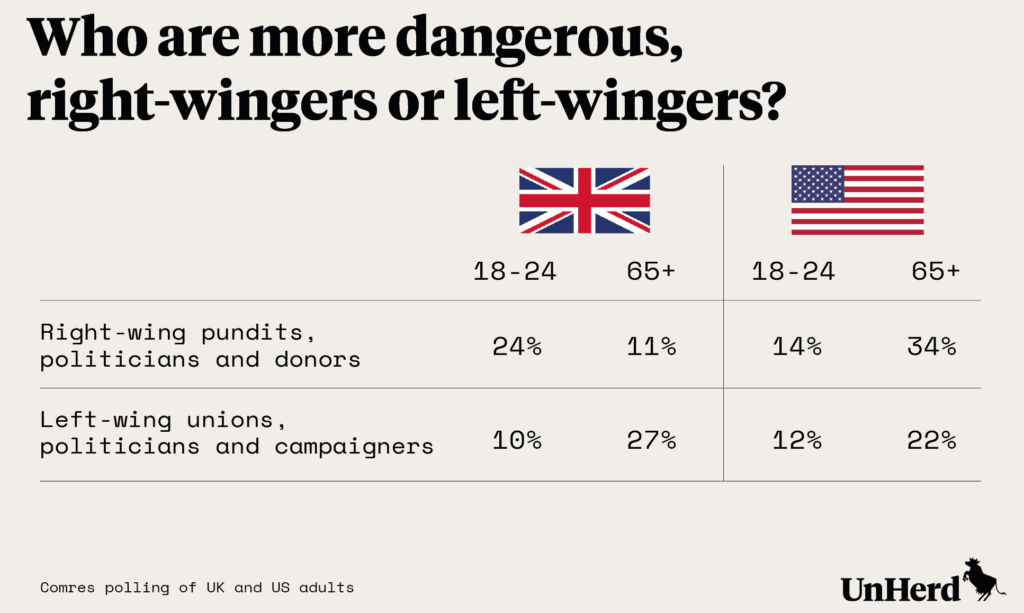
The main reason for our asking was to establish the popularity/unpopularity of left-wing versus right-wing flag-wavers. The overall totals suggest little difference in either suspicion of the two ideological camps or, indeed, between the two countries. 20% of Americans saw right-wingers as dangerous and, very nearly the same, 18% saw left-wingers as dangerous. The numbers in Britain were 17% and 16% respectively. As with the data we published last week, however, the totals hide a significant generation gap…
- Within Britain, 27% of those aged 65+ see left-of-centre unions, politicians and campaigners as most dangerous – but only 10% of 18 to 24 year-olds say the same. All of the Tory efforts in the recent general election – focusing, for example, on Jeremy Corbyn’s historical links with IRA paramilitaries – did, indeed, fall on stony ground.
- In contrast 24% of young Brits saw right-wingers as “most dangerous” and only 11% of older Britons agreed.
The numbers from America were, perhaps, more surprising…
- Older Americans are significantly more likely than younger Americans to consider political ideology dangerous: 34% of those aged 65+ say that right-wing pundits, politicians and donors are dangerous in the world today compared to only 14% of 18-24 year olds.
- On left-wing unions, politicians and campaigners, 22% of those aged 65+ say they are dangerous in the world today, compared to 12% of 18-24 year olds.
***
ComRes interviewed 2,059 UK adults on 7th and 8th August. 1,011 US adults were interviewed between 7th and 9th August. Both surveys were conducted online.
Tim Montgomerie was most recently a columnist and comment editor for The Times of London. Before that journalistic turn he was steeped in centre right politics, founding the Conservative Christian Fellowship, then the Centre for Social Justice and, just over ten years ago, ConservativeHome.com.
 montie